52 minutes ago
2
52 minutes ago
2

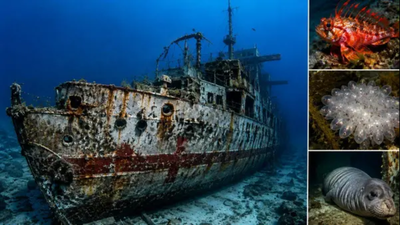
In 2002, South Australia sank ex-HMAS Hobart in under 3 minutes
A 134-metre decommissioned guided-missile destroyer lying 30 metres below the surface of Yankalilla Bay has become one of South Australia’s most diverse marine habitats, less than two decades after it was deliberately sunk.
The ex-HMAS Hobart was scuttled on 5 November 2002. It sank in two minutes and 17 seconds after controlled explosives were detonated along its hull, according to the Naval Historical Society of Australia. A detailed scientific survey carried out 18 years after the sinking found that the artificial reef was home to more than 50 different fish species, along with large communities of filter-feeding marine organisms.
The findings, published in reports by South Australia’s Department for Environment and Water (DEW), show how old military vessels can be reused to support marine life along areas of sea floor with few natural habitats.
Transformation from naval flagship to ecological haven
Built by the Defoe Shipbuilding Company in Michigan, United States, HMAS Hobart entered service with the Royal Australian Navy in December 1965. During more than 35 years of service, the warship completed three combat deployments during the Vietnam War before being officially decommissioned in May 2000.
After its retirement, the Australian Department of Defence gave the vessel to the state of South Australia.
The Fleurieu Artificial Reef Society and state authorities prepared the ship for sinking by removing dangerous materials, cutting access points for divers and clearing fuel remains to make sure it was environmentally safe. When explosives were detonated off the Fleurieu Peninsula, the vessel sank upright onto a flat, sandy seabed with few natural rocky features.
Its large steel structure, including gun turrets, decks and accessible engine rooms, created vertical surfaces that changed the otherwise flat sea floor. These structures also intercepted nutrient-rich coastal currents, attracting organisms such as sponges, barnacles and soft corals.
Scientific findings on reef colonisation and species diversity
The Marine Science team at South Australia’s Department for Environment and Water carried out the biodiversity survey using standard Reef Life Survey underwater visual census methods.
Researchers recorded species including snapper, southern blue devil fish, bullseyes and leatherjackets living in and around the wreck. The ship’s steel plates provide shelter from predators and strong tidal flows, creating small habitats at different depths.
The reef also benefits from legal protection under the state’s marine park system. The wreck is located inside the Rapid Head Sanctuary Zone within Encounter Marine Park, where both commercial and recreational fishing are banned.
According to Department for Environment and Water management guides, rangers patrol the sanctuary to enforce the no-take rules. This allows fish populations and organisms growing on the wreck to develop without pressure from fishing and other forms of human extraction.
Eco-tourism and the global artificial reef network
Alongside its conservation role, the ex-HMAS Hobart has become a major destination for experienced divers interested in temperate-water wrecks.
The site is unusual among Australia’s artificial naval reefs because divers have regulated access to parts of the ship’s interior, including the original engine room and missile areas. Australia has also sunk several other naval vessels for similar conservation and tourism purposes, including the ex-HMAS Adelaide off New South Wales and the ex-HMAS Canberra off Victoria.
International marine studies published in journals including Ecological Engineering and Frontiers in Marine Science have found that well-managed steel shipwrecks can support fish numbers and species diversity similar to nearby natural rocky reefs. By turning retired warships into permanent artificial reefs, environmental agencies can create long-term marine habitats while helping replace natural environments lost along developed coastal areas.