6 months ago
39
6 months ago
39

Jacob BoswallBBC Monitoring

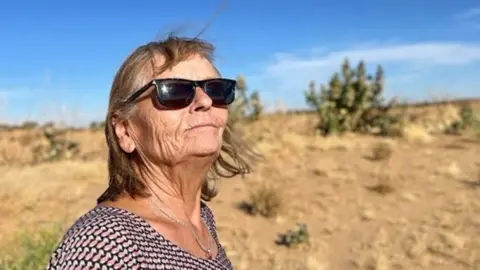 Christoph Greztmacher
It is over a year since Eva Greztmacher, now 74, was kidnapped from her home in Niger
When Marin Petrović arrived in Bamako in early September last year, he was elated. The Bosnian national had spent years applying for tourist visas to Mali, only to be repeatedly denied on security grounds.
The West African country has long been afflicted by civil war, foreign military interventions, and Islamist insurgencies.
Petrović declined to speak to the BBC for this article.
The plan was to visit some of the country's dramatic landmarks, before returning home. In Bamako, Petrović enjoyed the sights and sounds of markets, busy roads, schools, and even sampled some local beers, according to the post.
"The next day I set off for Mopti, known for its 100-year-old mud mosque," he continued, referring to the Grand Mosque of Mopti, a 15m (49ft) tall architectural feat made from mud bricks.
 AFP via Getty Images
Marin Petrović was heading to Mopti to see its famous mosque when he was abducted by Islamist militants
On Instagram, Petrović describes himself as a "mountain rescue" expert and "guide", whose motto is not to "dream your life", but to "live your dream". But before Petrović could continue his dream of exploring Mali's ancient treasures, his trip took an unexpected turn.
"An armed attack takes place on the road between Bla and San," he says in the same Instagram post.
"Six motorbikes with two long-bearded terrorists, each armed with Kalashnikovs, surround the vehicle and drag me into the bushes, along non-existent paths through the undergrowth, through swamps, far from the main road… I was kidnapped by al-Qaeda jihadists!!!"
Petrović had become the latest victim of a concerning trend for foreign travellers and expatriate workers in West Africa's Sahel region.
His story is not unusual. In 2025, growing insecurity and new jihadist tactics led to a notable increase in high-profile abductions of foreign nationals in the Sahel.
The latest data from Acled, an independent global conflict monitor, shows a considerable increase in the kidnapping of foreigners in Mali and Niger in 2025, compared to previous years.
There were 30 separate kidnapping events affecting foreigners by the end of November, and the number for the whole year is likely to be even higher.
Some cases of kidnapping received considerable international media attention. Two citizens of the United Arab Emirates (UAE) - one of whom is thought to be a member of the Emirati royal family - were kidnapped in Mali in late September.
The purpose of their visit and the exact circumstances of their abduction remain murky. Some local media outlets suggested that at least one of the men was involved in a business venture, possibly gold mining.
"Royal ransoms, a top money-maker for Mali's jihadist kidnappers," ran one headline.
Other especially high-profile cases took place in Niger: 73-year-old Austrian national Eva Gretzmacher and US civilian pilot Kevin Rideout. Both were involved in humanitarian work and kidnapped from their homes.
But analysis by BBC Monitoring of high-profile kidnapping in Africa has shown that, in terms of numbers, Chinese workers bore the brunt of foreign abductions.
Approximately 70% of cases tracked across the continent occurred in the Sahel countries of Mali and Niger.
Out of a total 89 foreigners kidnapped, 38 held Chinese passports - significantly higher than the next most common nationality, those from India who number 14.
The overwhelming culprit for last year's spike was al-Qaeda affiliate Jama'at Nusrat al-Islam wal-Muslimin (JNIM), which was behind a surge in jihadist attacks sweeping across several West African nations last year, especially Burkina Faso, Mali and Niger.
Foreign nationals are thought to be especially valuable to JNIM because they generate higher ransoms than locals, in addition to giving the group a stronger footing to negotiate with other conflict actors, such as the Malian government.
"Ransom is an obvious incentive for the group," explained Héni Nsaibia, Acled's West Africa senior analyst.
"But I think it fits more into broader economic warfare, and it has had direct ramifications for bilateral relations."
Since September last year, JNIM has been attacking fuel tankers heading to Mali's capital, Bamako, effectively choking the city of the essential import and bringing many activities there to a standstill.
Nsaibia believes that kidnapping is another way to put pressure on the Malian economy, with the ultimate aim of undermining the military government which seized power in 2020.
According to Nsaibia, Chinese workers are an obvious target for JNIM, both to deprive the regime of resources and to undermine its ties with China.
"The Chinese are heavily involved in co-operation with Malian state. They run mining sites, industry, construction," he told the BBC.
The militants' ultimate aim is to make it too costly and dangerous for foreign companies to invest in Mali.
Petrović spent more than a month as JNIM's prisoner.
"I slept on the hard ground for 55 nights, 55 days boiling water from a pond where cattle defecate in order to survive, eating dry rice and nothing else. I woke up to the sounds of all kinds of animals, mostly wolves and hyenas, and every day I killed scorpions around the place where I slept," he said in a follow-up post on 16 November.
In some moments, Petrović even managed to see the humanity in his captors, despite his discomfort and constant fear of being killed.
"I realised that, as incredible as it may sound, there are nice people in al-Qaeda, bearded men who, no matter how cold they may be on the outside, open up their souls after a while," he wrote.
"No matter how much they hide behind long beards and powerful guns, no matter how primitive and uneducated they may be, many of them have a heart."
Fortunately for Petrović, his traumatic ordeal had a happy ending. JNIM released him and one other Bosnian national in late October, after 50 days in captivity.
The release occurred without a ransom being paid, according to Nsaibia, who is an authority on kidnapping in the region.
Petrović has not publicly posted about the details of his release but said that he managed to survive thanks to his mountain rescue experience and by "'playing the game' persistently and convincingly from beginning to end".
Nsaibia believes that JNIM released the Bosnians without ransom because the group is on the charm offensive towards the West and is generally making concerted efforts not to kidnap or kill American or Europeans.
"They avoid it to build credibility among international stakeholders and for the international community," Nsaibia said.
Another factor may be that China does little to intervene or apply diplomatic pressure in cases where their nationals are kidnapped, according to the analyst.
However, there are some recent signs of a shift in tone from the Chinese government.
The Chinese embassy in Mali has not responded to the BBC's request for comment.
 AFP via Getty Images
Mali is a major gold producer - and much of the mining activity is unregulated
Other victims have not been as lucky as Petrović.
The now 74-year-old Austrian Eva Greztmacher remains in captivity, more than a year after her kidnapping.
Her son Christoph Gretzmacher is worried about how much longer his elderly mother can cope with the extreme conditions of the desert.
Christoph told the BBC that he was wary of giving further interviews while the dust settled on his most recent media push to ensure that "the case didn't fade from public attention".
"Right now, I need to wait and see how that pressure translates into concrete movement, while also gathering fresh information from the region and observing how the different key players are repositioning themselves," he explained.
"Ultimately, this is about one human life and the responsibility that comes with it. I remain committed to doing everything I can - carefully, responsibly and in co-ordination with those involved - to help bring my mother home safely."
You may also be interested in:
 Getty Images/BBC