1 hour ago
2
1 hour ago
2

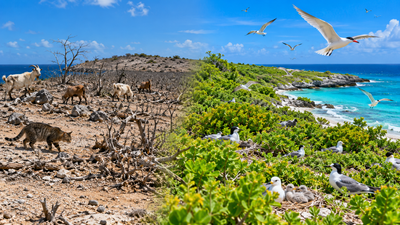
Klein Curacao, a flat 130-hectare coral island about 10 km southeast of Curacao, was left bare by guano mining and overgrazing by goats and sheep. Feral goats were removed in the 1990s and cats in October 2001, while native planting ran from 2000 to 2005.
For decades, the Least Tern was the only seabird confirmed breeding there. According to the study published in ResearchGate, titled ‘A case study of sea and shorebird breeding recovery following goat and cat eradication on Klein Curacao, southern Caribbean’, surveys in 2021 and 2022 then confirmed eight further sea and shorebird species. Documented nesting rose from 140 pairs of a single species in 2002 to more than 430 pairs in 2021 and 650 pairs in 2022.
How native plant restoration began on Klein Curacao in 2000
Klein Curacao covers 130 hectares and lies roughly 10 km southeast of the main island of Curacao.
The island is about 2.5 km long and about 700 m wide at its widest. Its maximum elevation is 4.7 m. Guano mining lowered and flattened it, and goats and sheep overgrazed it, leaving it devoid of bushes and trees for more than 100 years. Breeding boobies, once present, had disappeared by the early twentieth century because of egg harvesting, guano mining and grazing.
Feral goats were removed in the 1990s. In July 2001, the vacant Least Tern colony was found littered with dead terns, and feral cats were eliminated by the Carmabi Foundation in October 2001.
The Carmabi Foundation also assisted ecological recovery through replanting. Between 12 August 2000 and 16 November 2005, a total of 58 native plant species were taken from Curacao to Klein Curacao on 15-day trips. This comprised 1,174 individual saplings and potted plants, 482.7 kg of succulent cuttings, and 124.7 kg of seeds, fruits or cuttings of herbaceous plants. By mid-2022, the island's flora totalled approximately 54 species, of which 40 were surviving reintroductions, and many of these had been spreading naturally, producing landscape-level changes.
The island was designated an Important Bird Area in 2008 and a Ramsar wetland in 2018.
How weekly bird surveys were carried out in 2021 and 2022
Weekly avifaunal assessments were carried out on Klein Curacao from January to December in both 2021 and 2022. Rob Wellens and Henriette de Vries, who were occasionally accompanied by other co-authors. All significant sightings and photographs were submitted to the eBird.org database. Survey timing depended on the sailing schedule of the touring vessel Mermaid, and visits generally took place between 9:30 am and 2:00 pm.
During the height of the 2021 breeding season, Wellens stayed overnight once a week for three months, from July to September, to monitor birds and rat activity at night and at dusk.Bushnell trail cameras were used to monitor nesting by the Laughing Gull, Cayenne Tern and Least Tern. Sooty Terns and Bridled Terns were also monitored, as both are often most active at their nests at dusk or at night. In 2022, GPS coordinates were recorded for key locations to allow additional documentation.
The authors report that the nine species were documented nesting across the island in 2021 and 2022, and that most nesting activity took place on the northern half of the island.
The southern part was used almost exclusively by the Least Tern, and the single documented Green Heron nesting also took place there.
Which seabird species became dominant on Klein Curacao
The Cayenne Tern, Laughing Gull, Sooty Tern and Least Tern were the dominant species, in that order. The Cayenne Tern had approximately 230 breeding pairs in 2021 and 500 in 2022, and the authors note it had not been documented nesting on Klein Curacao since the 1960s.
The Laughing Gull bred in both years with approximately 75 pairs; the study states this is the first confirmation of its breeding on the island, although it had long been suspected.
Sooty Terns increased from 9 pairs in 2021 to between 40 and 45 pairs in 2022. The Least Tern colony was approximately 35 pairs in both years, compared with slightly more than 140 pairs recorded in 2002. The other four species had only a few nesting pairs each.Breeding by the Sooty Tern and the Bridled Tern are new national records for Curacao. In 2022, a Sooty Tern nest with a chick was confirmed on 13 July, and the first Bridled Tern chick was observed on 18 August. A Roseate Tern nest with one egg was found on 18 May 2022, and its fledgling was last seen near the nest on 20 July. The authors report the first nest of Common Terns, with two eggs, on 18 May 2022. They describe the American Oystercatcher as the first confirmed breeding for the territory of Curacao, with one pair in 2021 and two pairs in 2022.
Green Heron breeding had never before been documented on Klein Curacao. According to the authors, the island is now the island group's most diverse and active seabird breeding location.
What are the three major threats to seabird recovery on Klein Curacao
Three major threats to recovery: growing uncontrolled human recreation, the repeated threat of cat reintroduction and rat predation. On rats, the authors report that trail cameras recorded them in the breeding areas at night. In 2021, rats took Cayenne Tern eggs the night after they were laid, and all monitored nests lost their eggs.
The authors state that rat predation appears to be less of a threat to the large, densely nesting Cayenne Tern than to smaller, less gregarious species.
Starting in 2022, rat poison in the form of Klerat wax blocks containing 0.005% brodifacoum was deployed at selected tern nests. The authors urge at least seasonal rat control by poisoning during the tern breeding season, and recommend that rat removal be pursued as a priority.On cats and visitors, the authors credit the increase in abundance and diversity of nesting principally to the removal of cats. They cite Hughes et al. (2008), who found that around 100 cats on Ascension Island killed adult Sooty Terns at an average rate of 33 individuals a night in large breeding colonies. As of 2019, a single recently introduced house cat was present on Klein Curacao, and the authors state that the absence of cats at large must be guaranteed.
They also report that the island receives more than 600 recreational day visitors a week. To limit disturbance, they recommend signage, a ban on unleashed pets, closure of the northern half of the island except with designated seabird guides, and cooperation from tour operators.
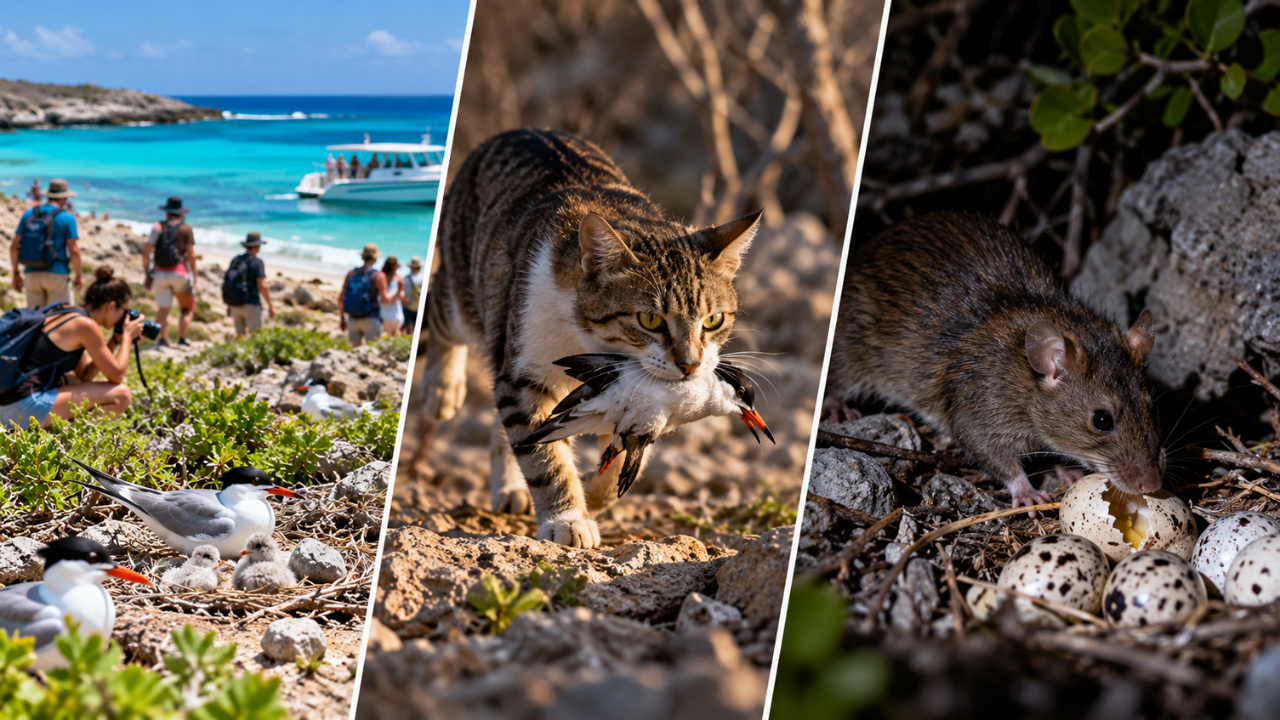
Image AI generated