5 months ago
32
5 months ago
32


 South Wales Police
Police say Kamran Aman suffered "abhorrent racist abuse before, during and after" the attack
Two teenagers have been detained for life in youth detention after murdering a stranger in an unprovoked racist attack.
The pair attacked Kamran Aman as he was delivering groceries to his mother's home.
The 38-year-old was stabbed through the heart and was subjected to further racist abuse as he lay dying on the floor of a neighbour's house.
Marcus Staniforth, 17, who ran into his cousin's house to get a knife, was sentenced to 17 years. The second defendant, 16, who cannot be named for legal reasons, was sentenced to 15 years.
Describing Staniforth as a "very dangerous man indeed", Judge Mr Justice Griffiths, said: "You turned a failing attempt at beating a man into murder and you tried to destroy evidence using bleach.
"You are exceptionally violent using exceptional violence for the most trivial of reasons."
Turning to the 16-year-old, who was sentenced on the basis that he was intent on hurting Aman "because he was not white", he said: "You instigated a deliberate, unprovoked, sustained, violent racist attack.
"You were old enough to know that to cause serious injury on a stranger because of his race was wrong."

Kamran Aman was attacked just before midnight in Barry
On 23:50 on 30 June Aman arrived in Barry Road and parked a few doors down from his mother's home. He had been working during the day before spending time with his wife and four-year-old daughter.
Marcus Staniforth and the second defendant had been drinking alcohol for several hours before arriving at a house on the same road where they continued to drink.
The trial heard the second defendant had behaved in a "volatile and aggressive manner" earlier in the day, "confronting a train conductor" and "later threatening" Staniforth.
It was the younger of the two, looking down from a bedroom window, who noticed Aman in his car in the street below and decided to attack him. Initially he took a hammer from the house but the weapon was taken off him.
The youth started hurling racist abuse at Aman and, after unsuccessfully trying to get in to the passenger side of the car, went around to the driver's side.
Aman came out of the car and began defending himself against a barrage of punches that were thrown first by the 16-year-old and then Staniforth who had joined the attack.
Several neighbours told the trial how they were alarmed by shouting in the street, in an attack described as "relentless" by one witness, with the boys behaving like a "pack of animals".
Staniforth was seen running back into the house, returning 15 seconds later armed with a large kitchen knife.
Neighbours, who gave evidence during the trial, said Staniforth swung the knife "multiple times".
Another neighbour, who said she had known Aman for many years, said he ended up in her doorway and he told her: "I think I've been stabbed."
The neighbour said she was surprised at how much blood was on the floor. She said Aman told her: "I can't breathe."
With Aman bleeding to death, the court heard how the boys were still intent on fighting, with the younger defendant bending over Aman shouting racist abuse.
Aman was stabbed once through his heart, a fatal injury despite the best efforts of paramedics who performed emergency open heart surgery.
Staniforth washed the knife and his hands with bleach before both boys fled the scene but they were arrested a short distance away, about 10 minutes after Aman was attacked.
Staniforth's DNA was later found on the knife and Aman's blood was found on his shorts and and the other defendant's shoes.
When interviewed by police that morning, the younger of the two youths blamed Staniforth for the murder, and shouted racist abuse at police.
 South Wales Police
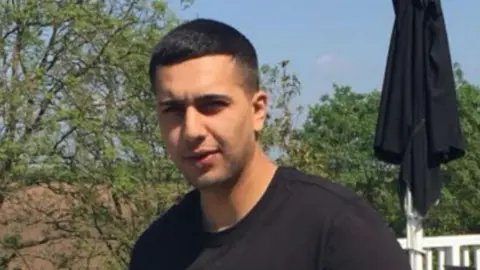
Kamran Aman was described by his wife Khaleela as "having a larger-than-life personality" who "was kind to everyone he met"
In a victim impact statement read in court, Aman's wife Khaleela James said it was "heart-breaking" to see the impact of his death on their daughter.
"She is understandably traumatised by this and is now suffering with separation anxiety with me because she does not want me to go and not come back 'like daddy did'."
Khaleela said she had flashbacks to the night of Aman's death and suffers from panic attacks as a result of what has happened.
Turning to the defendants in the dock, who showed no emotion, she said: "Life for us will never be the same without Kamran and not a day goes by where we do not think of him.
"There is a hole in our heart that can never be filled; a pain that will never go away. Without Kamran we are incomplete. The day he died, a part of us died with him.
"There is no sentence that would ever be enough for these two boys have done and the lives they have ruined."
Kamran Aman's mother also prepared an impact statement which was read out in court.
Shahnaz Aman said her family were now "terrified", and her son and his family do not come to Barry as they fear "someone will attack and injure them".
She said: "I am very sad now, and I think that as long as I live, I will be suffering from this grief that my son left this world.
Gerard Hillman KC, defending the 16-year-old, argued for a reduced minimum term on the basis that his client was suffering from a mental disorder at the time of the attack, and has since been diagnosed with Autism Spectrum Disorder and ADHD, "impacting on matters such as his emotional maturity, perception and intuition".
Hillman also argued his client was not racist and had only intended to inflict grievous bodily harm on Aman, that there was no intention to kill.
He argued that his client had no idea that Staniforth had brought a knife to the scene of the attack.
Staniforth will have to serve 16 years and 133 days before he is eligible for parole.
The 16-year-old will have to serve 14 years and 133 days before being eligible for release.
Speaking after the sentencing, Aliya Mohammed, CEO of Race Equality First, said she welcomed the court's recognition that Aman was killed in a racially motivated attack.
"Naming the racial element matters," she said.
"Racist violence harms not only an individual, but entire communities who feel the impact of that hatred. We know from our current research that it is often difficult to secure successful outcomes on the hate element of cases, so this sends an important message that racism has been taken seriously by the courts.
"Our thoughts remain with Kamran Aman's family at this devastating time."