54 minutes ago
1
54 minutes ago
1

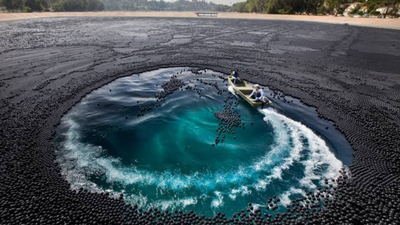
In 2015, millions of black plastic balls rolled across the surface of a reservoir in Los Angeles, creating an image that quickly travelled far beyond California. The 96 million shade balls were placed on the water during a severe drought, with a practical purpose: reducing evaporation while also helping protect drinking water from sunlight-related chemical reactions.
At first glance, the idea appeared straightforward: cover the reservoir, block the sun and keep more water in the system. But there was another part of the calculation that was harder to see. The plastic balls themselves required water to manufacture. A 2018 study examined that hidden water use and found that the environmental equation was more complicated than the reservoir alone suggested.
Why Los Angeles covered its reservoir with plastic balls
The shade balls were not introduced simply as a way of dealing with evaporation.
Los Angeles had already been using them before the spectacular 2015 deployment, beginning in 2008.One of their purposes was to keep sunlight from triggering chemical reactions in treated reservoir water. Sunlight can contribute to the formation of bromate when it interacts with naturally occurring bromine in water that has been treated with ozone. Bromate is regulated as a carcinogen by the US Environmental Protection Agency.
According to PBS, blocking sunlight also helped limit algae growth. For Los Angeles officials, shade balls offered a relatively inexpensive way of dealing with these water-quality concerns. Other types of reservoir covers had been considered, but the alternatives could have cost the city around $250 million more. The drought added another reason to expand their use.
How 96 million shade balls helped Los Angeles save reservoir water
The Los Angeles Reservoir covers about 175 acres, and in 2015 the city completed the installation of roughly 96 million shade balls across its surface.The Los Angeles Department of Water and Power estimated that the balls could reduce evaporation by around 85 to 90% during drought conditions. At the upper end of its estimate, the annual saving could reach about 300 million gallons of water, enough to supply roughly 8,100 people.That figure, however, describes what happens at the reservoir. It does not account for the water consumed before the balls ever reach Los Angeles.
This was the question examined by researchers from the Massachusetts Institute of Technology, Imperial College London and the University of Twente in the Netherlands, as reported by Nature Sustainability in a July 2018 research paper.
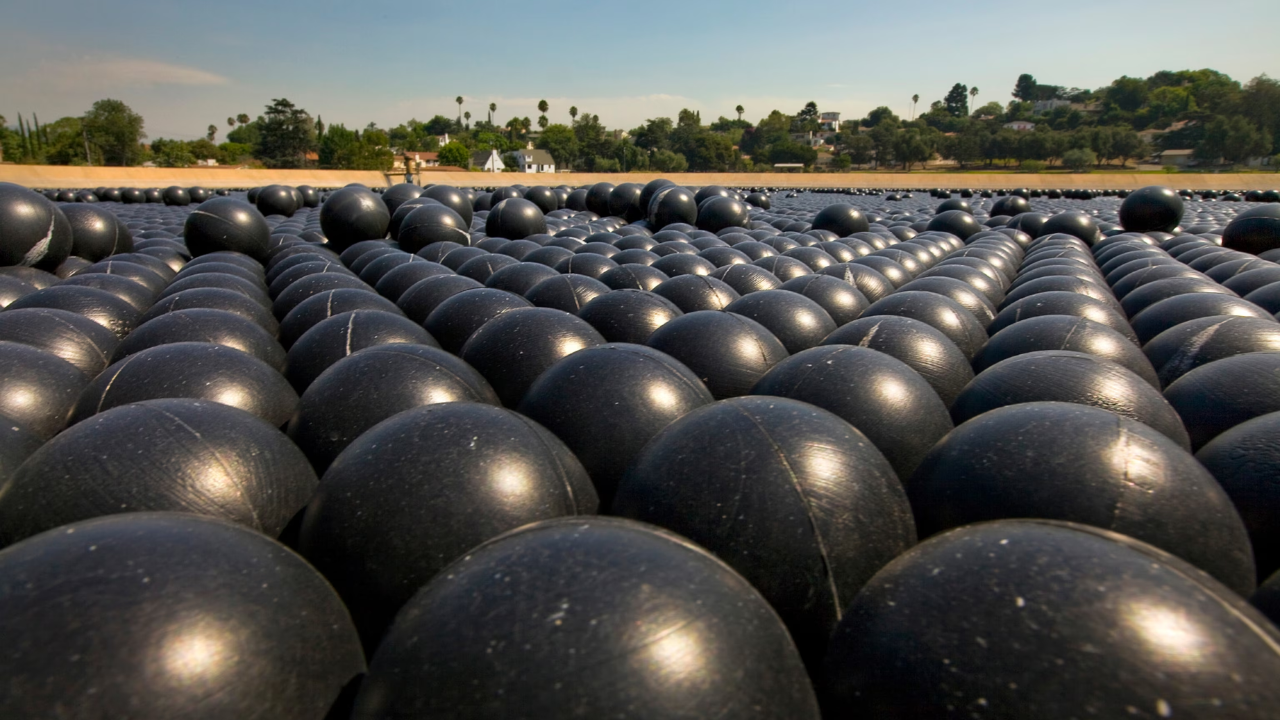
PC: National Geographic
Researchers calculated the water footprint of 96 million shade balls
The researchers looked at the water footprint of manufacturing the shade balls rather than treating them as if they appeared at the reservoir without an environmental cost. The balls are made from polyethylene, a plastic whose production depends on oil, natural gas and electricity.
Producing each of those inputs can consume substantial amounts of water. The amount varies according to where and how the materials and energy are produced.The team combined previously published estimates of water consumption with information about the quantities of oil, natural gas and electricity required to manufacture polyethylene. It then used those figures to estimate the water involved in producing the huge batch installed at the Los Angeles Reservoir.
Up to 766 million gallons of water may have been used
The researchers estimated that producing the 96 million shade balls consumed somewhere between 66 million and 766 million gallons of water. The difference between the two figures was largely linked to uncertainty over the balls' thickness. Manufacturing conditions and the location of production also affected the calculation.To put the numbers into perspective, the researchers compared the amount with Olympic-sized swimming pools.
Reportedly, the estimated manufacturing water footprint ranged from the equivalent of roughly 100 to 1,000 such pools.That does not mean the balls permanently used up all of that water in the same place. The point was that water had already been consumed somewhere in the production chain before the balls could begin saving water in Los Angeles.
The balls needed time to make up the difference
Based on their calculations, the researchers estimated that the shade balls would need to remain in place for between one and 2.5 years before the water saved through reduced evaporation could offset the water consumed during their production.The exact period depended on manufacturing conditions and the associated water use.By the time the study was published in 2018, the balls had already been covering the reservoir since 2015. That meant they were likely moving beyond the initial period in which their manufacturing water footprint outweighed the water they had helped retain. There was another complication, though. The evaporation benefit is not constant.During drought, when conditions are hotter and drier, preventing evaporation can save considerably more water. In wetter or less dry periods, the amount of water naturally lost from the reservoir falls. That means the time required to recover the manufacturing footprint could be longer outside drought conditions.
Other conservation measures saved much more water
The shade balls attracted attention partly because of their sheer number and unusual appearance, but their evaporation savings were relatively small when compared with some other measures used by Los Angeles.In a 2014 analysis published in Resources, Conservation & Recycling titled, ‘The effectiveness of water conservation measures on summer residential water use in Los Angeles, California’, water-saving strategies in the city found that mandatory restrictions on water use had produced much larger savings. Such measures included limiting activities such as lawn watering.According to hydrologist Aditi Bhaskar, "Savings in just May through June 2010 [with mandatory water restrictions] is 10 times larger than the 300 million gallons which they're getting per year for the shade balls," Bhaskar said, PBS reported.That comparison does not make the balls irrelevant. Their role also includes protecting water quality, reducing algae growth and limiting sunlight-driven bromate formation. It does, however, put their evaporation benefit into context.
Los Angeles planned to keep using the shade balls
The city intended to keep the shade balls as a long-term solution for water-quality problems at the Los Angeles Reservoir. Officials planned to replace them roughly every 10 years.The balls had also been used at other reservoirs in the Los Angeles area. Earlier deployments, including one at the Ivanhoe Reservoir beginning in 2008, were associated with reductions in bromate levels and algae growth. At three other reservoirs, the balls were used temporarily for periods ranging from five to nine years.Their usefulness, then, was never limited to one drought-era calculation about evaporation.
A water-saving idea with a wider footprint
The Los Angeles shade-ball project illustrates why the apparent simplicity of a conservation measure can disappear when its full life cycle is considered. At the reservoir, the balls prevent sunlight from reaching the water and reduce evaporation. Before they arrive there, however, petroleum, energy and industrial processes are involved in making millions of polyethylene objects. Those processes consume water, often far from the reservoir where the eventual savings are recorded.The 2018 research did not conclude that the shade balls could never save more water than was used to make them. Its calculation suggested that they could recover that manufacturing footprint after a period of roughly one to 2.5 years, depending on the circumstances.For Los Angeles, the balls also serve a separate water-quality function. Their story is therefore less about whether a single number proves them successful or unsuccessful and more about how a conservation measure can look different when its entire production chain is included in the calculation.