
 7 months ago
34
7 months ago
34

Abu Bakar YasinBBC Newsbeat

 MUBI
MUBI
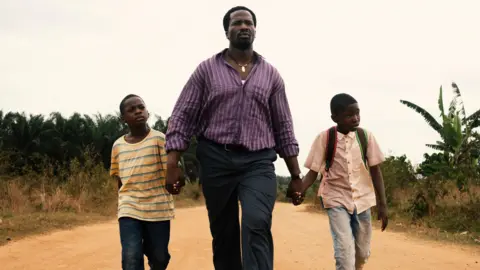
My Father's Shadow follows an unusual day in the life of Folarin and his two young sons
"Your father will instil values in you," says film director Akinola Davies Jr.
"How to be a man, how to stand up for yourself, how to behave, what is masculinity?"
As he reflects on the inspiration for his debut feature, the film-maker talks about the impact his own dad had on him.
It's an idea he wanted to explore with his brother, Wale Davies, when the two set about making the semi-autobiographical My Father's Shadow, about an absent father seen through the eyes of his two young sons.
"You grow in the shadow of your father - we wanted to show that on the big screen," he tells BBC Newsbeat.
My Father's Shadow debuted last year at the Cannes Film Festival, becoming the first Nigerian production to be chosen for the event's official selection.
The story follows two young brothers, Akin and Remi, who spend a day with their absent father, Folarin, after an unexpected reunion.
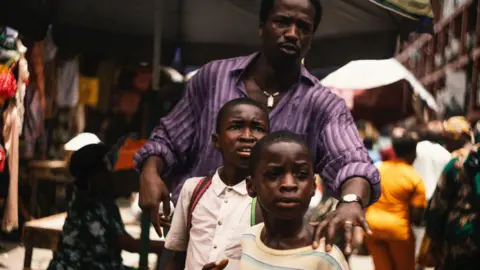
Set on the day of Nigeria's historic 1993 presidential election, the threat of unrest hangs over the father and sons as they travel into the former capital city, Lagos.
As the film unfolds, the viewer sees Folarin through his children's eyes, in what critics have called an "emotional" and "devastating" tale.
It explores father-son relationships, but also touches on themes of masculinity.
After picking up a string of international awards and prizes, Akinola and Wale are jointly nominated for this year's Bafta Film Awards for an outstanding debut by a British writer, director or producer.
 MUBI
MUBI
Folarin and his boys make a trek into Lagos as the movie progresses
The brothers wanted to explore the depiction of father-son relationships among black families.
In one scene Folarin, played by Sope Dirisu, cries as he tells his sons (played by Godwin Chiemerie Egbo and Chibuike Marvellous Egbo) about the death of his own brother.
"We don't often see enough of that representation of masculinity, especially within ethnic fathers," says Akinola.
"There's a certain level of tenderness with black boys and their father.
"It's important for people to know that exists.
"At the same time it's fine for fathers to be vulnerable with their children because that vulnerability builds bridges in relationships."
Ellis Lamai, a 26-year-old British-Nigerian, tells Newsbeat My Father's Shadow captures a certain type of masculinity which he feels is prevalent within Nigerian households.
"As a father you've got to go and get stuff and make sure your family is okay," he says.
"And that takes over everything, rather than having a relationship with your kids."
Ellis says this narrative plays out in the film - Folarin works so much that he becomes "neglectful and sidetracked".
But he also says the backdrop helped him to better understand his own family's history.
"The film made me realise why maybe my family left Nigeria," he says.
"My grandparents left in the 60s during the civil war, my dad was born in Nigeria but came [to Britain] in the late 80s and early 90s.
"There's always been a feeling of 'You got to get past your circumstances' in Nigeria... always a search for something better."
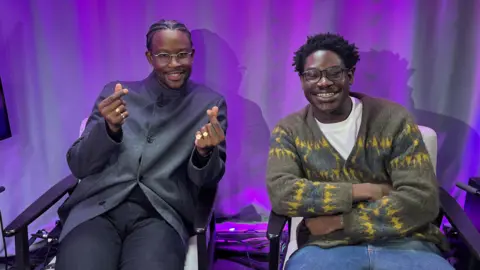
Director Akinola Davies Jr (left) and fan Ellis Lamai sat down to discuss My Father's Shadow with BBC Newsbeat
Akinola says he hopes the recognition the film's received will encourage others to tell their own stories.
"It's a win for anyone who wants to author stories in their own community - Nigeria, the Nigerian diaspora in the UK, the USA and across the world," he says.
He says the film gave the brothers an opportunity to challenge stereotypical representations of Nigeria.
"We never saw the Lagos I grew up with on screen," he says.
"Me and my brother wanted to show our Lagos, wanted to show it properly.
"There's a lot of joy in our music, sport and how we celebrate those who are ambassadors of Nigeria - the film is really made for people to see themselves."
But, Akinola says, the prevailing message of My Father's Shadow is to show how vulnerable parents can be, too.
"I think parents don't have the answers," he says.
"Parents just think they got to provide.
"All kids want is attention and to be taught by their parents and be told: 'I love you'."
And while the film sees events from the young brothers' point of view, he hopes it will also encourage viewers to consider the pressures parents are under.
"It enables us to see our parents less as supernatural beings but see them as flawed, human people," he says.
"They're imperfect as well, which should be celebrated, instead of putting them on a pedestal which you think you have to climb as well."



