1 hour ago
2
1 hour ago
2

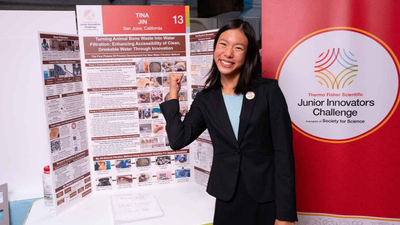
A 15-year-old Massachusetts student is exploring an unusual way to make polluted water cleaner: using discarded animal bones. Tina Jin, a student at Phillips Academy in Andover, developed a filtration system that uses ground cow, lamb or pig bones arranged in multiple layers to target different contaminants in water.
Her research focuses on places where conventional water-treatment systems may be too expensive or difficult to operate, and her latest project was presented at the 2026 Regeneron International Science and Engineering Fair (ISEF). The system showed promising results in experiments involving bacteria, heavy metals, turbidity and microplastics. Jin's work has also progressed beyond a school science project.
A US patent covering a filter made with ground animal-bone granules was granted to her in December 2025, while her 2026 ISEF project received a first award in Earth and Environmental Sciences and a $10,000 Ricoh Sustainable Development Award.
How Tina Jin got the idea from animal bones
Jin's interest in animal bones as a filtration material began with their porous structure. Instead of treating leftover bones simply as waste, she explored whether their physical and chemical properties could be useful for cleaning water.
Her research eventually moved from experiments with whole bones to ground bone particles that could be arranged into a controlled filtration system. The concept is unusual because the material is readily available in many parts of the world and does not depend on sophisticated filtration membranes or expensive chemical treatment.
Jin's work is therefore aimed at a practical question: whether waste material can be converted into a low-cost component for water treatment.
The filter uses four layers of bone particles
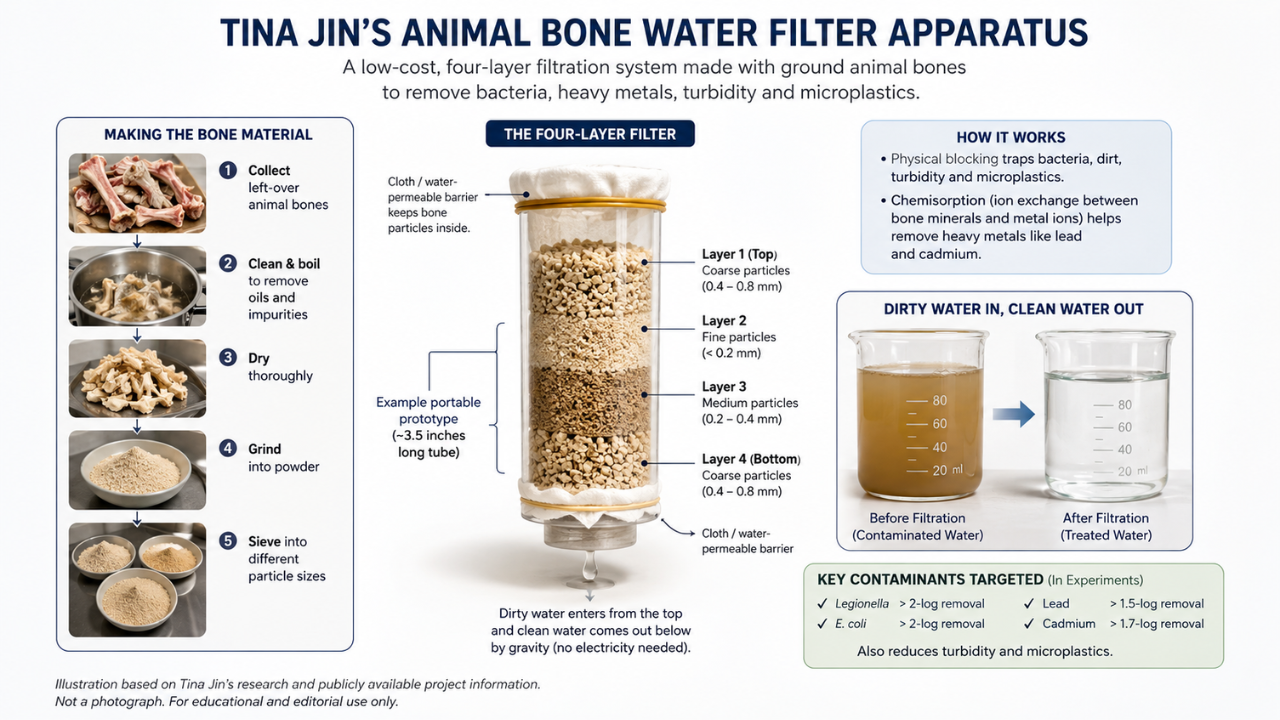
The filtration system uses animal bones that are cleaned, boiled to remove oils and other residue, dried and ground into small particles. The particles are then separated into different sizes. The patented design describes coarse particles measuring about 0.4 to 0.8 millimetres, medium particles measuring about 0.2 to 0.4 millimetres and fine particles measuring less than 0.2 millimetres. The particles are arranged in four layers.
Coarse material is placed at the top and bottom, with fine and medium particles between them. The arrangement is intended to help trap impurities of different sizes while allowing water to pass through the filter.The research proposes that the filtration effect comes from more than simply physically trapping particles. Animal bones contain mineral components, including calcium phosphate, that can interact with certain contaminants dissolved in water.
Jin's research suggests that this chemical interaction can help remove heavy-metal ions such as lead and cadmium. The different particle sizes also provide physical filtration.
Larger particles and debris can be blocked by the coarser layers, while finer particles can become trapped deeper inside the filter. The project therefore combines physical filtration with chemical interactions between the bone material and contaminants.
The experiments targeted bacteria and heavy metals
According to Jin's 2026 ISEF project summary, the filters achieved more than a 2-log reduction in Legionella and more than a 2-log reduction in E. coli. The experiments also recorded more than a 1.5-log reduction in lead and more than a 1.7-log reduction in cadmium. A 2-log reduction represents a 99% reduction in the measured contaminant under the test conditions. The reported results therefore suggest substantial removal, but they should not be interpreted as evidence that the filter can automatically make any contaminated water safe to drink.
The filter also removed turbidity and microplastics
The research went beyond bacteria and heavy metals. Jin's project also reports reductions in turbidity and microplastics after filtration. Turbidity refers to the cloudiness of water caused by suspended particles, so reducing it can make water appear clearer, although clear water is not necessarily safe water. The microplastic results add another dimension to the project because these particles are difficult to address with some conventional treatment approaches.
Jin's work explores whether the same inexpensive filtration material can contribute to removing several different types of contaminants. A central goal of Jin's research is accessibility. Many advanced water-treatment systems require electricity, specialised equipment, replacement membranes or chemicals. Her proposed system instead uses animal bones and a relatively simple filtration structure.The patent describes portable and stationary versions of the device.
A portable design can use a short tube containing the bone layers, while larger stationary configurations can be built for greater volumes of water.That flexibility is intended to make the approach adaptable to different settings, although further testing would be necessary before such systems could be considered a reliable replacement for established drinking-water treatment.
The invention has received a US patent
Jin's work has progressed beyond experimental research and science-fair demonstrations.
US Patent No. 12,491,453, titled “Method of making a filter with ground animal bone granules and filtering therewith”, was granted on December 9, 2025. The patent identifies Tina Jin as the inventor and describes a water-filter device containing layers of animal-bone granules. The patented process includes cleaning and boiling the bones, drying them, grinding them into granules and separating the particles by size before placing them into a filtration tube.
It also describes using a water-permeable barrier to keep the bone granules inside the device.
Jin's project won recognition at ISEF 2026
Jin presented the project, officially titled “Sustainable Animal Bone Filtration for the Design of Water Treatment Devices for Resource-Limited Regions”, at the 2026 Regeneron International Science and Engineering Fair.The Society for Science lists the project as EAEV052 and records Jin, from Phillips Academy in Massachusetts, as its sole researcher.
She received a First Award of $6,000 in the Earth and Environmental Sciences category.
She also received the Ricoh Sustainable Development Award worth $10,000 for the same project.The patent and prototype development are important because they show that Jin's work has moved beyond a simple laboratory demonstration. The project explores how the filtration material could be turned into practical devices that people could potentially assemble and use in different environments.
Her research also considers how quickly water moves through the filter. Finding the right balance between contaminant removal and filtration speed is essential because a filter that removes contaminants effectively but allows only tiny quantities of water through may not be practical.
There are still limitations to the technology
Despite the promising results, the animal-bone filter should not yet be described as a universal solution for polluted or unsafe drinking water.
Water sources can contain many contaminants at very different concentrations, and laboratory results under specific conditions do not automatically translate into safe treatment of every real-world water source. The patent itself describes boiling filtered water as part of some embodiments of the filtration process.
This is also an important reminder that filtration and disinfection are not necessarily the same thing.
Further independent testing, long-term durability studies and real-world validation would be needed before widespread deployment.
Turning waste into a potential water-treatment material
Jin's research ultimately connects two environmental problems: waste and access to clean water. Instead of viewing leftover animal bones only as discarded material, her work investigates whether they can become part of a useful filtration technology. The idea remains experimental, but its combination of low-cost materials, simple processing and multi-contaminant filtration has attracted significant scientific recognition.
For Jin, the project represents an attempt to use an everyday waste material to address a problem that affects communities around the world.