
 7 months ago
49
7 months ago
49

Sonja JessupLondon home affairs correspondent

 PA Media
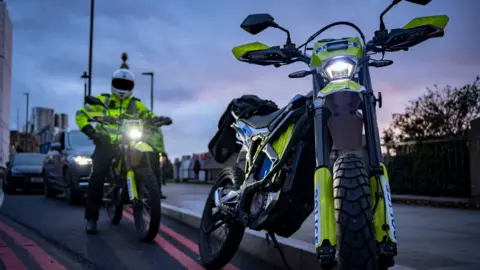
Bikes are more agile for catching thieves, the Met says
E-bikes, drones and live facial recognition are the latest frontier in the Metropolitan Police's efforts to cut the number of mobile phone thefts in London.
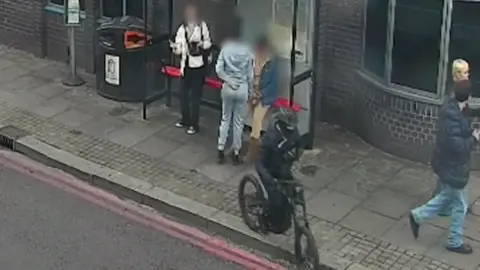
It comes as the force warns that children as young as 14 are being targeted over social media and paid up to £100 to steal phones for an organised crime gang.
New figures show that between 2017 and 27 February 2024, out of a total of 587,498 phones stolen in London, excluding the City, just 13,998 were recovered.
A phone is stolen in the capital every seven to eight minutes but the number of recorded mobile phone thefts in London fell to 71,391 last year, compared to 81,365 in 2024, a drop of 12%, Met figures show.
Assistant Commissioner Matt Twist admits the numbers remain "too high" but says for the first time, the force has used drones to help spot thieves, following a pilot last October to test if they could support the response to 999 calls.
Twist said the drones were acting as their "eyes in the sky" to feed live footage to a dedicated control room to identify thieves on e-bikes and to "guide in" officers so that they could "deal with the snatchers even before they know we're on them".
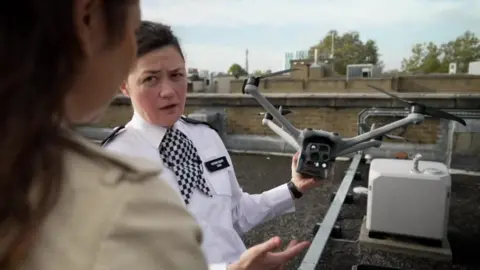
Drones are now being used to try to identify phone snatchers following a pilot scheme
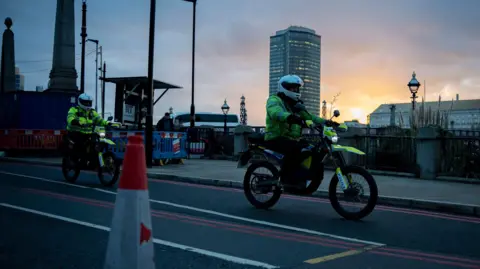
Alongside drones, officers have been using Sur-Ron electric bikes to pursue the snatchers.
The Met introduced them two years ago after realising that offenders had started using them, instead of mopeds, because they were more agile.
"We found that we had very little tactical options when we were confronting them," explained Sgt Ryan Perry. "They were getting away, going through tight gaps, alleyways, footpaths and even off-roads."
Now, he says, officers have a greater ability to keep up and the e-bikes are also acting as a powerful deterrent to offenders.
 PA Media
The Met plans to add 20 more e-bikes to its fleet
"They often send out spotters," said Perry. "They'll send them out on bikes to assess the police presence in the area. And if they see police solos, or motorcycles as they're called, or in fact the Sur-Rons, then it's rare that we will see them."
But don't the phone snatchers simply target other areas instead?
Perry said it was aware that if they were running an operation in the West End, it would also consider places like Camden High Street, Islington and south of the river to curb this.
The Met says 20 more bikes are due to be added to its fleet in the next few months.
 Metropolitan Police
Met Police figures show 71,391 phone theft offences were recorded last year
Twist said a series of operations over four weeks this January and February had brought together local officers with specialist teams to target the crime "in three tiers".
He added: "We're looking at the people that are doing the snatches and the 'dipping', the pick pocketing.
"We're doing the middle layer: the handlers receiving and organising that activity.
"And then our organised crime teams and specialist crime are focusing on those at the upper end: the bigger networks exporting them across the world."

PC Matt Murrant described the challenges facing officers in trying to pursue suspects
Scotland Yard said 32 people had been arrested, and 24 charged, in connection with one gang and more than 1,000 phones and 200 laptops had been recovered.
One suspect was arrested in connection with 20 offences of so-called "table surfing" over two months, the Met added, where criminals distract customers in order to swipe their phone from their table top in bars or cafes.
The force said 39 stolen phones had been recovered following a search of the suspect's house.
The new stats come as London mayor Sir Sadiq Khan announced a further £4.5m investment to tackle phone theft and a new West End hub to speed up response times to call-outs.
PC Matt Murrant is part of the interceptors team who've been taking part in operations to pursue the thieves, but said officers faced a number of challenges.
"It is stacked against the police," he told me. "By the time we get notified of what's happened sometimes it's already been 10 or 15 minutes. That bike could be anywhere."
He said pursuits had to be considered carefully, giving an example of one moped rider spotted snatching multiple phones on Oxford Street.
"One of our motorbikes got behind it, straight into a pursuit, but it's doing 60 -70 miles an hour down Oxford Street in the middle of the afternoon.
"So we're balancing trying to catch that individual but also the risk to that individual and the members of the public. He was on and off the pavement."
He said the rider got away in the end, after turning the wrong way down a one-way street.
"Sometimes we'll have to call the pursuit off - terminate it - because it's just too dangerous."
Murrant said, in another case, a man on an electric motorbike had carried out a "spree for about an hour" before police stopped him close to Lambeth Bridge.
The suspect was later charged with theft and Murrant said divers from the Met's marine unit recovered a stolen phone from the River Thames.
He pointed out how vulnerable many pedestrians are as they walk around the West End, staring down at the phones in their hands, some with headphones on.
"It's hard. Not everyone lives in London, it's a tourist hot spot, and you're trying to follow Google Maps or whatever to know where you're going and before you know it, your phone's gone."
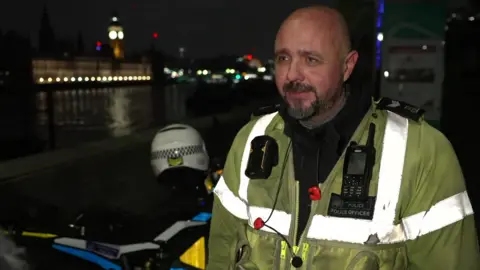
Sgt Ryan Perry said the police use of Sur-Ron electric bikes was helping deter phone snatchers
Mobile phone theft has soared in London over recent years and many victims have criticised the Met over both failing to prevent the crime and in their response after their phone has been stolen.
Last October, the force's newly appointed lead on phone theft Commander Andy Featherstone told the BBC the force had not been "good enough".
Westminster has the highest rate of phone theft of any London borough, the number of recorded mobile phone "theft from person" offences dropped by 25% in the 12 months up to January 2026 compared to the previous year, according to Met police data.
However in December 2025 alone, 1,874 offences were reported. Just 10 cases resulted in a "positive outcome" such as a charge or other sanction.
"The numbers are truly enormous," Twist acknowledged. "I know the public are worried about phone theft and the number of phones that are stolen is still too high, but we need to also work with the industry."
He called on phone providers to make it harder for devices to be reprogrammed.
"At the moment, people are stealing these phones so they can be exported, largely.
"They've got quite a high monetary value and at the moment they're too easy to reset and reuse and monetise, often in other countries."
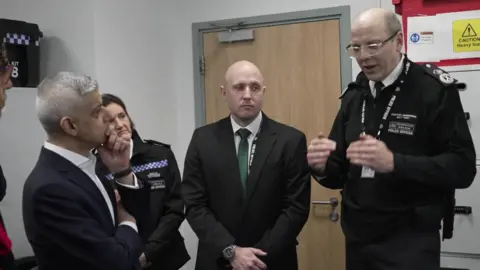
Mayor of London Sir Sadiq Khan and Assistant Commissioner Matt Twist visited the CCTV control room at Charing Cross police station during the four-week operation
Police believe the gang could be responsible for exporting up to half of all phones stolen in London.
Asked why gangs were continuing to get away with phone snatching, the mayor said that he was "proud" that 10,000 fewer devices had been stolen last year but acknowledged it was "still too high".
Sir Sadiq promised that he and the Metropolitan Police Commissioner Sir Mark Rowley would reduce the number of phone thefts, in the same way the Met had reduced homicide rates.
The mayor said he was also "frustrated" with phone companies and operators.
"Why can't they have a kill switch so a stolen phone can't be used? Why can't they stop somebody having access to a cloud so a phone that's stolen is not reset and reused?"
The mayor said he would invest a further £4.5m this year towards tackling the crime, including plans to set up a new "command cell" in the West End to coordinate intelligence and provide a "real-time response" to call-outs to incidents, including phone theft.
Sir Sadiq said there would also be funding to help Trading Standards and the Met to create a taskforce to crack down on shops that buy and sell stolen phones.
Twist said the data he was seeing "week on week" showed the positive impact that the force's targeted action on phone snatchers was having.
But can the Met sustain that?
Senior officers have warned of a £260m funding gap and a "shrinking" workforce.
The Met lost 1,461 officers in the year ending September 2025, a fall of 4.3% compared to the previous year, according to Home Office figures.
"Whilst the organisation as a whole has got smaller, we've maintained our effort and our focus on neighbourhoods, and particularly in the West End," said Twist. "It's one of the few teams that actually got bigger in the last 12 months."
Sir Sadiq said resources were being focused on front line policing and that West End teams had doubled.


