3 months ago
37
3 months ago
37

9 minutes ago
Hugh Pym,Health editorand Tabby Wilson

 EPA
EPA
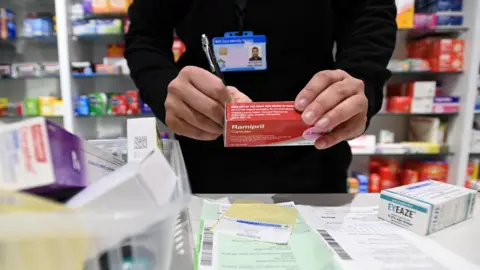
More pharmacists in England will be able to prescribe medications as part of an effort to speed up care and ease pressure on GP surgeries and hospitals.
As part of the Pharmacy First scheme, pharmacists can currently prescribe medication for a sore throat, earache, sinusitis, shingles, impetigo, infected bites and urinary tract infections.
From the autumn, the new £340m investment will see five common ailments added to this list, although it is not yet clear what these will be.
However, National Pharmacy Association (NPA) has said the deal does not do enough to address rising business rates, employer costs and medicine prices.
The Pharmacy First scheme in England was first launched in 2024, and allows patients to see their pharmacist for advice, over-the-counter treatments and prescription-only medicines.
People can also visit the pharmacy for eye, ear, oral and dental care, as well as seek treatment for digestive problems.
According to the Department of Health and Social Care, more than 3.3 million consultations under the scheme were carried out between March 2025 and February 2026.
Health Minister Stephen Kinnock said the government is "making the most of our highly skilled pharmacists, while boosting access to services and giving patients more care right on their doorstep".
"Independent prescribing will play a major part in delivering this shift, easing pressures on GPs, cutting unnecessary red tape and helping patients get the right care closer to home," he said.
The NPA said that while the deal "points in the right direction", it did not address the "crippling" new costs hitting pharmacies.
"We remain concerned that it does very little to close the £2.5bn funding gap that the NHS itself identified a year ago," said NPA chairman Dr Olivier Picard, adding that the expanded scheme was "nowhere near ambitious enough to transform patient access to care, nor make full use of pharmacists' skills".
He went on: "We are also concerned that the current funding levels mean that many pharmacies will struggle to take this development forwards, risking its success. Pharmacies cannot sustain yet more loss-making work."