
 7 months ago
55
7 months ago
55

Joshua NevettPolitical reporter

 PA
PA
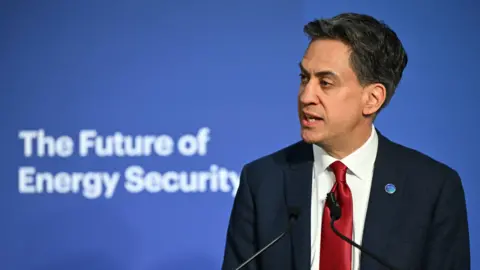
Energy Secretary Ed Miliband has said it's important to take data centres into account
Ed Miliband has been urged to explain whether a planned boom in energy-hungry data centres have been factored into his plans to deliver net zero carbon emmisions.
In a letter to the energy secretary, Labour MP Toby Perkins, who chairs the Environmental Audit Committee, said data centres are a "key area of concern" in hitting the emissions target.
Data centres are giant facilities full of powerful computers used to run digital services, such as streaming and artificial intelligence (AI).
The government has backed plans for many more to be built to help turn the UK into an "AI superpower", despite the large amounts of electricity needed to run them, including from gas-powered generators.
Perkins said it was concerning that the UK government was relying on a carbon-reduction plan that made no allowance for the impact of data centres.
"The issue of data centres and its impact on energy use and emissions have been highlighted as a key area of concern, which is why my committee was concerned by its omission in CB7," Perkins said in his letter to Miliband.
Perkins added: "We would like to know whether this has been accounted for and how, including projections of emissions and possible mitigations."
The BBC has asked Miliband's department for comment.
On Wednesday, Miliband told a committee of MPs his Department for Energy Security and Net Zero (DESNZ) would scrutinise emissions from data centres.
Last year, the BBC reported that almost 100 new data centres were being planned.
Many of these will be funded by US tech firms, such as Google, and would be based near London.
The UK government has designated data centres as critical national infrastructure, meaning they can not be blocked by local objections.
Perkins is leading an inquiry into the latest emissions-reduction proposals from the Climate Change Committee (CCC), which advises the UK government on net zero.
These proposals suggest a legally binding limit - a carbon budget - for greenhouse gases emitted in the UK for the period 2038-2042.
The government must set this budget by June this year, as part of its legally binding commitment to achieve net-zero emissions by 2050.
Last month, the CCC told the BBC the government had not asked it to provide advice specifically on data centres.
Its advice does not mention data centres directly but it does include an expected large increase in the nation's electricity use.
Three charities - Opportunity Green, Foxglove, and Global Action Plan - have warned data centres pose "a risk of substantial carbon emissions that challenge decarbonisation efforts inside UK carbon budgets".
In written evidence submitted to the Environmental Audit Committee's inquiry, the charities said not including data centres in carbon budgets "can only be considered a serious oversight of a major, challenging new source" of emissions.
In their evidence, they said "developers' own figures indicate that just ten of the larger data centres in planning or construction will cause the UK's annual emissions to rise by equivalent to 2.75m tonnes of CO2".
"This partial, conservative figure would all but wipe out the carbon savings expected in 2025 from the switch to electric cars (2.9m tonnes CO2)," the evidence said.
 Getty Images
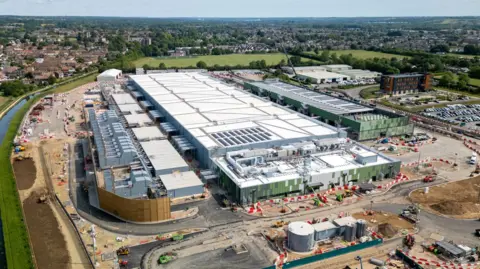
The number of data centres, like this Google facility in Hertfordshire, are increasing
Electricity demand from data centres in Great Britain was estimated to be 7.6TWh in 2025, according to the National Energy System Operator (NESO).
That was about 2% of total electricity demand which, according to Carbon Brief analysis, was 322TWh.
NESO expects data centres to be increasingly used for AI and many of them could install on-site generation fuelled by gas as back-up supply.
But there is high uncertainty over the future growth of data centres, with NESO forecasting electricity demand anywhere between 30TWh and 71TWh by 2050.
One source with knowledge of the government's approach to carbon budgets said DESNZ was not panicked about the growth in data centres.
But, the source added, DESNZ recognises the need to balance the carbon budget if growth is faster than they have accounted for.
Prime Minister Sir Keir Starmer wants the UK to become a world leader in artificial intelligence and his government is establishing AI Growth Zones to speed up planning proposals for data centres.
There have been concerns about the impact of data centres, including their water consumption and the effect on household energy bills.
The impact of data centres on energy demand came up during Miliband's appearance in front of the Energy Security and Net Zero Committee on Wednesday.
Miliband said it was "obviously important to take into account the impact of data centres".
But when pressed on whether the Climate Change Committee had accounted for data centres in its latest carbon budget, Miliband said: "I don't know the answer but I'm happy to find out."


