
 5 months ago
74
5 months ago
74


 Leanne Rinne / BBC
Dena Tickner feels guilty sometimes.
When she gets home from work, she worries she can be too short-tempered with her children.
"I'll be snappy with them when it absolutely isn't their fault."
Tickner is a teacher, as well as a mum of two.
She returned to teaching about four years ago, following an eight-year break to have her children. She worked part-time initially, before transitioning back to full time work.
She says balancing teaching and parenting can be like a "juggling act", and setting boundaries and routines has become paramount to managing the day.
"You feel like you don't get that moment to reset yourself between being a teacher and then coming home and being a mum."
The NASUWT teachers' union says the majority of people who responded to a recent survey of its members said they struggled to balance their work responsibilities with being a parent.
Seven in 10 of those responding said they had considered leaving teaching because of the impact of their work commitments on their children, the union says.
"I have considered leaving teaching, and have looked at other jobs outside the profession," she says, but adds that the salary she has reached at this stage of her career wouldn't be matched elsewhere.
Her husband works from home, which helps the family a lot, but Tickner says that sort of flexibility needs to be more prominent for teachers too.
It recently updated its guidance on flexible working, targeted towards schools on how to implement it, and for teachers who want to request it.
The latest annual data on teacher numbers, published last year, suggested the number of teachers leaving the profession had slightly improved in 2024-25, but remained high compared with previous years.
Tickner says some schools struggle to facilitate part-time or flexible staff, because of the need to have enough staff in school with the children each day.
But for her, more flexibility could be the difference between teachers staying in their jobs, or deciding to leave.
For Tickner and her family, a weekday starts at 06:00, when she and her husband get up, get ready and eat breakfast.
She is out of the door with her son Samuel at 07:30 to drop him off at the breakfast club at his primary school.
Her daughter Jennifer walks to her secondary school.
Tickner arrives at the school where she teaches at 08:00, with pupil registration starting at half past.
"I've got half an hour - that may be doing some last-minute printing or checking emails to see if there are any changes to the day," she says.
On Mondays, Tickner is on a cover rota, meaning she may have to take over a different lesson to that which she had planned to teach.
Teaching is an "all-consuming role", she says, and the behavioural issues she has to handle in the classroom can take an emotional toll - which she sometimes struggles to leave at the school gates.
"There's many children now with complex needs that you've got to take into account when you're teaching," she says. "It is hard, sometimes, not to take that home.
"I have been known to utter the phrase: 'I've spent a day being ignored by other people's children, I don't expect to be ignored by my own.'"
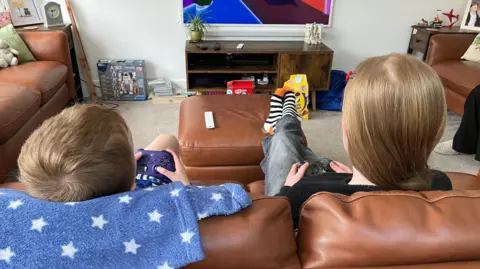 Leanne Rinne / BBC
Tickner says she can sometimes be short-tempered with her children due to the emotional toll of her job
The school day finishes at 15:00, but is followed by teacher training every other Monday.
Tickner says she tries to finish as much of her lesson planning as possible while at school so she can leave by 17:00.
Planning takes up a lot of her time when she's not with her pupils.
After leaving school, she collects her son from after-school club, and arrives home at roughly 18:00 to have dinner.
"It can be as late as 10:30 in the evening that I can sit down and have time to myself or with my husband," she says.
Her working day varies throughout the week, with staff briefings and department meetings taking place on Tuesdays and Wednesdays.
As a head of department, Tickner needs to plan and deliver these sessions, which last an hour.
On Thursdays, after the school day has finished, there are academic board meetings every other week, and she hosts revision sessions for Year 11 students too.
It means she can stay at school for two hours after the end of the school day.
Her children also take part in after-school activities, with her daughter Jennifer at guides on a Wednesday and son Samuel at cubs on a Thursday.
Fridays are about trying to get ahead for the next week wherever she can.
"I make sure my lessons are prepared for the Monday so there are no surprises, sometimes there are phone calls to parents to make, they have to be fitted in as well."
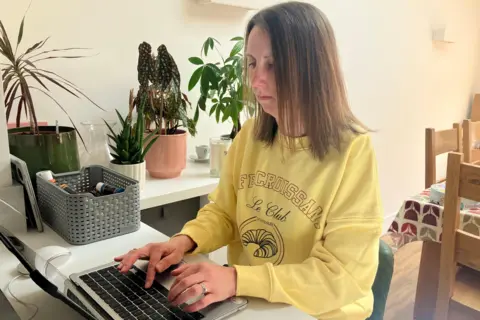 Leanne Rinne / BBC
Like many other teachers, Tickner spends hours working at home outside the school day
Like lots of other teachers, there are evenings where she needs to do extra work, resulting in her giving her children more screen time than she would like.
"That can also create conflict and arguments in the home as well, as they don't always take too kindly to being told that screen time is over," she says.
"It feels like it could be avoided if I could focus more on them rather than work. It feels like you're just ignoring your own children."
She also believes she could have supported her own daughter more when she was making the move to secondary school, but at the time felt "overwhelmed" with work.
"It can be emotionally exhausting," she says. "I know that I am sometimes not the best mum myself when I get home."
Tickner acknowledges that school holidays are "certainly an advantage when it comes to childcare", but says work in term-time can get so intense "you need the holiday time to reset".
The cost of going away during the school holidays is also "restrictive", she says, and there is always work to catch up on or prep.
Over the Easter holidays this year she has supported her Year 11s with their revision. In summer, she is in school for exam results day, and as head of department she needs to provide analysis and feedback reports on those grades.
At the weekends, Tickner tries to structure her time to allow herself to spend as much time as possible with her children while doing school work.
When she worked part-time, she says she had the "luxury" of not doing any school work when the kids were in the house.
Now working full-time again, she tries to limit her work to around two hours on a Saturday or Sunday afternoon, as this fits around her children's swimming lessons and her son's cricket matches.
"You sort of swap one job for another one really," she says. "I need to do the meal planning, washing, ironing. That's another mum-wife job that I do at the weekend to make sure the weeks run smoothly."
 Leanne Rinne / BBC
She says the mental load of teaching can become taxing, and it is hard to switch off
At the weekends, "we make sure we do something as a family," Tickner says.
But she feels guilty when she can't spend as much time with her children as she would like.
There is often an expectation to offer after-school sessions, or even virtual sessions on a weekend, she says.
It can make her feel "conflicted and emotional" at the thought of missing one of her own children's milestones.
She was a stay-at-home mum when her daughter started school, so felt she was able to attend every event, like school plays or parent evenings.
But with her son it has been different since returning to full-time work.
"I've had to prioritise what I go to and what I don't," she says. "It makes me feel bad for not being able to support my son in the same way as I did my daughter."
Tickner says she feels she can manage the workload more effectively because of the support from her husband and the fact he can work remotely - but says she "can't imagine doing it all completely on my own".
She believes flexibility is crucial to retaining teachers like her.
"It is really hard to maintain that balance," she says. "There needs to be a more flexible approach again in schools.
"I think that would do a lot to retain female teachers."


