
 5 months ago
42
5 months ago
42

Ema Sabljak,England Data Unit,and Alix Hattenstone,BBC England

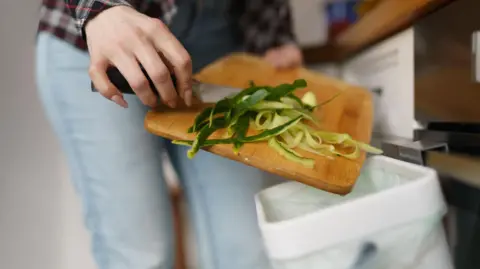 Gennadiy Kravchenko/Getty
Several councils in England are unable to offer weekly food waste collections yet
New rules requiring weekly food waste collections for all homes in England have come into force, but dozens of councils are still not ready to provide the service.
An earlier BBC investigation found 79 English councils - the equivalent of one in four - did not expect to meet the March 31 deadline.
Councils blamed the delay on demand for new specialist vehicles and funding issues, despite the Department for Environment, Food & Rural Affairs (Defra) giving out more than £340m in grants.
Defra said it would continue to work with local authority waste networks and the wider industry, providing targeted support to help address outstanding issues.
WRAP, a non-governmental climate action organisation, called the Simpler Recycling rules "the biggest shake-up in recycling policy in England in 20 years".
When recycled separately, food waste can be used to produce electricity. This reduces the amount of waste rotting in landfill and releasing greenhouse gases.
It is also hoped that making food waste collections available to all homes will encourage people to reduce how much food they waste in the first place.
What do the new recycling rules mean?
- Food and garden waste
- Paper and card - although depending on where you live, this can be grouped with other dry recyclables
- All other dry recyclable materials (glass, metal and plastic, including cartons)
- Residual waste - this is the rubbish that cannot be recycled and so is sent to landfill or for energy recovery
Roughly half of councils were not collecting food waste weekly before the creation of the new legislation, while some have had the collections in place for more than a decade.
This meant not all councils needed to make changes to meet the new rules, but the BBC approached each local authority responsible for waste collection to find out what was happening in their area.
At least 57 of the councils who told the BBC that they would miss the deadline aim to launch their service for all households by the end of 2026. More than a dozen could not give an approximate start date.
A further 31 councils had secured agreements allowing for a later start date for their weekly food collections, so will not be viewed as missing the deadline.
These transitional agreements allow them to delay the introduction, in some cases for more than a decade, because they are locked into existing contracts which would be too costly to change.
When those councils are factored in, more than a third of English councils will not be collecting food waste from all homes yet.
 Claire Shrewsbury/WRAP
Claire Shrewsbury says weekly food collections will create a "big win" when it comes to recycling unavoidable waste
Claire Shrewsbury, director of insights and innovation at WRAP said the new rules would mean that "wherever you are you'll have the same service at home, at work, and when out and about".
She said: "We're a nation of recyclers, but most households put two or more items in the rubbish each week that could be recycled - because of confusion.
"Food waste is where we'll see the big win. It's difficult to prevent all food waste and so recycling one kitchen caddy of unavoidable food waste could power your fridge for 18 hours, and a whole truck would keep that fridge cool for five years."
Ashley, a refuse worker in south-east England, is known to fans on social media as the No1 Binman.
He said maggots and flies were attracted to food left in general waste bins as they tended to be collected less often.
Recommending taking your food recycling bin out every week, he said lining a food caddy meant food waste was less likely to get congealed and sticky.
He said: "If you leave waste for a couple of days, it sticks to the bottom. Then you're the one having to scoop it out. Most councils allow you to use newspaper at the bottom of your food recycling."
Ashley said biodegradable bags could also help, adding that food recycling was for solids only, not for milk or sauces.
 The No1 Binman
Ashley enjoys sharing his experience of 13 years in the "bindustry"
Defra said if waste collection authorities did not comply with their statutory duties, they risked judicial review - but as independent bodies, councils were accountable to their electorate rather than ministers or government departments.
It said more than two thirds of councils were ready for the recycling changes to come into effect and they had been empowered to deliver services in the best way for their local communities.


