49 minutes ago
4
49 minutes ago
4

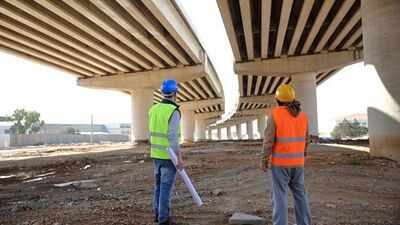
As the world grapples with mounting waste and rising carbon emissions, a bridge project in New York is offering an unusual example of how something destined for a landfill can be given a second life.
In June 2024, construction began on a $21.2 million project in the Village of Whitney Point, where New York is replacing an ageing bridge over the Tioughnioga River and incorporating recycled glass into concrete used for parts of the new infrastructure. The pilot project is expected to divert 106 tons of waste glass from local landfills and prevent more than 72 tons of carbon dioxide emissions.The project is part of a broader push towards a circular economy, in which materials traditionally treated as waste are recovered and reused rather than discarded.
Turning waste glass into a cement alternative
The idea behind the project comes from KLAW Industries, a New York-based company founded in 2019 by Binghamton University engineering students Jacob Kumpon and Jack Lamuraglia. The founders saw two problems that could potentially be addressed together: the enormous amount of glass entering the US waste stream and the carbon-intensive nature of cement production.The US produces an estimated 12 million tons of glass every year.
Of that, only about 3 million tons are recycled, leaving roughly 9 million tons of waste glass going to landfills annually. KLAW developed a technology that turns post-consumer glass into a fine powder that can partially replace conventional cement in concrete. The resulting material, called Pantheon, is designed to reduce the amount of cement required while maintaining or improving the concrete's strength.Rather than simply grinding glass and mixing it into concrete, KLAW's patented process removes unwanted materials from waste glass before producing Pantheon.
According to the US Environmental Protection Agency, the resulting material reacts with cement and creates additional crystal structures within the concrete, helping strengthen it. The approach tackles two waste problems at once. It gives discarded glass another use while reducing the quantity of cement needed in concrete.
From a college idea to a state infrastructure project
Kumpon and Lamuraglia began developing the technology after recognising the potential of combining recycled materials with lower-carbon construction.
KLAW later received support through the EPA's Small Business Innovation Research programme. Its first Phase I award was $100,000 and was used to establish proof of concept for a project titled “Prototyping a Process to Reuse Wasted Glass in High Performance Low Carbon Concrete.
”The company worked with Binghamton-based concrete producer Barney & Dickenson to test and demonstrate the technology. Following the initial research, KLAW received a Phase II award to further test and promote its cement alternative.The technology subsequently attracted attention in Binghamton, where Pantheon was adopted for municipal projects. After several successful local applications, KLAW was approached by the New York State Department of Transportation for a much larger project in Whitney Point.The U.S. Route 11 bridge project became a significant milestone for the company. According to the EPA, it is KLAW's largest single-location project and its first state-sponsored project.
A 77-year-old bridge gets a greener replacement
The project is replacing the existing U.S. Route 11 bridge over the Tioughnioga River, a three-span steel structure built in 1947. The bridge has been an important transportation link for the community, connecting people to businesses, recreational areas and community facilities. The route also provides access to Interstate 81 and state routes 26, 79 and 206. More than 11,000 vehicles travel through the project area on an average day.But the old structure was nearing the end of its service life and was also on New York State's High-Risk Flood Watch List. That designation meant it required round-the-clock monitoring whenever water levels reached a predetermined elevation.The replacement will use a multi-girder design intended to be less vulnerable to flooding. Once completed, the new structure is expected to be removed from the state's High-Risk Flood Watch List.The $21.2 million project includes more than the bridge. It also includes 1.5 miles of new ADA-compliant sidewalks along both sides of U.S. Route 11, stretching from Main Street to Keibel Road. New crosswalks are also being installed near Whitney Point Middle School and the Broome County Fairgrounds. Pantheon is being incorporated into concrete used for sidewalks, curbs and barriers on the new bridge, as well as the new sidewalks along U.S.
Route 11.
Why recycled glass matters
The construction industry is one of the biggest opportunities for reducing the environmental impact of materials. Cement, a key ingredient in concrete, is particularly carbon-intensive.By allowing concrete producers to use less cement, Pantheon can reduce emissions without adding additional cost, according to the EPA. At the same time, the process creates a market for post-consumer glass that might otherwise be buried in landfills.The Whitney Point project also comes as New York moves to implement its Buy Clean Concrete Guidelines, announced in 2023, which encourage lower-carbon concrete and consideration of emissions associated with construction materials.For KLAW, the project represents more than an experiment with recycled materials. Company COO Jacob Kumpon described it as a turning point that marked the business's transition out of its startup phase.
For New York, it is an opportunity to test whether waste-derived materials can become part of everyday public infrastructure.
From landfill waste to public infrastructure
The significance of the project lies in its simplicity: glass that could have remained waste is being transformed into a material that becomes part of a bridge, sidewalks and other infrastructure.The 106 tons of glass diverted by the project may be modest compared with the millions of tons discarded across the US each year.
But the pilot demonstrates how a material considered waste can be brought back into the production cycle.The new bridge is also being designed with resilience in mind, combining infrastructure upgrades with an attempt to lower the environmental footprint of construction. Work is expected to continue through late 2026. During construction, a temporary bridge has been built alongside the existing structure to accommodate pedestrians, bicycles and two-way vehicle traffic.