3 months ago
21
3 months ago
21

Makuochi OkaforBBC Africa, Lagos

 Anadolu via Getty Images
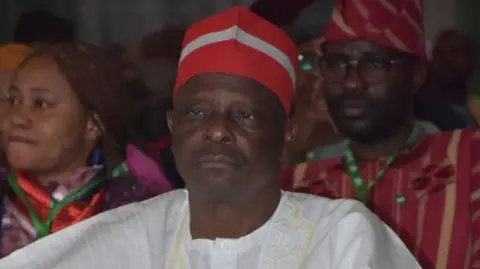
Rabiu Kwankwaso has a loyal army of supporters known as the Kwankwasiyya movement
The coalition poised to challenge Nigeria's president in next year's election has received a major boost after prominent opposition figure Rabiu Musa Kwankwaso announced that he was joining.
Kwankwaso, a former governor of Kano state, said on Monday he was now part of the African Democratic Congress (ADC) - a day after resigning from the New Nigeria People's Party (NNPP).
A number of opposition heavyweights have joined the emerging ADC coalition in an effort to unseat President Bola Tinubu's All Progressives Congress (APC), which has been in power since 2015.
Former Vice-President Atiku Abubakar and ex-state governor Peter Obi, two of Tinubu's biggest rivals, have become the face of the ADC.
Kwankwaso ran for president in 2023, finishing fourth. Abubakar and Obi came second and third respectively.
On Sunday, Kwankwaso announced he was not only stepping down as the NNPP's leader, but leaving the party altogether as "the current trajectory of the nation's political landscape" calls for "strategic realignment".
"I have found it necessary to identify with another political platform that offers the best opportunity to effectively change the nation," he said in a statement.
On Monday evening, he revealed that the "political platform" in question was the ADC.
The shake-up comes with less than a year to go until Nigeria's next general elections. The ruling party has endorsed President Tinubu to seek a second term in the January 2027 poll and he is widely expected to run.
The ADC has not yet picked a flagbearer.
Kwankwaso brings a fresh appeal to the coalition and he has a large support base in the mainly Muslim northern Nigeria, a key voting bloc in national elections.
His followers, known as the Kwankwasiyya movement, are recognised for their trademark red caps and have remained loyal to Kwankwaso through several party changes over the years.
With Nigeria facing significant security challenges, Kwankwaso's past experience as a defence minister provides the ADC with a rallying point ahead of the elections.
Speculation about Kwankwaso's move to the ADC had spread prior to the official announcement - hours before, hundreds of his supporters gathered outside the politician's house, waving ADC flags.
The former NNPP leader also shared photos of himself receiving senior ADC figures at his home in Kano.
Kwankwaso made headlines in February, when a bill put forward by Republican lawmakers in the US proposed he be sanctioned in connection with the alleged persecution of Christians in Nigeria.
Claims of a genocide against Nigeria's Christians have been circulating over the past year in some right-wing US circles - but this has been strongly denied by the government, which says violence affects members of all faiths, and none.
The NNPP staunchly condemned Kwankwaso's inclusion in the bill, saying the move was unfounded and that their leader had no links to religious extremism.
The ADC is bolstering its ranks at a time when Nigeria's two main opposition groups, the People's Democratic Party (PDP) and Labour Party (LP), are battling internal crises.
The PDP has been split into two rival factions, weakening its traditional position as the country's biggest opposition party.
Elsewhere, Nigeria's electoral commission has introduced reforms aimed at addressing concerns from the disputed 2023 vote.
Under the new rules, results from polling stations are to be transmitted electronically in real time.
However, opposition parties have raised concerns about provisions allowing votes to be sorted manually where internet access is unavailable, warning this could weaken transparency.
 Getty Images/BBC