4 weeks ago
28
4 weeks ago
28

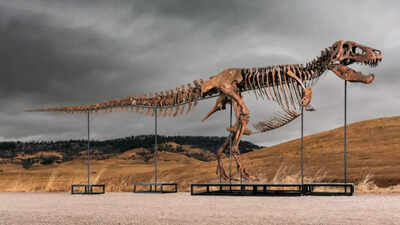
“Gus” the T. rex—discovered on a cattle ranch in South Dakota—goes up for auction this summer, July 14, 2026. (Credit: Matthew Sherman / Sotheby’s)
Owning one of the world's largest Tyrannosaurus rex skeletons could soon become a reality. But there is a huge "if" factor to it. The buyer must having and willing to spend between $20 million and $30 million.A massive T. rex fossil nicknamed "Gus" will go under the hammer at auction house Sotheby's in New York on 14 July. Measuring 38 feet (11.6 metres) long and nearly 12.5 feet (3.8 metres) tall, the specimen is among the largest and most complete T. rex skeletons ever discovered. Sotheby's has set the opening bid at $19 million, while the auction house estimates the final sale price could reach as high as $30 million.If achieved, it would be one of the highest prices ever paid for a dinosaur fossil at auction.
A giant hidden beneath a cattle ranch
The fossil is named after the late Gary "Gus" Licking, a cattle rancher from South Dakota who spent years finding small fossil fragments on his 6,500-acre property. Believing the scattered bones pointed to something much larger underground, he eventually proved to be right.Excavations began in 2021 when commercial palaeontology company Theropoda Expeditions started digging at the Harding County ranch. The work continued over three consecutive summers until 2023.
Licking died about a year after the excavation began and never saw the dinosaur fully uncovered. His widow, Dana Licking, has continued to follow the project as researchers completed the reconstruction.The finished skeleton consists of 183 fossilised bones and is around 63 per cent complete by bone count, making it one of the most complete T. rex specimens ever offered for public sale.
Years of painstaking work
Recovering Gus was only the beginning. After excavation, the fossil required years of cleaning, cataloguing, identification and assembly before it could stand as a reconstructed dinosaur.The entire project took nearly five years, including three years of excavation and research followed by another two years preparing the fossil for display.Thomas Heitkamp, president of Theropoda Expeditions, described the challenge of rebuilding the prehistoric predator."It really does feel like tackling the world's hardest puzzle, except we have to find all the pieces first," Heitkamp said.He added: "All those bones separated for 67 million years that we can now, almost magically, fit back together."The dinosaur once roamed North America during the Maastrichtian age between roughly 72 million and 66 million years ago.
Why Gus stands out
According to Sotheby's, Gus attracted attention because of its size, condition and level of preservation.Sotheby's Global Head of Science and Natural History Cassandra Hatton said it was "the completeness, the quality, the size, [and] the preservation" that made Gus stand out as a viable auction item.She also discussed about the specialised work involved in recovering dinosaur fossils."What I think is really important for people to understand, when we talk about dinosaur fossils, is that they don't come out of the ground complete," Hatton told Reuters.He added: "It takes highly specialized, careful, diligent, skilled people to recognize what they're looking at, to tell the difference between a piece of rock and a piece of this animal."The fossil's estimated value of $20 million to $30 million is the highest pre-sale estimate ever placed on a dinosaur skeleton. The record for the most expensive dinosaur sold at auction still belongs to the Stegosaurus skeleton known as Apex, which fetched $44 million at Sotheby's two years ago.
A growing market for dinosaur fossils
Auction houses have seen rising demand for rare dinosaur fossils from museums, private collectors and wealthy buyers around the world."The dinosaur market today is broader than most people realize and widening," Hatton, who also serves as Sotheby's vice chair, told Artnet. "Interest now comes not only from US-based museums and private collectors, but also major international museums, foundations, and individuals creating destinations of their own. What unites them isn't a single profile but a shared respect and curiosity for objects."Supporters of commercial fossil sales argue that private funding helps uncover specimens that might otherwise remain buried.For her part, Hatton told the Australian Financial Review, "These sales are super important because they are helping us find fossils that would otherwise be lost to everyone."
Debate over who should own the past
The growing commercial market for dinosaur fossils has also sparked concern among palaeontologists and museum experts.Some researchers argue that soaring auction prices make it difficult for public museums and scientific institutions to acquire important fossils. Others have warned that high-value sales could encourage fossil hoaxes or reduce opportunities for scientific study if major specimens disappear into private collections. Whether Gus ultimately becomes a museum centrepiece or joins a private collection will be decided when bidding begins on 14 July.