3 months ago
25
3 months ago
25

10 hours ago
Ken BanksNorth east Scotland reporter, Rothienorman, Aberdeenshire

 BBC
BBC
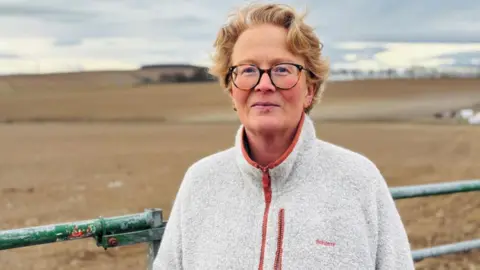
Marguerite Fleming has fears about the impact of the plans, the site of which is photographed behind her
When Marguerite Fleming and husband Frank Richards moved to Aberdeenshire, they were looking forward to escaping the city and embracing rural life.
Eleven years later they are facing the prospect of a major battery energy storage site on their doorstep in the countryside near Rothienorman.
Many of them are controversial and the Rothienorman project is no different - Marguerite and Frank are among residents who have opposed the plans, raising concerns such as fire safety and noise.
But experts say battery energy storage sites are vital to Scotland's transition from oil and gas to renewable energy.
The decision on the future of the Rothienorman plan is now with the Scottish government's energy consents unit (ECU).
The proposed Rothienorman facility will have a storage capacity of one gigawatt-hour (GWh) of energy, producing enough to power up to 500,000 homes for two hours.
If it is given the go-ahead by Scottish ministers, it will be constructed on a 16 hectare (40 acres) site, near a local sub station from which power can be taken.
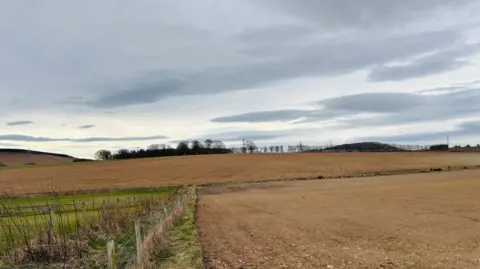
The facility would take up significant field space in the Rothienorman countryside
Marguerite, 56, and Frank, 60, moved to the area from Aberdeen in 2015.
They both have a background in geology and the oil and gas industry, and Marguerite now runs a wool business from home.
"We moved here to live a rural life on a smallholding with sheep and hens, just to have a life away from an urban setting - not to be living on an industrial estate," she told BBC Scotland News.
"This 500MW facility is pretty much facing where our house is.
"It's enormous, an entire field. You look at that field and go 'oh my God'. It will completely change the landscape for the people who live here.
"The objection is not just nimbyism, it's huge and out of place in this rural landscape."
Blackford Renewables, the developer of the Blackford Energy Park scheme, said it had sought the views of locals in a consultation before drawing up the plans.
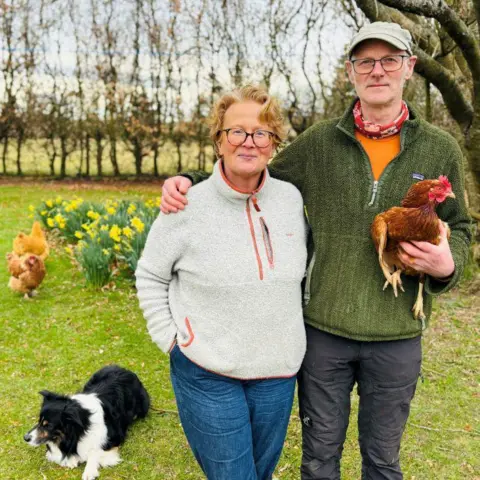
Marguerite and Frank have chickens, sheep and dogs
She explained: "Our biggest concern is fire, what that might do in terms of where we live, would we be able to get away from our house in time if there was a fire?
"We appreciate that the risks for a fire are low, but there is a risk there, and it's a very scary prospect. It's terrifying for people who live here."
Frank added: "How people would escape in the event of a fire needs to be addressed. It has fallen through the gaps so we hope the ECU looks at that.
"We have to have faith they will make a fair decision.
"It's not just we do not want this next to us, it's way beyond that. Never in our wildest dreams did we think something of this size could be next to us."
The developer said it was committed to the "highest safety standards".

Our electricity infrastructure is changing massively and large-scale batteries, like the one proposed near Rothienorman, are a vital part of that shift.
Fossil fuels are on their way out, replaced with wind and solar which run at the mercy of the elements and so consideration has to be given to what happens on those still, cloudy days.
Spreading generation around the country helps because while it might be calm in one area, it can be blowing a hoolie in another.
But being able to store energy is vital to balance supply and demand on the electricity grid, and Blackford could be seen as an ideal location because there's already a large substation from which the power can be taken and stored when supply is plentiful.
The community battles against them are being replicated across the country and with the grid operator saying battery storage needs to expand four-fold by 2030, there will be many more fights ahead.

Elaine Bryson, 65, is a community councillor and chairwoman of Rothienorman Community Association.
"People are frightened and angry, and the icing on the cake is the village does not really benefit," she said.
"Maybe B&Bs and shops [while it is being built], but that is temporary."
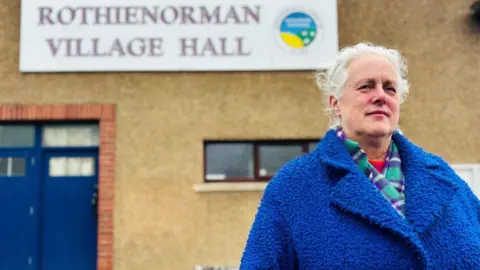
Elaine Bryson said Rothienorman itself would not really benefit from the project
She said because of the scale of what is planned she had not heard anyone coming out very much in favour of it.
"You cannot put on a rural village this scale of industrialisation," she said.
"I would imagine some people in the village do not even know, information is fragmented.
"People are having their futures demolished. They are trapped. There is shock and anger and fear for what it means for the community."
A spokesperson for the developer said it had designed the project to minimise visual impact and reduce noise.
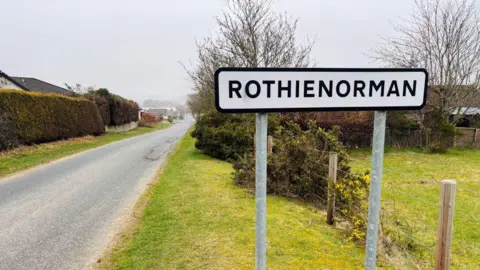
The plans are in the countryside in the Rothienorman area
Katie and Neil Sime moved to their home near the site of the project in 2013.
They now have children aged nine and 11.
"It's not about 'we hate renewable energy', it has its place," Katie, 46, said.
"We also understand that farmers need to diversify.
"But you cannot have an area so small and rural have a 500MW field of containers.
"This is not an industrial environment. There is also a road safety issue due to increased traffic.
"We are entitled to fight this."
Another nearby resident, who asked not to be named, said: "We moved here because we love this area.
"It will be an absolute eyesore. My house will be virtually worthless."
A spokesperson for Blackford Energy Park said battery energy storage systems "contribute to energy security, and, importantly, help to create a more efficient, resilient, and affordable energy system."
They added: "We have actively sought feedback from the local community and stakeholders throughout public consultation to help shape and inform the proposals.
"Our design specifically takes advantage of the site's natural topography to minimise visual impact, and we have carefully selected the proposed equipment to reduce noise impact."
The statement continued: "We take local concerns about fire safety very seriously, and we are committed to maintaining the highest safety standards through the use of advanced technology, fire safety systems and close coordination with emergency services."
Aberdeenshire Council - a formal consultee - responded to the ECU with an objection, unless various conditions are met to "secure appropriate environmental controls".
A Scottish government spokesperson said: "As this is a live planning application, it would not be appropriate to comment."