11 hours ago
5
11 hours ago
5

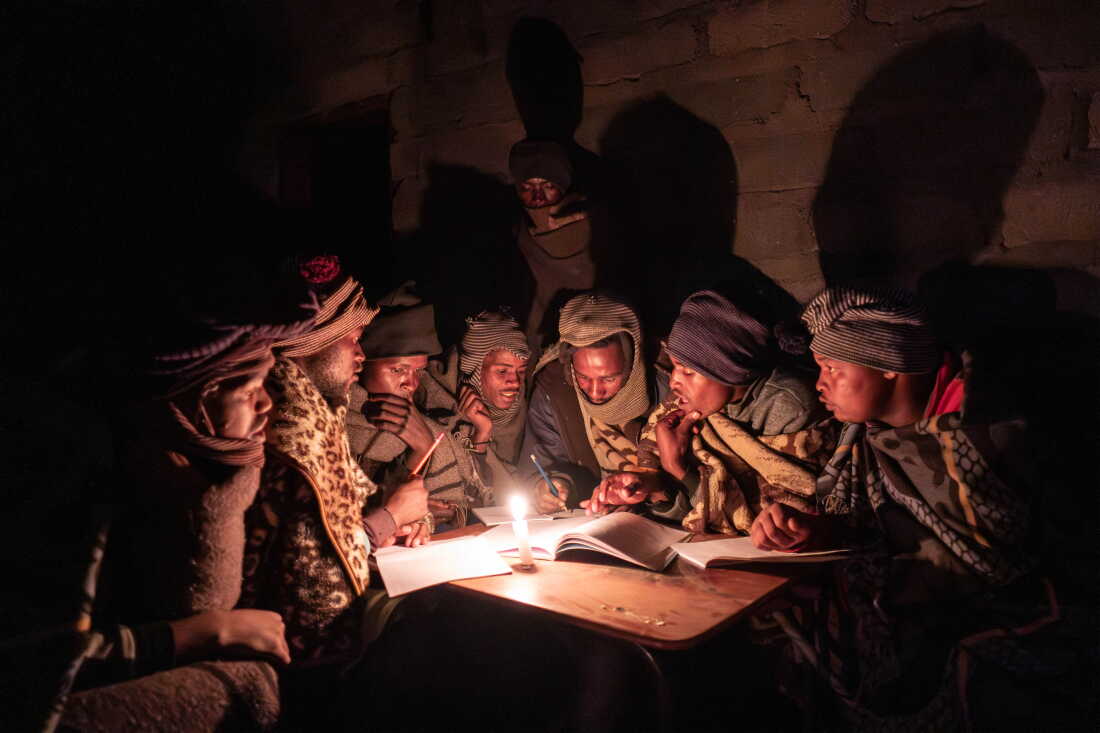
Shepherds attend a part-time night school near Mokhotlong, Lesotho. For many, these classes are the only form of education they can access. Tommy Trenchard for NPR hide caption
toggle caption
Tommy Trenchard for NPR
The sun has already started setting behind the towering peaks of central Lesotho when Kabelo Mohai and Lepeli Maapesa begin their long walk to school.
Wool blankets draped over their shoulders against the biting cold, the two young men scramble down rocky paths nearly 8,000 feet above sea level. Far below, scattered rural villages appear as tiny dots. The moon is high in the sky, an hour and a half later, when they finally spot the lights of the small town of Semonkong in the distance.
In the pitch darkness, dozens of similar blanket-clad silhouettes make their way down the mountainsides, singing and chatting excitedly as they approach a building illuminated by fluorescent lights: the Good Shepherd School, where more than 40 herders gather every evening for night classes.
Mohai and Lepeli are among tens of thousands of boys and young men working as shepherds in this small, mountainous southern African country. Livestock is deeply woven into Lesotho's economy and culture: Wool and mohair account for nearly 60% of agricultural exports and support a quarter of the rural population. Driven by poverty and tradition, school-aged boys are often called to tend the flocks, spending months at a time herding alone in the mountains, cut off from society. A World Bank analysis of 2018 data found that nearly half of all boys in the country were engaged in some form of herding. For many, like Mohai, the work comes at the expense of schooling.
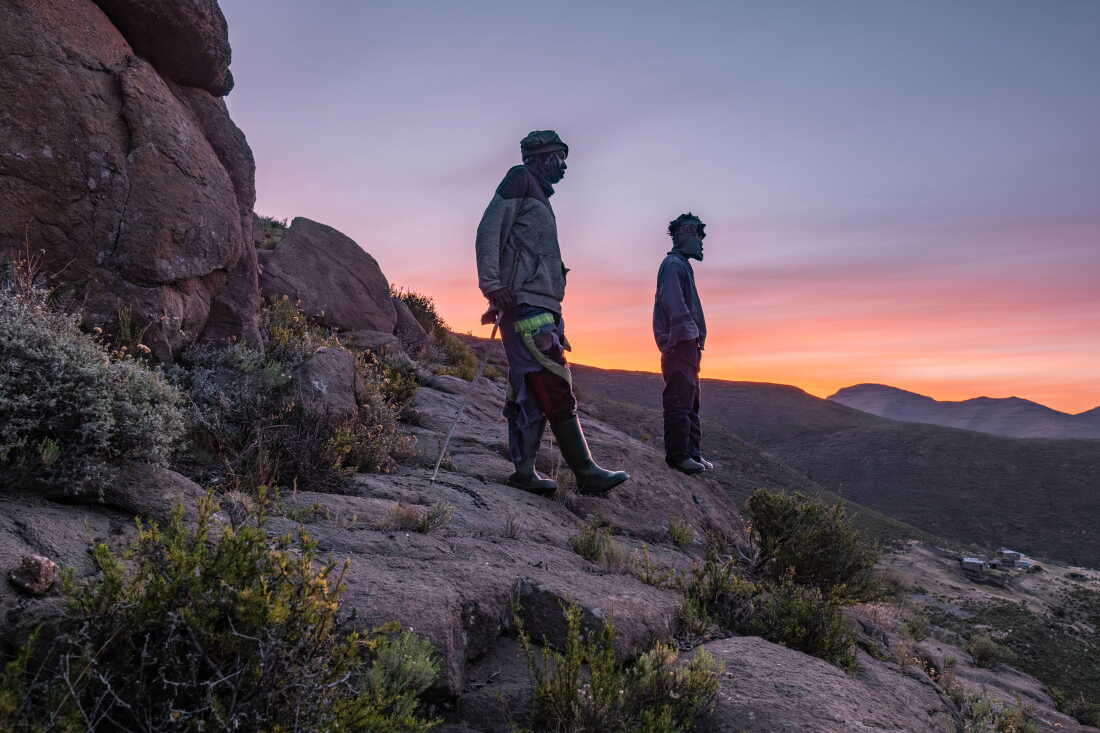
Shepherds Lapeli Maapesa and Kabelo Mohai take a break while trekking down from their cattle posts in the mountains to attend class at the Good Shepherd night school in Semonkong, Lesotho. Some shepherds walk as long as two hours to attend their night classes. Tommy Trenchard for NPR hide caption
toggle caption
Tommy Trenchard for NPR
"I started working with animals when I was 9. I only finished primary school," says the now 20-year-old, his youthful face peeking out from under a ski mask patched with colorful threads. His companion, Lepeli, is 23.
A second chance
To give these "herd boys" a second chance at education, dozens of dedicated schools have emerged across the country. Mostly run by volunteers on shoestring budgets, they hold classes at night, once the flocks have been safely brought into their pens. The teaching is often basic — reading, writing, counting. And the schools constantly struggle financially to keep their doors open. Yet for many, they offer the only chance to dream of a different future.
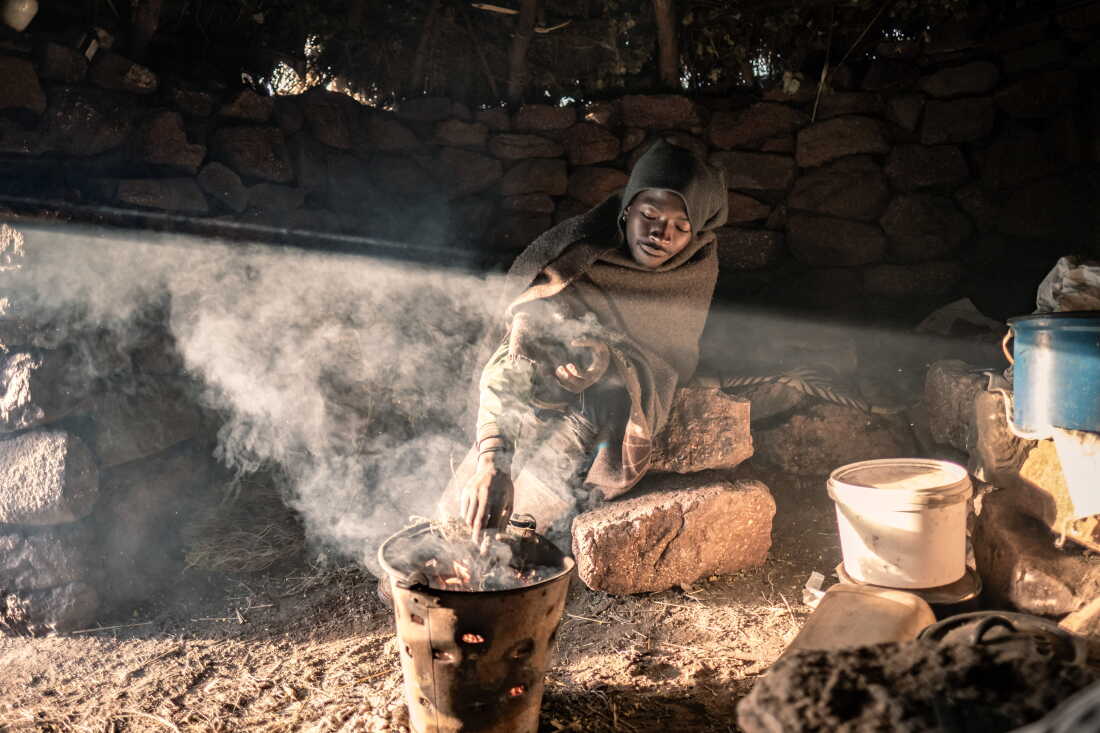
Khotso Rants'etile, 22, who has been working as a herder since the age of nine, prepares breakfast in his isolated cattle post in the mountains of Mokhotlong District, Lesotho. Tommy Trenchard for NPR hide caption
toggle caption
Tommy Trenchard for NPR
At 15, when he started herding full-time, Mohai moved into a cattle post — a makeshift hut high up in the mountains — to live alongside his family's flock of 155 sheep and goats.
Inside the shelter he built from rocks and branches, a water can and a cast-iron pot sit beside a rudimentary bed made of flat-surfaced stones and covered with a thin blanket. A few shirts and bags hang on sticks protruding from the thatched roof. Other young herders live in similar huts scattered across the mountainside, but most days, Mohai's main companion is his dog Balireng — meaning "enemy" in Sesotho.
"It's very nice most of the time, being up here among the animals. Nobody can tell me what to do," the young man says with a smile. But life in the mountains is challenging even at the best of times. The tiny nation of Lesotho is the only country in the world to lie entirely more than 1,000 meters (3,281 feet) above sea level, earning it the nickname "Kingdom in the Sky." Heavy snow is common in winter, and summers can be scorching.
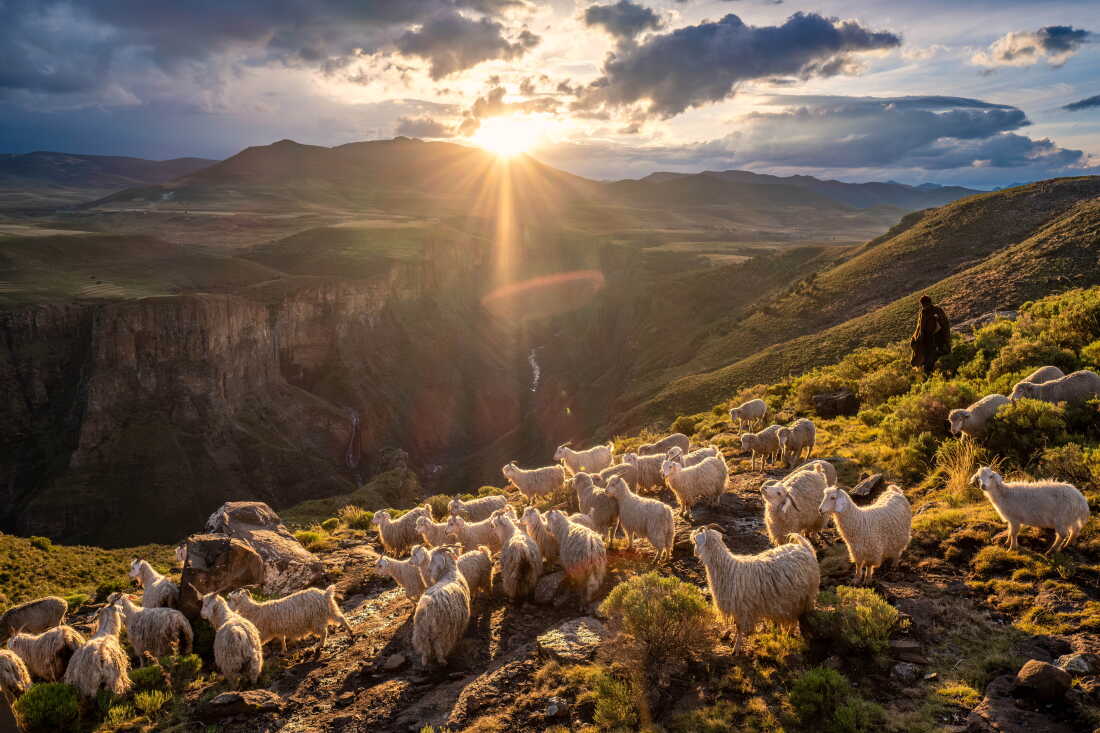
Shepherd Mokoto Masotsa watches over his flock on the edge of a gorge near Semonkong, Lesotho. Like many in Lesotho, Masotsa started herding as a young child and was never able to attend school. It's estimated that around a third of the country's school-age boys are working as shepherds at any one time, often spending months at a time away from their families living in isolated cattle posts in the mountains. Tommy Trenchard for NPR hide caption
toggle caption
Tommy Trenchard for NPR
"Day or night, raining or hot, we have to look after the animals. And sometimes, it's not good not to socialize," admits Mohai.
So when he heard about the Good Shepherd Night School three years ago, he seized the chance to return to the classroom. Now, every weekday after a long day of herding, he makes the trek down the mountain to attend his Grade 7 class before clambering back up to his hut a few hours later.
"It's very important for us to have some knowledge and learn," he says. One day, he dreams of becoming a soldier. "I go to school so I can keep my ability to read and write. Maybe, in the future, I can be hired somewhere."
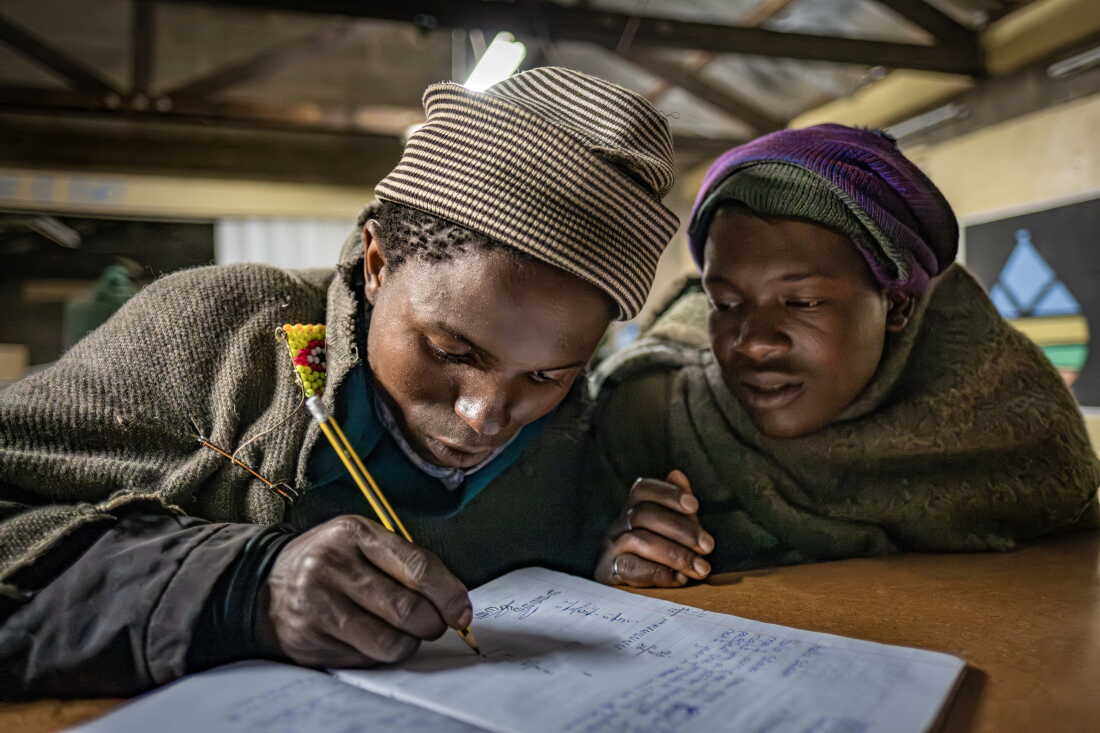
Shepherds Lepeli Maapesa, 23, (left) and Phakiso Phomane, 22, study at the Good Shepherd night school in Semonkong, Lesotho. Maapesa and Phomane both dropped out of formal schooling at a young age when they began working as herders. The Good Shepherd school is one of many night schools around the country striving to provide a basic education to the tens of thousands of shepherd boys and men who missed out on their schooling. Tommy Trenchard for NPR hide caption
toggle caption
Tommy Trenchard for NPR
By 8 p.m., the dimly lit classroom of the Good Shepherd Night School is crowded. Mohai and Lepeli have settled at a desk in the corner shared with two other students. Two dozen boys line the long tables, all dressed in the traditional attire of patterned blankets, hats and rubber boots. They read aloud as their teacher, Sister Rosemary Mokebe, writes math equations on the blackboard.
'They are sitting in the dark'
The night school was founded in 2003 on the grounds of a convent belonging to the Good Shepherd Sisters of Quebec congregation. "We discovered that most boys in Semonkong could not read or write," recalls Mokebe, a 55-year-old nun who runs the school and teaches grades 6 and 7. Classes run for a couple of hours every weeknight and have more than 40 students, ranging in age from 15 to 55 and divided into three levels.
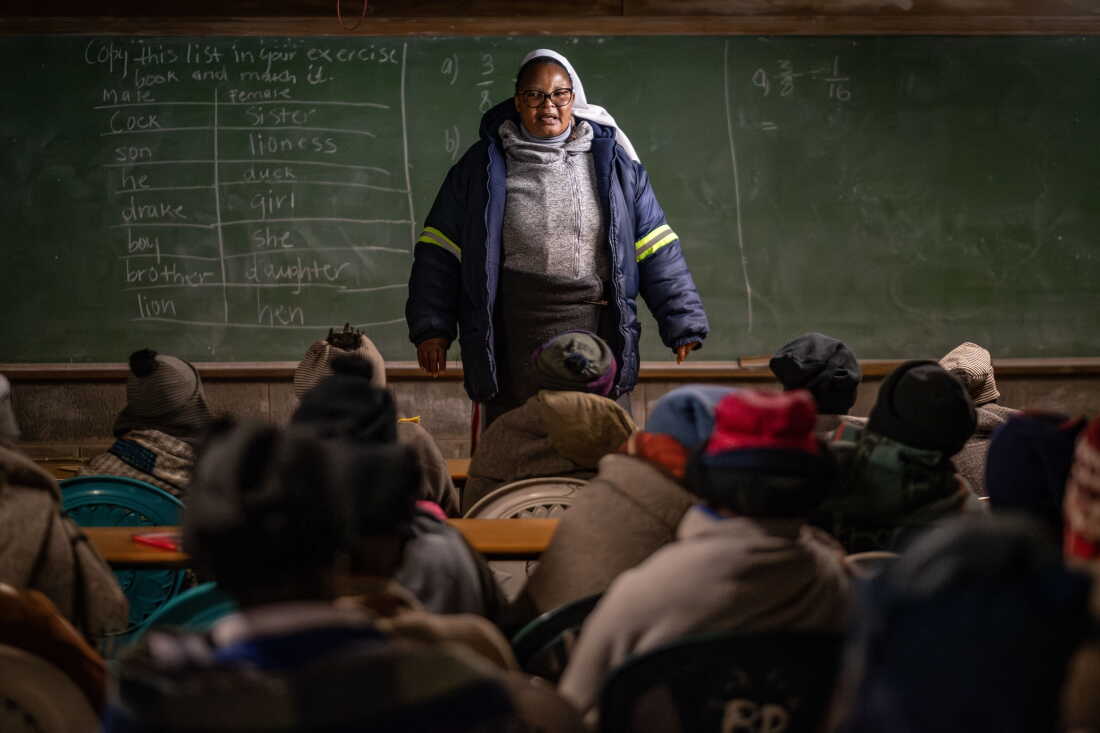
Sister Rosemary Mokebe teaches students at the Good Shepherd night school in Semonkong, Lesotho. Tommy Trenchard for NPR hide caption
toggle caption
Tommy Trenchard for NPR
"Shepherds are very important to our country. The economy rests on their shoulders," Sister Mokebe says. Without the school, "they are sitting in the dark, because they may never know how to read and write," she adds.
Lesotho's government estimates there are about 155 such schools nationwide. They were originally supported by various nongovernmental groups, but in recent years the Ministry of Education has slowly taken over, seeking to formalize the volunteer-run classes and provide stipends to rural educators. The process has been hampered by delays and bureaucratic hurdles. When we visited in May, the educators' annual contracts were yet to be renewed — and that it still the case. The government's Non-Formal Education Department, which is responsible for overseeing the night schools, did not respond to NPR's requests for comment.
In Semonkong, the convent has kept the classes going for more than two decades. From the other side of the classroom rises a low hum of voices reciting the alphabet. Sister Patricia Neko stands in front of a mix of young boys and weathered adult men, teaching today the first grade of primary school.
Motlatsi Monoana furrows his brow as he tries unsuccessfully to decipher the large letters on the blackboard. In his mid-40s — he does not know his exact age — he had never been to school until this year.
"My parents refused to send me because they needed someone to look after the animals," he says in a pained voice.
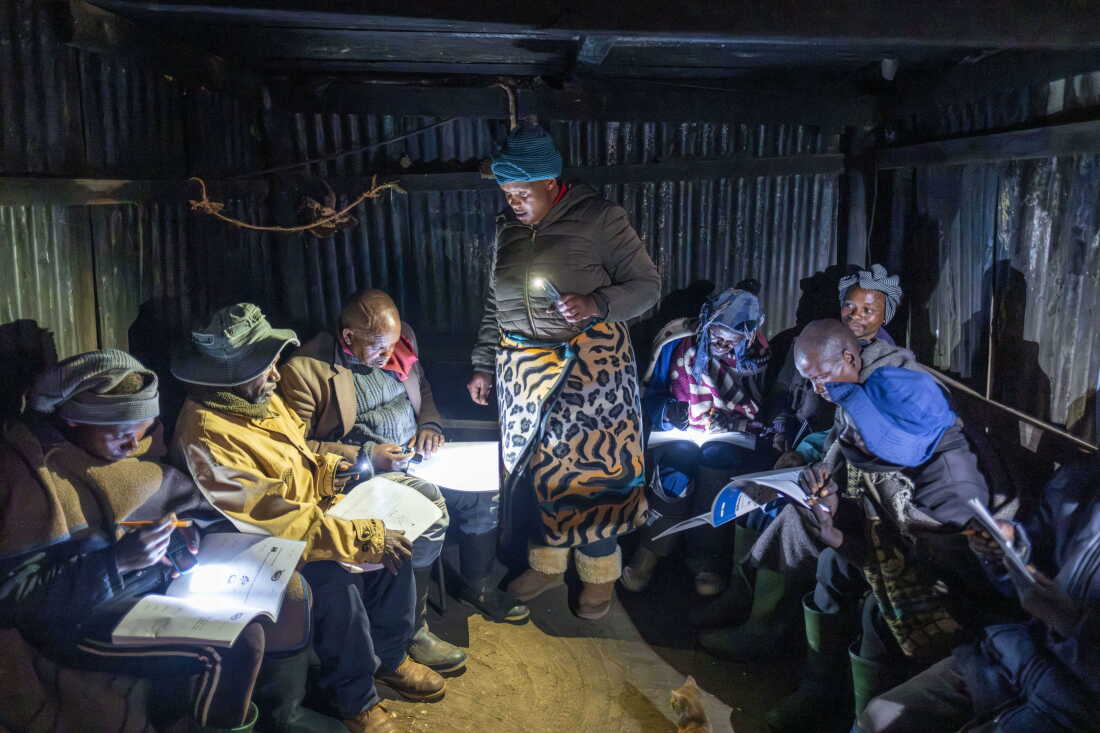
Mampho Makha teaches students at a rudimentary night school in the village of Ha Ntsokoane in Thaba Tseka, Lesotho. Many of the students are shepherds who missed out on formal schooling during childhood. The school operates on a shoestring budget and lacks electricity, so students study by the light of their phones. Tommy Trenchard for NPR hide caption
toggle caption
Tommy Trenchard for NPR
Unable to count either his animals or his money, he says he is regularly cheated by employers and cannot read the contracts he signs. Over the decades, he has developed a chronic fainting condition that puts his life at risk when he is working in the mountains.
The night school has given him hope that he might eventually find employment outside herding. But learning the basics of reading and counting, he says, "is difficult at an old age."
Hunched over a textbook in a corner, 18-year-old Ketso Mokoena has managed to escape that fate. He started herding part-time at 11 and dropped out of school a few years later, after his parents could not afford to send him to formal high school. "It was very difficult. Students bullied me, saying that I'm a shepherd and uncultured," he recalls, wrapped in a blue blanket and wearing a striped balaclava.
But Mokoena kept attending night classes at the shepherds school, determined to continue his education. Eventually, the nuns pooled their money to pay his high school fees. Now in Grade 11 at a government-sponsored school, he is studying for his mid-year exams the next day. "I like chemistry and physics," he says in fluent English. "I hope to become a pharmacist."
Lessons beyond learning
Mokoena's story is a rarity. For most shepherds, the basic evening lessons are unlikely to lead to a high school diploma. According to UNICEF, only 69% of boys in Lesotho complete primary school, compared to 92% of girls. Only 22% of boys go on to secondary education, leaving the country with one of the world's highest ratios of 1.6 girls for every boy in high school. Yet these schools provide something beyond learning: a rare opportunity for these isolated boys to socialize and reconnect with society.
"School doesn't only provide an education, it's also an environment for a child to grow by mixing with other children. And that's what shepherds miss," explains Lisemelo Mosakeng, the former head of the Lesotho Association for Non-Formal Education (LANFE), an organization supporting education outside of the formal school system.
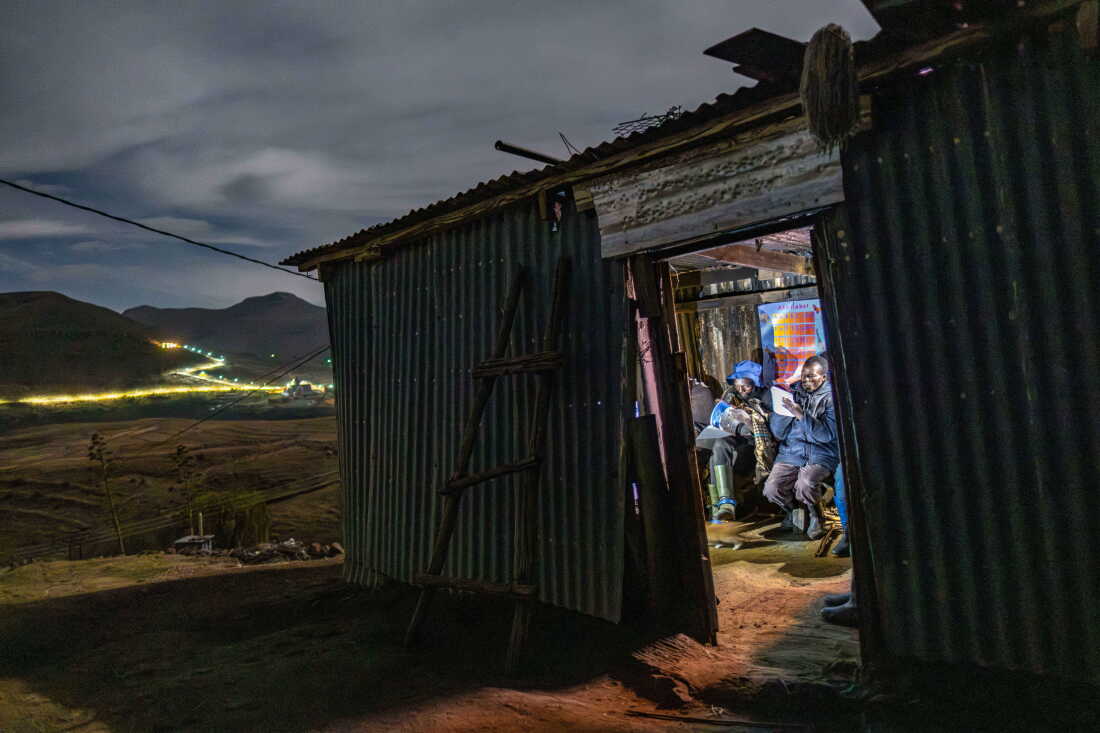
Class is in session at a night school in the village of Ha Ntsokoane in Thaba Tseka, Lesotho. Tommy Trenchard for NPR hide caption
toggle caption
Tommy Trenchard for NPR
"Most shepherds will tell you about the loneliness of the job," explains Mosakeng. "Due to the lack of social skills, they can't handle relationships. They don't know how to solve issues amicably and often resort to violence. This is a direct outcome of not allowing children to go to school."
The night classes offer a way to reach boys who are otherwise cut off from society. In Semonkong, the nuns regularly host social workers and provide health programs to raise awareness about widespread issues like HIV and tuberculosis, Sister Mokebe explains.
"As they grow, these boys should know the good from the bad," she says. "They should also have wishes and dreams, like any other child, and not only be destined to herd for the rest of their lives."
Nearly 150 miles away, in the rural Thaba-Tseka district, teacher Mampho Makha knows the pain of illiteracy all too well. On a cold Thursday evening, the 42-year-old mother of two welcomes her students into a tiny tin shack perched on the edge of a steep escarpment.
Makha founded the school in 2003, working on her own on a volunteer basis. She was inspired to do so after teaching her own father to read, following an incident that left a lasting impression on her. When she was 18, her father — an illiterate farmer and village chief — refused to sign an affidavit he could not decipher.
"The magistrate said he was not complying with the instructions of the judge, and he was jailed for a night," she recalls. "It made me so angry I decided to teach him to read and write. And I did. That's where my love of teaching started."
A dedicated teacher
Makha now teaches 35 students — shepherds, farmers, housewives and others who never had the chance to learn — at two night schools in nearby villages.
"Some can't even say how many animals they have. They can't count their money or read instructions on their medicines. It's important for them to know how to read and write, so they can live as independent people," she says.
After receiving a government stipend for several years, she is once again working as a volunteer, waiting for her contract to be renewed. "It is important for me to carry on with this work, because I want everyone here to be able to read and write," she says with a shrug.
As night falls, the small shack fills with a dozen students. Colorful alphabet posters with images of animals hang on the walls. A few young children toddle around while their parents squint at notebooks under the dim glow of their mobile phones.
A tiger-patterned blanket wrapped around her waist, Makha hovers from one student to the next, coaxing them through their exercises. After an hour, as the cold seeps in, the class breaks up. One by one, the villagers return home and the shepherds' silhouettes disappear toward their mountain huts.
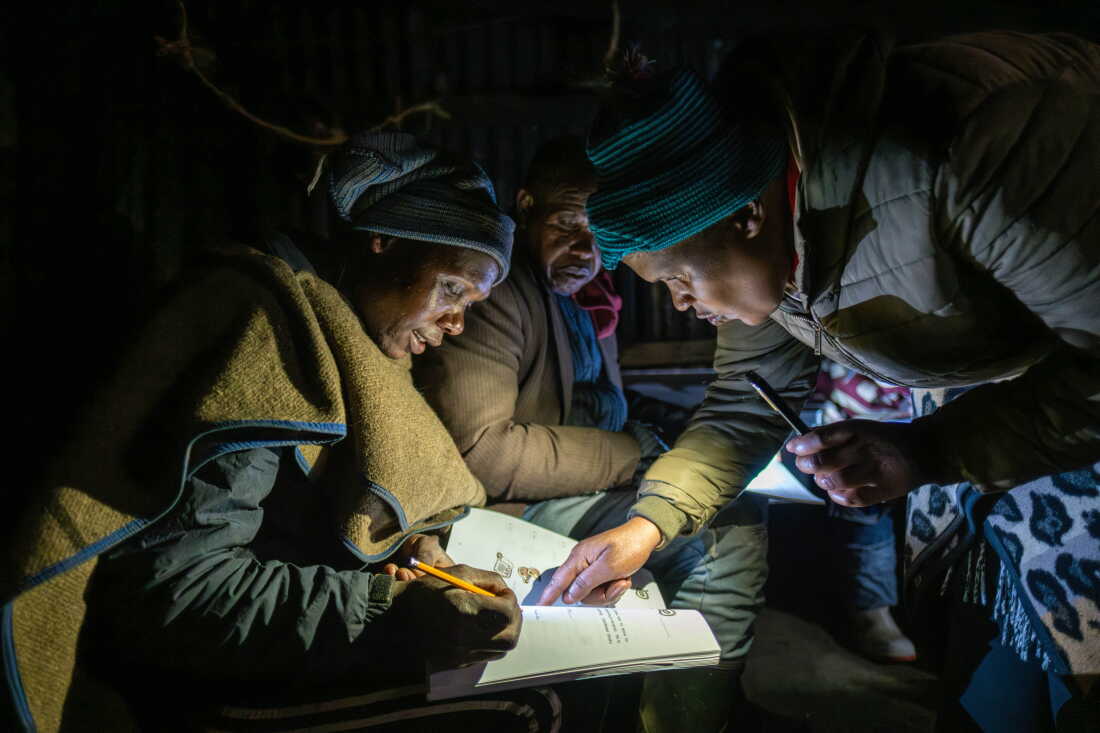
Teacher Mampho Makha assists a student at a shepherd night school in the village of Ha Ntsokoane in Thaba Tseka, Lesotho. Tommy Trenchard for NPR hide caption
toggle caption
Tommy Trenchard for NPR
Makha gathers her things and sets off down the rocky path under the stars. With a flashlight in hand to light the way, she faces an hour-long walk home. Tomorrow, she will do it all again.
Julie Bourdin is a freelance journalist based in South Africa. She covers human rights and climate-related stories across Africa and Europe. She's trudged through abandoned mines, dived in Cape Town's icy waters and flown over Lesotho's mountain Kingdom.
Tommy Trenchard is an independent photojournalist based in Cape Town, South Africa. He has previously contributed photos and stories to NPR on the Mozambique cyclone of 2019, Indonesian death rituals and illegal miners in abandoned South African diamond mines and won a World Press Photo prize for the images in his story for NPR on clashes between elephants and people in Zambia.
For stories about life in our changing world, subscribe to NPR's Global Health newsletter.