1 hour ago
2
1 hour ago
2

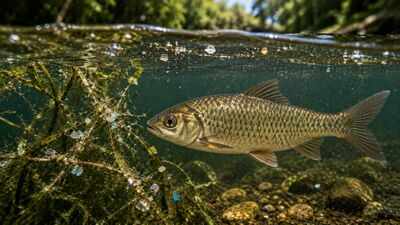
The Amazon’s fish live in water that can change dramatically with the seasons. In some places, oxygen levels fall so low that ordinary gill breathing is not enough. Several Amazonian species have adapted by taking oxygen from the air or by breathing at the water’s surface.
That unusual ability is now being considered alongside another feature of the modern Amazon: plastic pollution. Three studies point to different parts of the same problem. Plastic has been found in the gills and digestive tracts of small stream fish, plants along the Amazon River can trap plastic particles, and a recent review suggests that fish adapted to breathe air may have particular vulnerabilities when microplastics are present.
How Amazon fish ingest plastic through food and water
A study published in ScienceDirect, titled ‘Contamination of stream fish by plastic waste in the Brazilian Amazon’, examined 68 fish representing 14 species from 12 small streams in the eastern Brazilian Amazon. The researchers looked not just at what the fish had swallowed, but also at material attached to their gills. The distinction matters because the gills are in constant contact with the surrounding water. The results were unusually widespread. Plastic was present in 98 per cent of the fish examined, while 87 per cent of their digestive tracts contained plastic, with individual tracts holding between zero and 12 pieces.
The researchers also found that the amount and location of plastic differed between species. Crenicichla regani and Pimelodella gerii, for example, had more plastic attached to their gills than several other species.The material was not all the same. Fibres were the most common form overall, while the smallest particles, including microplastics and nanoplastics, were especially likely to adhere to gills. The study described the pattern simply: “The smaller the particle, the easier it is to adhere to the gills.”
That gives plastic pollution two possible routes into a fish. It can be swallowed directly or enter through food and detritus carrying plastic particles.
At the same time, water continuously passes across the gills, allowing small particles to become attached there. The study was also careful not to treat every species as equally vulnerable. Differences in feeding behaviour, habitat and body structure appeared to matter.
Floating plants can hold plastic in different parts of the Amazon River
The plastic does not simply drift downstream and disappear. A study published in Springer Nature, titled ‘The retention of plastic particles by macrophytes in the Amazon River, Brazil’, examined aquatic plants, known as macrophytes, in an urbanised section of the Amazon River in Brazil. The researchers sampled 77 quadrats across 23 plant banks during both the dry season, in September 2020, and the rainy season, in June 2021.Five plant species were recorded. Paspalum repens accounted for the largest share of accumulated plastic during the dry season, while Pontederia rotundifolia was dominant during the rainy season.
Plastic accumulation was particularly high in those two species, which together accounted for most of the particles recorded in the vegetation.Microplastics appeared in roughly three-quarters of the samples in both seasons: 75.98 per cent during the dry period and 74.03 per cent during the rainy period. Upstream plant banks retained more plastic than those farther downstream. The particles were often white or blue fragments measuring between 1 and 5 millimetres, while laboratory identification linked different pieces to polypropylene, polyethene and polystyrene.
This creates a more complicated picture of how plastic moves through a river. Floating vegetation can act as a temporary trap, gathering particles from the water rather than allowing all of them to continue travelling with the current. Fish moving through or feeding around these habitats may therefore encounter plastic in places where food, shelter and vegetation are already concentrated. The study describes this as the first evidence of plastic particles being retained by macrophytes in the Amazon.
It does not establish that the plants themselves are causing fish to ingest more plastic, but it does show that vegetation can form another part of the river’s plastic-pollution pathway.
Why plastic pollution may be a concern for Arapaima gigas
According to the study published in the Annals of the Brazilian Academy of Sciences, titled ‘Perspectives on the impact of microplastics (MPs) on fish of the Amazon that exhibit air-breathing and aquatic surface respiration ’, many species encounter periods of low dissolved oxygen and high carbon dioxide. Some have consequently developed air-breathing organs or the ability to take oxygen from the surface.Species including Arapaima gigas, the pirarucu, are considered in terms of how their specialised respiratory systems might interact with microplastic pollution. It is important to distinguish this paper from the stream-fish study: it is a prospective review, not a new experiment measuring microplastic exposure in air-breathing Amazonian fish. The authors themselves say that there is currently very little direct information on the effects of microplastics in these particular fish.
The concern comes partly from the structure of their gills. Air-breathing fish generally have smaller gills than closely related species that rely entirely on water for respiration. In pirarucu, for example, the gills become substantially reduced as the fish develops its specialised air-breathing organ. Microplastics can adhere to gill tissue and cause clogging or physical damage in fish, so the authors argue that this could be especially significant in species whose gills are already highly specialised.And breathing air does not mean the gills become irrelevant. They continue to contribute to gas exchange and remain involved in regulating salts, acid-base balance and nitrogenous waste. The review therefore raises the possibility that plastic particles affecting the gills could interfere with several physiological functions at once. The digestive system raises another question. Some Amazonian fish can use parts of the gut for air breathing, particularly species that live under conditions where oxygen in the water is scarce.
The review notes that microplastics can be swallowed either directly or after becoming associated with prey and detritus. In ordinary water-breathing fish, there is evidence that microplastic ingestion can affect the gut, although whether particles cross the gut barrier appears to depend on factors including their surface chemistry.
Plastic has been found in Amazon fish, gills and digestive tracts
Taken together, the studies do not show that every Amazonian fish is being harmed by plastic, nor do they establish the same effects for every species.
They show something more basic: plastic is present across several parts of the aquatic environment, and fish encounter it through different routes.The stream-fish research provides direct evidence of plastic in gills and digestive tracts. The macrophyte study shows that river vegetation can retain plastic particles, creating areas where fish may encounter them. Fish that have evolved to breathe air or use the water surface are stressed, although it is stressed that direct research on these species remains scarce.The strongest evidence among the three studies is observational evidence of contamination in fish and vegetation. The potential consequences for Amazonian air-breathing fish are, at this stage, largely a research question rather than an established outcome. The review explicitly describes its conclusions as perspectives intended to encourage further investigation. It has been detected in small headwater-stream fish, attached to gills, inside digestive tracts and retained among aquatic plants.
For species whose survival depends on finely adapted respiratory systems, that adds another environmental pressure to habitats already shaped by fluctuations in oxygen and carbon dioxide.