
 2 months ago
36
2 months ago
36

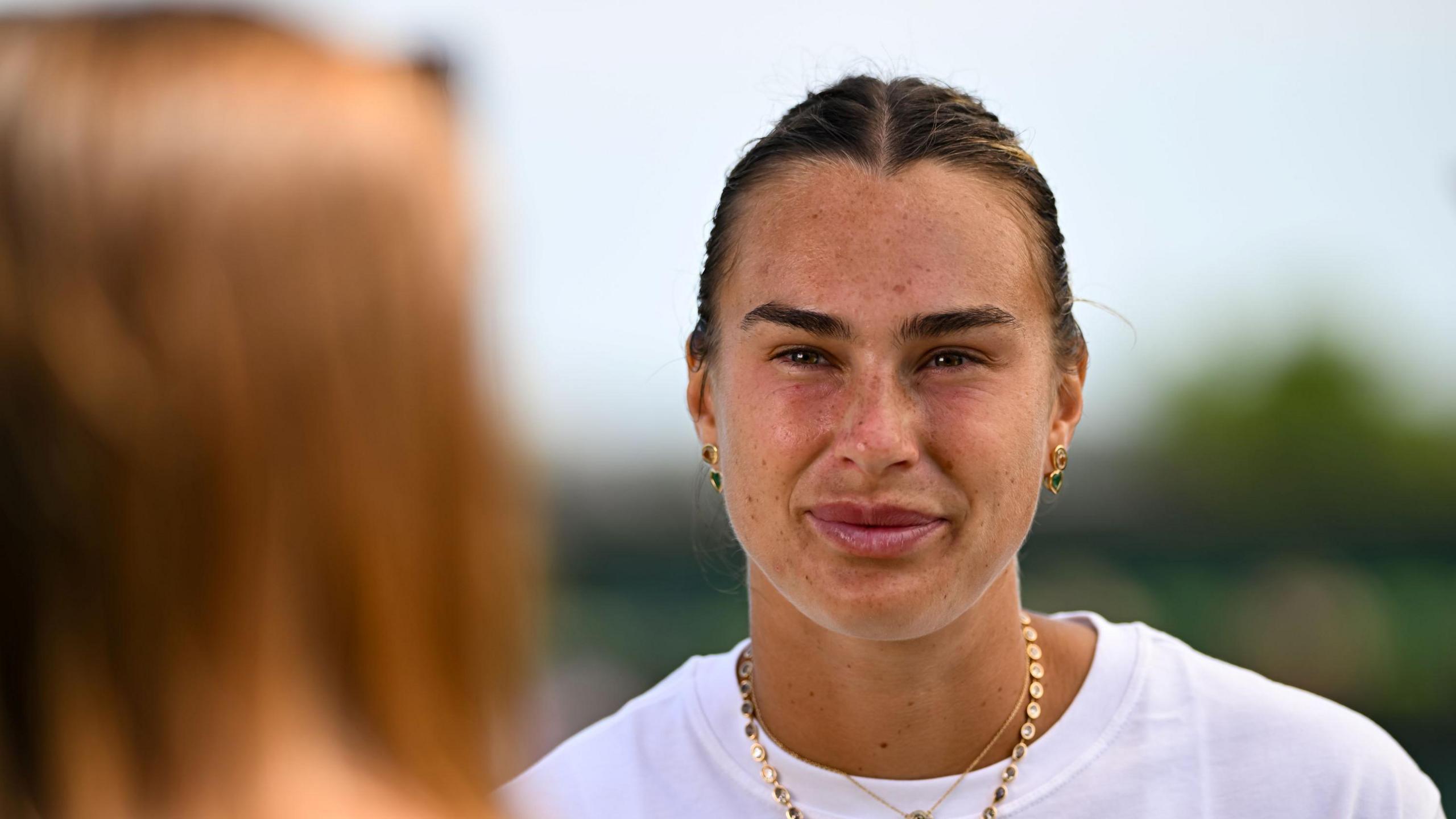 Image source, Getty Images
Aryna Sabalenka was among the leading players protesting
By
BBC Sport tennis news reporter at Wimbledon
The world's leading players have ended their boycott of Wimbledon media duties after "constructive meetings" with the All England Club.
World number ones Aryna Sabalenka and Jannik Sinner were among the stars who limited their media appearances to 15 minutes on Saturday and Sunday in protest at the amount of prize money on offer at the Grand Slams.
The group, which also includes major champions Coco Gauff and Iga Swiatek, want the Grand Slams to put a greater share of their revenue towards prize money, as well as an increased contribution to welfare benefits such as pensions and maternity leave.
The action was supposed to take place over the entire first week of the Championships.
But the players' representatives said they have decided to resume their full commitments immediately, given the positive nature of talks with Wimbledon organisers.
However, they still want the four Grand Slams to take further action.
"This decision is based on Wimbledon's commitment to return with specific proposals addressing all three points of the players' submission," a statement issued on behalf of the players read.
"The underlying matters remain unresolved and players will carefully evaluate the proposals once received.
"Players will also be providing Wimbledon with further information they have requested in connection with those proposals during the course of the tournament.
"Constructive dialogue with Wimbledon and the other Grand Slams will continue."
The 15-minute limit on media appearances was meant to symbolise the 15% of revenue which - broadly speaking - the Grand Slams allocate to prize money.
The players are asking each Grand Slam to provide a 16% slice of their revenue in prize money - with that figure increasing to 22% by 2030.
Wimbledon has already increased its overall prize money by 20% this year - the largest annual increase in the event's history - to a total prize fund of £64.2m.
Organisers believe Wimbledon's increased contribution is more than fair and also point to the money spent on improving player facilities at the All England Club.
On Saturday, Sabalenka said she hoped the world's leading players will not have to "boycott" their Grand Slam media duties again after Wimbledon.
But there were signs that not all of the players were sticking to their time limit - and some decided to break rank because they were happy with Wimbledon's offer.
"I hope we're not going to get to this boycotting again," said Sabalenka.
"We do it for the tour, we don't do it for ourselves. We do it for the rest of the players who are suffering to even hire [a] coach.
"It's not an easy life for players who are lower in the rankings."
'Nobody is angry' - how protest unfolded
Defending men's champion Sinner shut down questions about the protest - saying he wanted to talk only about tennis - in a short English language section before switching to Italian.
Others - including defending women's champion Iga Swiatek and former world number one Daniil Medvedev - also limited their media commitments to one main news conference and one or two broadcast interviews.
It was the second successive Slam where players protested at what they perceive as a lack of action following a similar move at last month's French Open.
In comparison, seven-time Wimbledon champion Novak Djokovic - who is not participating in the protest - held a 15-minute news conference and spoke to 18 television outlets across about an hour.
"Maybe what we did at Roland Garros partly helped us to push Wimbledon," said Medvedev.
"We're not accountants but we're processing the information we are given. We're seeing the percentage of the revenue is lower than 10 years ago, so we're kind of getting less money.
"We're pushing for something more which we think is fair. Nobody is angry - it is just a discussion."
On Saturday, protesting players were timing their news conferences, with several agents seen urging moderators to wrap them up.
Sally Bolton, the All England Club's chief executive, told BBC Sport on Friday she was "surprised and disappointed" by the move to protest.
Wimbledon defends prize money increase
Australian sixth seed Alex de Minaur was involved in the protests at last month's French Open but decided he did not want to take part at Wimbledon.
"I think the sense that we had at Roland Garros was everyone was on board, even though we didn't, as a collective, achieve the numbers that we were looking for," he said.
"I thought that Wimbledon made a big step in the right direction, and something that should be noted. So this is for me to acknowledge their big step."
Germany's Alexander Zverev, who claimed his first major win in Paris earlier this month, also decided to step back.
"I still want to be part of the players' movement, but also I realised the media can't really do anything about it, or can't really change it," said Zverev, who represented the players in talks with the Grand Slams at Wimbledon last year.
"It's not good to take it [out] on someone that doesn't have the power of control, so I'm doing half an hour [of media]. But I still hope for some change in tennis, for sure."
This year's Wimbledon singles champions will each take home £3.6m, up from £3m last year, while first-round losers will earn £80,000.


