4 months ago
27
4 months ago
27

Douglas FraserScotland Business and Economy Editor

 PA Media
Parties hoping to form at least part of a government will want to show how they will pay for their vote-winning promises
Less than 90 days until the Holyrood election and the pressure's on – not just from recent evidence on voting intentions, but the pressure to write manifestos, and to make them add up.
That's the way it's been for the past seven elections to the Scottish Parliament, and with Westminster. This one feels different, however, because of the pressure from public finance watchdogs and experts to be honest with voters.
That partly reflects the lack of candour about the state of public finances at the last Westminster election, leading to promises not to raise the big taxes which have failed to square with the commitments to spend.
It also reflects the growing evidence that Holyrood's budget is getting squeezed exceptionally tight.
A new study by the Accounts Commission, the watchdog for local government, has found that there's a need for "radical change" to the way health and social care services are delivered by integration joint boards (IJBs)
It says they're using dwindling reserves to help meet a gap of almost £450m between demand and available funding.
The report is calling on IJBs together with their NHS and council partners to make decisions urgently on where to redesign, reduce or discontinue services.
Funding to Scotland's 30 IJBs increased by more than 2% in 2024-25 to more than £12bn.
However, the report says this was insufficient to meet rising costs and demands, and the boards now face a significant risk that they will become financially unsustainable within the next 12 to 24 months.
The Scottish government response is that at least the £12bn budget is up, and that it's committed to reform.
That's one part of a bigger picture, highlighted by the Scottish Fiscal Commission (SFC) on Wednesday, as next year's Budget was passed by MSPs.
That watchdog issued a call for parties to be "realistic, open and transparent" about their tax and spending choices for subsequent years - almost as if they might not be.
This official budget adviser to the Scottish government has set out pledges already in the system to reduce child poverty and tackle the housing emergency.
That's while warning of the lowered performance of public services since the pandemic, measured by key indicators pointing in the wrong direction.
And it's while the attempt to constrain the pay bill that gobbles 55% of day-to-day spending is coming unstuck, two years into a three-year cap.
And there's the growing costs to government of an ageing population and climate change. Scotland's share of over-65s will reach nearly quarter of the population by the start of next decade, with one million people receiving disability payments.
 Getty Images
The Scottish Fiscal Comission forecasts that living standards over the next parliament, measured by disposable income, will rise at less than a third of the average rate since the Scottish Parliament was set up
The SFC also cites evidence that the costs of tackling the impact and threat of climate change will fall more heavily on devolved services than on those reserved to Westminster.
Prof Graeme Roy, who chairs the commission, also explained that things could be worse if the chancellor, Rachel Reeves, had pushed her welfare reforms through the Westminster Labour group.
Downing Street's U-turns on that had the by-product of delivering more funds to help Holyrood pay for its commitments on welfare spending – a system that is already £1bn a year more generous than it would have been if Westminster rules still applied. That extra welfare spending cannot also be used for public services.
But, Roy added, the Treasury and the Department of Work and Pensions are coming back to perceived unaffordability of Westminster's welfare budget, so we can expect new approaches to cuts and reduced entitlement. If that goes ahead, Holyrood will find itself facing further cuts in block grant.
The SFC looked at the other side of the ledger, and the limits of increasing income tax.
While the number of people being pulled into the higher rate, at 42% instead of the basic 21%, is more than doubling over this decade, there's a reminder that the choices for higher tax on higher earners in Scotland are not delivering the revenue you might expect. That's because the Scottish economy and tax revenue are under-performing.
The commission forecasts that living standards over the next parliament, measured by disposable income, will rise at less than a third of the average rate since the Scottish Parliament was set up, and that continues to limit growth of income tax revenue.
Economists at the Fraser of Allander Institute last week focused their attention on the public sector pay pressure, publishing a report warning of a "looming crisis" being deferred until after the election on 7 May.
They point to past experience of pay deals that break through the ceiling imposed by finance secretaries leading to rapid and sometimes painful revised budgets during the financial year.
Joao Sousa, deputy director, said: "The Scottish government's approach to pay is symptomatic of a broader can-kicking strategy. Whoever is in power after May will have to seriously grapple with implausible settlements in areas such as health and justice."
The lack of economic growth has been taken up in the wake of the Budget Stage 3 vote by the Institute of Chartered Accountants in Scotland (Icas).
Icas can claim to have a membership in touch with the business base in Scotland with a "growing concern among the highly-skilled professionals witnessing the real-world business impact of continued uncertainty".
Its recent survey found that four in five of them lacked confidence in the health of the Scottish economy and nearly two-thirds said Scotland needed to prioritise a long-term economic and tax strategy.
Chief financial officer Chris Barber said: "With the Scottish elections approaching, the next government must move beyond incremental tax tinkering and set out a coherent economic vision – one that delivers tax stability, supports key growth sectors and invests in skills to strengthen Scotland's long-term competitiveness."
 Getty Images
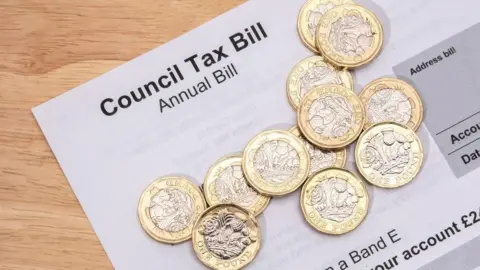
Some council tax bills are going up by as much as 10%
Focused more on the problems of poverty, the Joseph Rowntree Foundation is advising manifesto-writers to go bold on change to the "broken" council tax system.
Bills are going up by as much as 10% under decisions being made this week in council chambers around Scotland, yet the system is seen as "unfair by design" while "outdated, regressive and desperately" in need of reform, says the foundation.
It added: "Bold action is needed urgently to break a 30-year cycle of hoping a problem will just go away, which has sustained a deeply unpopular tax system, protected the interests of the wealthiest in society and perpetuated poverty and inequality in Scotland."
Based on property valuations from 35 years ago and taking a bigger share of household budgets in cheaper homes than in the more expensive ones, you won't find much disagreement from tax experts.
But during 19 years in power, the SNP has said it has lacked the consensus to drive through change. Ministers have ruled out even a revaluation during the next session of parliament if the SNP wins power.
This is an important point where, behind the scenes, parties are preparing their manifesto offerings on which they'll fight the election.
They matter more where Holyrood arithmetic could force parties to make deals on pacts or coalitions, where manifestos, implying a mandate, form the basis for negotiations.
To an unusual extent, the voices of watchdogs and economic experts – not just the people with vested or commercial interests – are sounding ever more concerned that the positions set out so far are far from confronting the difficult choices after 7 May.