1 hour ago
1
1 hour ago
1

Success is often judged differently depending on where a person is standing. Someone who continues to grow, think differently or pursue an ambitious goal may appear increasingly distant to people who do not share the same vision.
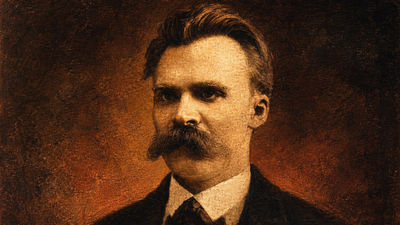
German philosopher Friedrich Nietzsche captured this idea in the striking line, “The higher we soar, the smaller we appear to those who cannot fly.” The quote comes from aphorism 574 of his 1881 work Daybreak, also translated as The Dawn. Nietzsche uses the image of flight to explore perspective and the way people perceive those who move beyond familiar boundaries. More than a century later, the words can still be read as a reflection on ambition, individuality, personal growth and the difficulty of being understood by others.
Quote of the day by Friedrich Nietzsche: What does the quote mean?
At its simplest, Nietzsche's quote suggests that a person's achievements can become harder for others to recognise as that person moves further beyond ordinary expectations. The phrase “the higher we soar” can represent intellectual development, ambition, creativity, success or personal transformation. Meanwhile, “those who cannot fly” represents people who have not experienced the same journey or who are unable to see the possibilities that someone else has discovered.
From that perspective, the person who has risen higher has not actually become smaller. They only appear smaller from a distance. Nietzsche is therefore drawing attention to the importance of perspective. What looks insignificant to one observer can be extraordinary when viewed from another position.
The meaning behind Nietzsche's image of flying
The metaphor of flying is particularly important because it turns an abstract idea about human achievement into a visual image.
Imagine two people looking at a bird in the sky. As the bird rises higher, it becomes smaller to the person watching from the ground. Its apparent size decreases, but its actual position has changed dramatically. Nietzsche applies the same principle to people who move beyond conventional limits.
Their achievements may become less visible to those who remain at the same level of experience. The quote can therefore be interpreted as a reminder that recognition does not always increase alongside achievement.
Sometimes, the further a person travels from the familiar, the harder it becomes for others to understand where they have gone.
Nietzsche wrote the quote in Daybreak
The quote appears as aphorism 574, titled “Never Forget!” in Daybreak. The book was published in 1881 and is part of the period in which Nietzsche increasingly developed his critique of conventional morality and social values. Cambridge University Press describes Daybreak as an important stage in the development of Nietzsche's mature philosophy, while the Stanford Encyclopedia of Philosophy notes that the work continued his characteristic aphoristic style and contained early ideas that would become important to his later philosophy.The wording varies slightly between English translations. Some versions use “seem” rather than “appear”, but both translate Nietzsche's original German formulation. The original aphorism reads, in part, “Je höher wir uns erheben, um so kleiner erscheinen wir Denen, welche nicht fliegen können”, which corresponds closely to the English wording used in this article.
Nietzsche's idea of going beyond conventional thinking
The quote becomes more interesting when placed alongside Nietzsche's broader philosophy.
He was deeply critical of unquestioned assumptions and conventional moral values. Rather than simply accepting inherited ideas, he encouraged people to examine where those ideas came from and whether they genuinely served human development. His writing frequently challenged readers to reconsider what they regarded as normal, valuable or true.
Daybreak was particularly concerned with questioning moral prejudices and examining the origins of values.This helps explain why the image of soaring is so appropriate. To “fly” can be understood as moving beyond established boundaries of thought. Someone who questions accepted ideas may initially appear strange or misguided to people who remain committed to those ideas. Nietzsche's point is not necessarily that the person who rises is always right. Rather, the metaphor highlights the gap that can emerge between a person who changes their perspective and people who continue to see the world from their existing position.
Who was Friedrich Nietzsche?
Friedrich Wilhelm Nietzsche was born on October 15, 1844, in Röcken, in what was then Prussia. He initially established himself as a classical philologist and, remarkably, became a professor of classical philology at the University of Basel at the age of 24. His early academic career eventually gave way to a much broader intellectual project involving philosophy, morality, religion, culture, art and human psychology.Nietzsche resigned from his Basel position in 1879 after years of serious health problems. He subsequently spent much of his life travelling between locations in Switzerland, Italy and elsewhere while continuing to write. His major works included The Birth of Tragedy, Human, All Too Human, The Gay Science, Thus Spoke Zarathustra, Beyond Good and Evil, On the Genealogy of Morality and Twilight of the Idols. He died in Weimar on August 25, 1900, aged 55.
Why people who grow can sometimes feel misunderstood
Nietzsche's quote can also be read as a reflection on the loneliness that sometimes accompanies personal growth. When people change their ambitions, beliefs or priorities, their relationships can change with them. Friends, colleagues or relatives who once understood their choices may no longer recognise the person they are becoming. This does not necessarily mean that anyone is deliberately rejecting anyone else.
People simply experience the world from different positions.The metaphor suggests that distance itself can alter perception. A person who once seemed ordinary may become difficult to understand after developing an unusual skill or pursuing an unconventional path. Likewise, someone who leaves behind familiar surroundings may discover that people who remain there cannot easily see what they see. The challenge is to continue growing without becoming dependent on everyone else's approval.
The quote is about perspective, not superiority
It would be easy to interpret Nietzsche's words as saying that successful people are inherently better than everyone else. That would be a much narrower reading than the quote itself requires. Nietzsche's metaphor is primarily about perspective. A person appears smaller because of the distance between the observer and the person in the sky, not because the person has somehow lost value.This distinction matters. Achievement does not automatically make someone wiser, kinder or more important than others.
Similarly, people who do not understand a particular ambition are not necessarily inferior. They may simply have different experiences, priorities or ways of seeing the world. The quote can therefore be read as an encouragement to recognise that human judgement is limited by perspective.
Why Nietzsche's words still resonate today
The idea feels particularly relevant in a world where people constantly compare themselves with others. Careers, education, creative work, entrepreneurship and personal achievements are frequently displayed in public, while the struggles behind them remain largely invisible.
Someone pursuing a difficult or unconventional goal may receive little recognition at first. From the outside, their efforts may even appear unrealistic.Nietzsche's image of soaring offers another way to look at that situation. Progress does not always look impressive to everyone watching from the ground. Sometimes the people closest to a person's journey may be the least able to understand where that journey is leading.
The quote therefore encourages readers to think about their own direction rather than measuring every step through the judgement of others. It does not promise that every ambitious pursuit will succeed, but it suggests that unfamiliar heights can be difficult to appreciate from the ground.
The enduring lesson of Nietzsche's quote
“The higher we soar, the smaller we appear to those who cannot fly” remains memorable because it captures a complicated truth in a remarkably simple metaphor.
Growth can create distance. Ambition can invite misunderstanding. A new perspective can make old surroundings look different. Nietzsche's words remind readers that other people's inability to understand a journey does not necessarily determine its value.At the same time, the quote invites humility. Soaring higher should not become an excuse for looking down on those who remain on the ground. Everyone sees the world from their own position, and every perspective has its limitations. Perhaps the most useful lesson in Nietzsche's words is therefore not simply to keep climbing, but to understand that the view changes as we rise, and so does the way others see us.