3 hours ago
3
3 hours ago
3

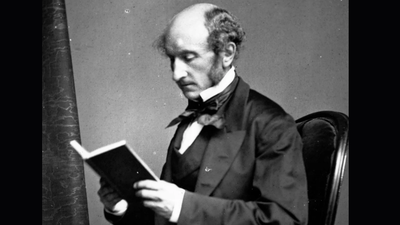
John Stuart Mill was a 19th-century philosopher who argued that true happiness comes from developing the mind
A shopper standing in the middle of a brightly lit superstore, holding three slightly different versions of the same household item, often feels an odd sense of confusion rather than freedom.
The endless scroll of online stores promises that the perfect product to complete life is just one click away. Yet, as packages keep arriving at the door, the promised happiness often disappears, replaced by a lingering desire for whatever comes next.This cycle of endless consumption is exactly what the Victorian philosopher John Stuart Mill described when he wrote: “I have learned to seek my happiness by limiting my desires, rather than in attempting to satisfy them.”Mill’s observation completely changes the usual idea of finding happiness. Instead of seeing human desire as an endless list of needs that must be fulfilled, he argued that desire itself is what needs to be controlled. Satisfaction, in his view, does not come from building a bigger net to catch every passing impulse, but from reducing what we expect and demand from the world.
The breakdown of a calculating mind
John Stuart Mill published this reflection in his Autobiography in 1873, a book describing one of the most intense intellectual upbringings in Western history.
Born in London in 1806, Mill was raised under a strict educational experiment designed by his father, James Mill, and the founder of Utilitarianism, Jeremy Bentham. By the age of three, he was learning Ancient Greek; by eight, he was reading Herodotus and Plato in their original language; and by his early teens, he had mastered political economy and formal logic.The purpose of this education was to create a perfectly rational follower of Bentham—a person trained to judge every action by calculating how to produce the greatest pleasure and the least pain for the greatest number of people.The experiment seemed successful until 1826, when twenty-year-old Mill suffered a serious mental breakdown. In one of the most famous parts of his memoir, Mill recalled asking himself a simple question: if all his political and social goals were achieved tomorrow, would he truly feel happy? His honest answer was an immediate “no.” His highly rational way of thinking had left him emotionally empty.Mill’s recovery happened gradually, helped by the poetry of William Wordsworth and by a major reconsideration of Utilitarian philosophy.
He realized that Bentham’s basic idea—treating happiness as simply the total of fulfilled desires—was deeply incomplete. To recover his peace of mind, Mill had to rethink what true well-being meant. The quotation from his Autobiography marks this important turning point, showing his realization that lasting happiness comes from controlling desire rather than satisfying every new craving.
The utilitarian paradox
To understand Mill’s change in thinking, we must examine a tension within Utilitarian philosophy.
Traditional Utilitarianism viewed happiness as the total amount of pleasure minus pain. If people could continue creating and satisfying new desires, happiness should, in theory, continue increasing.Mill recognized the major problem with this idea: human desires constantly grow. As soon as one desire is fulfilled, our expectations rise again, a pattern that modern psychologists call the “hedonic treadmill.”
Trying to find lasting happiness by satisfying every new want is like trying to fill a bucket full of holes.By encouraging people to limit their desires, Mill was not promoting extreme self-denial or the lifestyle of monks. Instead, he brought his updated version of Utilitarianism closer to older philosophical traditions. Epicurus had argued centuries earlier that simple, easily achieved pleasures bring the greatest peace of mind, while Stoic thinkers such as Seneca believed that true wealth comes not from owning many things, but from wanting fewer things.Mill adapted this idea for the modern industrial world. He argued that higher intellectual and emotional pleasures—such as art, friendship, public service, and personal development—are naturally more valuable than endlessly collecting material possessions. Limiting material and superficial desires frees mental energy, allowing people to develop deeper, non-material sources of happiness that do not lose their value once they are achieved.
Curbing the engine of infinite wants
In 2026, Mill’s insight speaks directly to one of the biggest challenges of modern life: the commercialization of human attention and desire. Today’s digital systems are carefully designed to constantly create new wants that can only be satisfied through more consumption. Targeted algorithms, personalized advertising, and micro-influencers work together to convince people that something important is always missing from their lives.The growing popularity of voluntary simplicity, digital minimalism, and anti-consumption movements reflects Mill’s principle in action. When technology workers switch to basic feature phones or consumers commit to “no-buy” years, they are putting his idea into practice. They are not doing so because they lack money, but because they want to break the endless cycle of constantly creating new desires.The same principle also applies to work and professional burnout.
Modern workplaces often define success through constant growth: higher salaries, bigger teams, and continuous promotions. However, research in behavioral economics consistently shows that once people reach a comfortable middle-class standard of living, extra income brings smaller and smaller increases in everyday happiness. Executives who reject promotions to protect their personal lives or professionals who choose lower-paying jobs for better health are deciding to reduce their ambitions rather than spend their lives chasing ever-growing demands.By describing happiness as the relationship between what people have and what they want, Mill offered a lasting mathematical insight: the result can be improved either by increasing what you have or by reducing what you want.When Mill died in Avignon in 1873, he left behind writings that influenced modern liberal democracy, individual freedom, and economic thought. Yet perhaps his greatest personal achievement was overcoming the crisis of his youth. By understanding that peace of mind depends on controlling desire instead of constantly feeding it, he left a timeless guide for staying mentally balanced in a world designed to keep people forever wanting more.