1 month ago
28
1 month ago
28

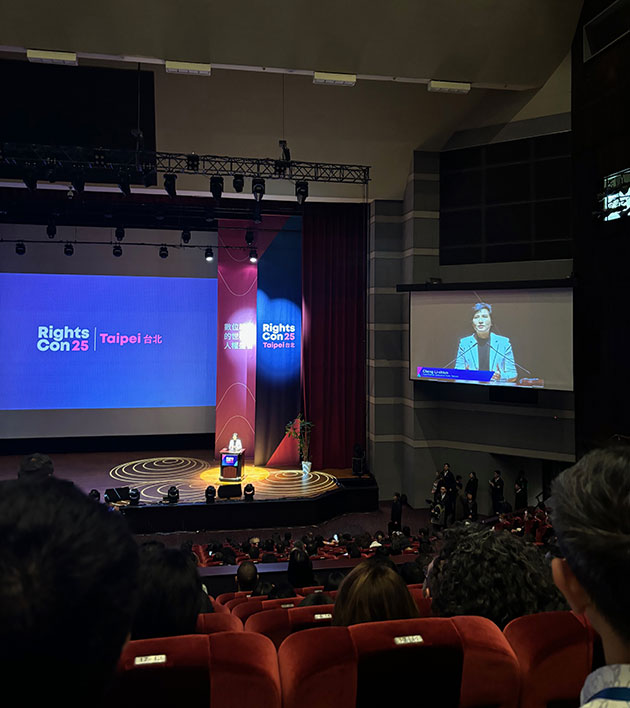 Opening ceremony of RightsCon 2025 in Taipei, Taiwan. Credit: Equality Now
NEW YORK, June 19 (IPS) - RightsCon, the world’s leading summit on human rights in the digital age, has served for over a decade as a vital global gathering, bringing together civil society, academics, technologists, policymakers, and the private sector in cross-border collaboration. The abrupt cancellation of RightsCon 2026, following intervention by Zambia’s government just days before the convening was due to commence in Lusaka, should concern us all.
Worryingly, this is not an isolated disruption. It reflects a deeply troubling global pattern of shrinking civic space alongside a rapidly growing, well-resourced, and increasingly networked transnational anti-rights movement. We are calling on civil society, donors, the media, and democratic governments to take a strong stand against these coordinated efforts to undermine human rights and the forums that uphold them.
 S. Mona Sinha
Access Now explains RightsCon cancelled due to political interference
On May 1, RightsCon organiser and host Access Now released a statement announcing the summit, scheduled to run between May 5 and 8, could not proceed after Zambia announced it was postponing the event to ensure it “aligns with Zambia’s national values, policy priorities, and broader public interest.”
Access Now reported that on April 27, one day after the Zambian Ministry of Technology and Science had endorsed RightsCon, government officials told organisers that diplomats from China were pressuring Zambia because Taiwanese civil society participants were planning to attend. Zambia’s new conditions for allowing the conference to proceed included select topics being moderated and the exclusion of some participants, including Taiwanese civil society representatives.
Access Now has called this interference “transnational repression” and a deliberate effort to project authoritarian preferences across borders and shrink civic spheres.
 Mrinalini Dayal
Why RightsCon matters for digital rights and gender equality
Digital rights advocacy is essential to advancing gender equality. That is why Equality Now co-founded the Alliance for Universal Digital Rights (AUDRi), a global campaign working toward a digital future where everyone can enjoy equal rights to safety, freedom, and dignity.
Equality Now and AUDRi were looking forward to returning to RightsCon to reconnect with allies and forge new relationships. Over 500 sessions were scheduled, including two by Equality Now on co-creating solutions to online safety and privacy challenges, and addressing the exclusion of women from artificial intelligence development and other emerging technologies.
Activists have spent months preparing, from developing proposals and collaborating with partners to organising funding, travel, and logistics. Significant time, energy, and resources have been invested that cannot be recouped.
RightsCon is one of the few annual, in-person opportunities where smaller frontline organisations meet potential funders. Locally led groups, particularly those in the Global Majority already grappling with funding cuts and rising competition for limited resources, will be hardest hit by the lost networking, visibility, and donor engagement that sustains their work.
Beyond this substantial loss is the deeply troubling shutting down of a vital locus for dialogue and collective action, alongside a growing anxiety that this will not be the last such disruption of an essential global forum.
RightsCon: a unique mix of diverse voices
RightsCon is the only global, civil society-led convening focused on the intersection of technology and human rights. Other international gatherings on the internet, emerging technologies, and digital governance are generally complex, exclusionary multilateral processes dominated by governments and the tech companies whose products and power are meant to be scrutinised.
Discussions about digital harms, inequality, and the future of our online world are often relegated to the margins or excluded completely, despite their far-reaching consequences. In contrast, RightsCon is where activists set the agenda, and lived experience is central.
Participants working towards safer, inclusive digital futures can share insights and learn from others’ successes and challenges across diverse contexts. The summit’s activist spirit prioritises voices often excluded elsewhere: women and girls, LGBTQI+ communities, Indigenous peoples, and those resisting surveillance and authoritarian rule.
Holding RightsCon in Zambia was a deliberate choice by Access Now intended to lower barriers to participation. For people from Global Majority countries, visa requirements and travel costs to Europe or North America are routinely insurmountable, and increasingly restrictive visa policies are making access evermore difficult. Equality Now staff have been unable to attend UN gatherings in New York for exactly this reason.
The impacts of widespread exclusion from attending consultative and decision-making settings cannot be overstated. That Zambia’s government sought to justify postponing RightsCon on visa grounds, saying some speakers and participants were “subject to pending administrative and security clearances”, is a stark illustration of how bureaucratic levers can be wielded to stifle dissent.
Tech-facilitated gender-based violence
In an increasingly digital world, women and girls face distinct and escalating threats to their rights, safety, privacy, and freedom. The rapid advance of technologies is opening new frontiers for human traffickers, coercers and abusers, but existing legal systems everywhere are ill-equipped to handle these multi-jurisdictional harms.
At RightsCon 2026, we were going to jointly explore legal solutions to the explosion of tech-facilitated gender-based violence. Online violence is rarely, if ever, confined to a ‘virtual’ space; it follows women and girls into their homes and workplaces, and often involves real-world harm including physical violence.
Emerging technologies such as artificial intelligence risk deepening existing inequalities and amplifying misinformation and bias, while expanding surveillance and online exploitation and abuse place fundamental rights and freedoms at risk.
Without civil society-led convenings that centre human rights in digital technologies, it becomes harder to build the intersectional, integrated, responsive movements needed to defend online rights, especially for marginalised communities.
That is precisely why losing this moment hurts so much, and why the issues that RightsCon sought to elevate, including those that governments seek to suppress, must be debated in the global spotlight. At Equality Now and AUDRi, we are planning alternative ways to hold conversations with even wider audiences than a conference format allows. We will not be deterred.
Standing against the pushback on human rights
Equality Now has been tracking the pushback against human rights advocates globally, particularly those working on gender equality and against misogyny and gender-based violence. Even knowing how organised that pushback has become, it is devastating to watch RightsCon become a casualty of it.
The cancellation and the speed of it set a worrying precedent for future international human rights convening. No forum is truly safe from political scrutiny, interference, or silencing.
This is the moment for a coordinated response. Funders must step up to prioritise digital rights and engage with organisations at the convergence of human and digital rights and development. Regional gatherings and alternative spaces need resourcing to replace this year’s RightsCon.
Democratic governments need to defend the right to assemble across borders and scrutinise international pressure that may have shaped RightsCon’s cancellation.
To our peers across the digital rights community: we stand with you. Silencing one convening will not silence the movements behind it. We will continue to organise, collaborate, and defend the freedoms and human rights at stake, because the price of allowing authoritarian pressure to determine who gets to participate, speak, and assemble is simply too high.
S. Mona Sinha, Chief Executive Officer, Equality Now, and Mrinalini Dayal, Global Coordinator of the Alliance for Universal Digital Rights (AUDRi)
IPS UN Bureau
© Inter Press Service (20260619081617) — All Rights Reserved. Original source: Inter Press Service