5 months ago
25
5 months ago
25


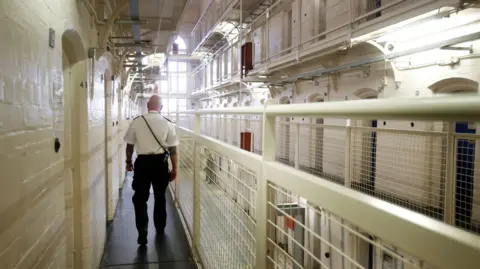 PA Media
The latest figures from the Scottish Prison Service recorded a total of 19 transgender inmates
Judges are to hear a legal challenge against the guidance which helps decide which prisons trans people are held in.
Scottish Prison Service policy says inmates are assessed on an individual basis, with rules based on whether they could pose a risk to female prisoners.
But campaign group For Women Scotland says last year's Supreme Court ruling on the definition of a woman in equalities law means admission to women's jails should be strictly based on biological sex.
The Scottish government argues that having a "blanket rule" on which prisons trans people are housed in "would violate the rights of some prisoners".
Three days of legal argument are due to begin at the Court of Session in Edinburgh.
The latest figures from the Scottish Prison Service (SPS) - dating to June 2025 - recorded a total of 19 transgender inmates.
That amounts to around 0.2% of the prison population of more than 8,000 people - 96% of whom are male.
The SPS implemented new guidance in February 2024 following a row over the case of Isla Bryson, a double rapist who was initially housed in the female estate having decided to transition while standing trial.
The previous guidance, dating back to 2014, said prisoners should be recorded and placed in facilities which "reflect the gender in which the person in custody is currently living".
That changed to an "individualised approach", which underlined that any transgender woman - who was born biologically male - who could pose a risk to women and girls would not be placed in the female estate.
The service stated that "only when staff have enough information to reach a decision that a trans individual can be safely accommodated will they be placed in an establishment which matches their affirmed gender".
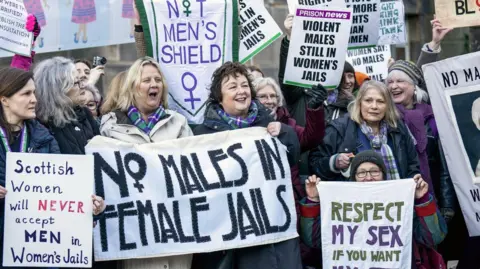 PA Media
For Women Scotland says admission to women's jails should be strictly based on biological sex
For Women Scotland contend that this guidance is not compatible with the Supreme Court ruling in 2025 which said sex should be defined in terms of biology in the Equality Act, the UK's main anti-discrimination law.
The group's written argument quotes the ruling as saying that "a person is either a woman or a man…provisions that refer to protection for women necessarily exclude men".
They argue that the government is obliged to provide women-only prison accommodation, and must ensure that no male prisoners - regardless of whether they have a gender recognition certificate - are in the women's estate.
They say the SPS policy is unlawful because it is based on the idea "that at least some male prisoners, among those who claim the protected characteristic of gender reassignment, might lawfully be assigned to serve their sentences within the women's prison estate".
The Scottish government meanwhile argues that the Equality Act was designed to give people a basis on which to make a claim of discrimination.
Its written arguments state that the Act "does not mandate sex segregation", and "does not absolutely prohibit deviation from any norm".
The rights of individuals
The government said that a "blanket rule of the kind advanced by [For Women Scotland] would violate the rights of some prisoners" under the European Convention on Human Rights.
And it questioned how the group's argument would apply to trans men - who were born biologically female - noting that the Supreme Court had said those of masculine appearance could still be excluded from female facilities.
The government said this showed that "biology is not the sole determining factor in such a case".
For Women Scotland had initially sought to challenge the government's guidance for schools, but that was changed in September 2025 to say that separate boys and girls toilets must be provided.
First Minister John Swinney has told MSPs that his administration accepts the Supreme Court ruling, but that its assessment was that the prisons guidance "does not need to be changed".
He said ministers "must wrestle with complex issues and make difficult decisions which balance and reflect the interests and rights of individuals".