1 hour ago
1
1 hour ago
1


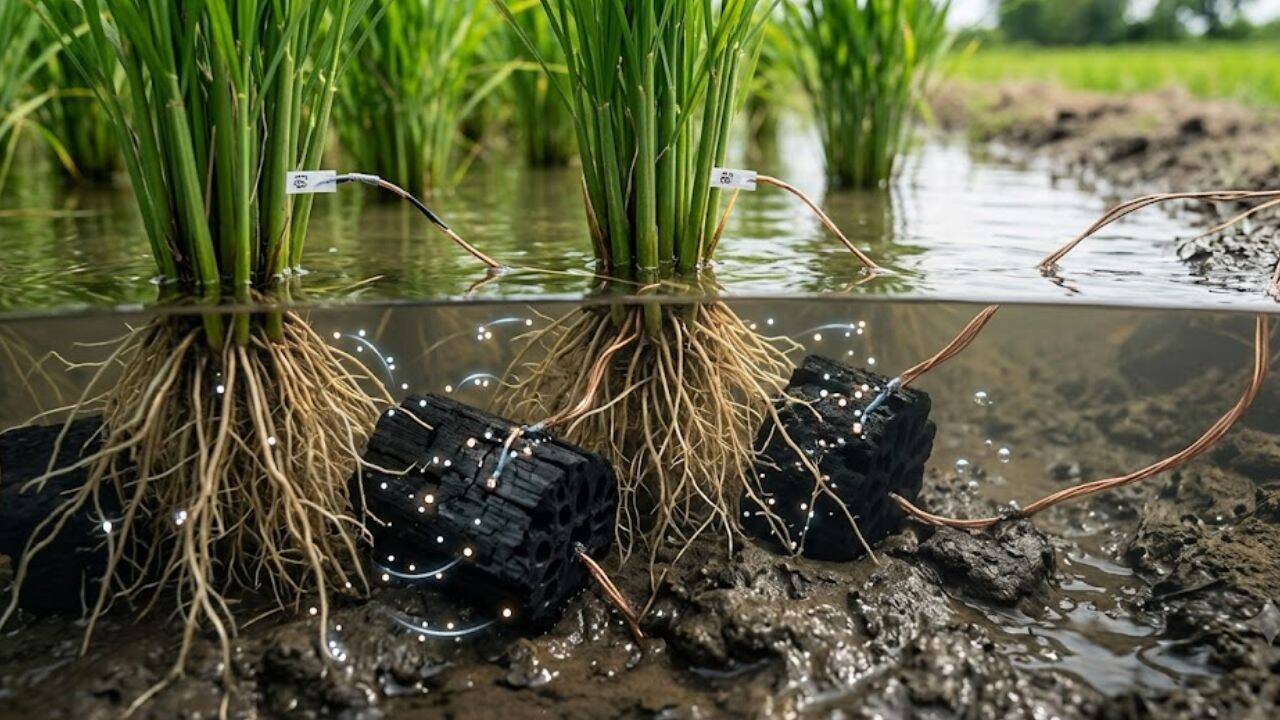
In the rice fields, the soil around plant roots is home to countless microorganisms that feed on organic matter released by the plants. As microorganisms break down this organic matter, they release electrons that can produce a small electrical current.
Researchers are investigating whether this process can be harnessed without affecting normal rice growth. According to the research published in ‘Energy Conversion and Management’, scientists used plant microbial fuel cells with rice plants to generate electricity while also reducing methane emissions. The system used activated biochar as an electrode and reached a peak power density of 106.67 mW per square metre of anode area.
How did the researchers test electricity generation from rice plants
The study used plant microbial fuel cells, or PMFCs, to turn chemical energy into electricity through a bio-electrochemical process.
The system was tested during the ‘Aman’ rice-cropping season from June to September 2020. The experiment lasted 110 days in a greenhouse at Khulna University. The researchers used the local rice variety Aloron and compared the rice-based PMFC with a sediment microbial fuel cell.
The PMFC produced higher voltage than the SMFC, with performance increasing by 36.6%. After about two weeks, the rice-based system consistently generated more voltage than the sediment-based setup.
PC: AI Generated
Why did researchers use activated biochar in the fuel cell
The researchers used activated biochar as an electrode material to improve plant microbial fuel cells. They investigated whether this material could raise electricity production while lowering methane emissions from paddy cultivation. The study notes that PMFC technology still faces a major limitation because its voltage generation is too low for large-scale application. Activated biochar was tested as an alternative to traditional graphite electrodes.
It helped the rice PMFC achieve its highest measured power density of 106.67 mW per square metre of anode area. By comparison, the sediment microbial fuel cell with a biochar anode reached 38.28 mW per square metre in the experiment.
How much electricity did the rice-based system produce
The rice-based plant microbial fuel cell recorded the strongest electricity-generation performance in the experiment. Its activated-biochar setup reached a maximum power density of 106.67 mW per square metre of anode area.
The sediment microbial fuel cell using a biochar anode reached 38.28 mW per square metre. The researchers also found that the PMFC generated significantly higher average voltage than the SMFC, with performance increasing by 36.6%.
At the beginning, both systems showed similar rising voltage trends. After about two weeks, however, the voltage from the PMFC remained consistently higher. The study also found that temperature and sunlight influenced power generation.
How did electricity generation affect methane emissions
The researchers found that the plant microbial fuel cell could reduce methane emissions while generating electricity. Rice PMFCs produced 38% less methane than normal rice plants in the study. When activated biochar was used with the rice plants, methane emissions were reduced by 27.1%. The researchers also reported that PMFCs reduced greenhouse gas emissions by 70% compared with traditional coal-based power plants and by 67% compared with natural gas-based power plants.
The study links the methane reduction to the bioelectrochemical system used around the rice plants. Electricity generation and methane mitigation can occur together, although the technology needs further work.
What limits the use of rice fuel cells on a larger scale
Despite the promising results, the researchers said plant microbial fuel cells are not yet viable for large-scale application because their voltage generation remains low. The study presents activated biochar as a promising step rather than a replacement for conventional energy systems. The experiment showed that power generation was affected by temperature and sunlight. They found no significant change in rice yield.
Their results provide a baseline for further development of PMFC technology in paddy fields.