4 months ago
33
4 months ago
33


 AFP via Getty Images
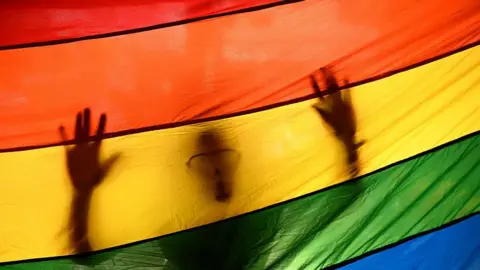
The new law follows a wave of arrests last month over alleged same-sex relationships (stock image)
Senegal's parliament has approved a new law doubling to 10 years the maximum prison term for sexual acts by same-sex couples and criminalising the "promotion" of homosexuality.
A total of 135 MPs voted in favour, zero against and three abstained. The next step will be for the president to sign it, then it will become law.
The legislation, which was a campaign promise of President Bassirou Diomaye Faye and Prime Minister Ousmane Sonko, was sent to parliament after a wave of arrests over alleged same-sex relationships, already banned under Senegalese law.
The government spokesman dismissed international criticism of the bill, arguing that the move reflected the views of Senegalese people.
"The majority of Senegalese do not accept homosexuality. Our culture rejects it and we are firmly opposed to it," said Amadou Moustapha Ndieck Sarré.
Some conservative activists in Senegal have long demanded harsher penalties.
The movement And Sàmm Jikko Yi, which campaigns to defend what it calls Senegalese moral values, has repeatedly urged authorities to adopt stricter legislation criminalising homosexual acts. Its leaders argue the law is necessary to protect Senegalese cultural and religious norms.
However, rights groups warn the move could worsen discrimination and violence against sexual minorities. Human Rights Watch researcher Larissa Kojoué said the proposed changes were worrying.
"Criminalising same-sex conduct and arresting people for their sexual orientation violates multiple internationally protected rights, including equality and non-discrimination."
She added that such measures risked exposing people who were already stigmatised to "violence and fear."
Alioune Tine, founder of the think-tank Afrikajom Center, told the BBC that the current climate could worsen social tensions. "If it is true that social concerns must be addressed, [the law] also has to respect human rights and protecting public-health policies."
Others have pointed out that same-sex relationships are a part of life and cannot be abolished by a law.
"Most of the same-sex relationships were hidden anyway. There are even people who are married in the society and who are still entertaining a safe-sex relationship because of the norm and the cultural norm in that society," Senegal LGBTQ Association head and medical doctor Charles Dotou told BBC Newsday.
All that will happen is "people will be hiding more, it will create more fear and people will be scared to live normally in that community. So there will be an exodus of people, particularly people who were already exposed so that that creates a bit of chaos in society," Dr Dotou added.
The toughing of Senegal's law follows a wave of arrests last month over alleged same-sex relationships. Police detained 12 men - among them two public figures and a prominent journalist.
Some supporters of the tougher legislation say they have concerns about HIV transmission, although it has long been scientifically established that people of any sexuality can contract and spread the illness.
Experts warn that further criminalising same-sex relations could vilify gay people living with HIV to the point that they shy away from receiving the vital medical care they need.
Senegal has been praised for its efforts to control HIV. Between 42,000 and 44,000 people are living with the virus in the country, with a national prevalence of about 0.3% among adults, one of the lowest rates in West Africa, according to the health ministry.
At the Fann University Hospital in Dakar, the executive secretary of the National Council for the Fight Against Aids (CNLS) - the body that has coordinated the country's HIV response for decades - is worried about the situation with LGBTQ+ people.
"We have managed to control the HIV epidemic and we are moving towards eliminating Aids as a public health problem in Senegal," Dr Safiétou Thiam told BBC News Afrique. "But what is happening now risks undermining the results of 30 to 35 years of efforts in the fight against the disease."
Ousmane Sonko, the longtime firebrand opposition leader appointed prime minister in 2024, had told lawmakers the bill would punish what it describes as "acts against nature" with fines of up to 10,000,000 CFA francs ($17,600; £13,000) and prison sentences ranging from five to 10 years, compared with the current one- to five-year terms in the Muslim-majority country.
Several other African countries have also introduced tough new laws against the LGBTQ+ community in recent years.
In September last year, Burkina Faso's transitional parliament approved a bill banning homosexual acts, following its neighbour Mali in 2024.
In 2023, Uganda voted in some of the world's harshest anti-homosexual legislation meaning that people engaging in same-sex relationships can be sentenced to death in certain circumstances.
Ghana is also planning to re-introduce an anti-homosexual bill that activists say threatens basic human rights, safety and freedom.
More about Senegal from the BBC:
 Getty Images/BBC