2 hours ago
2
2 hours ago
2

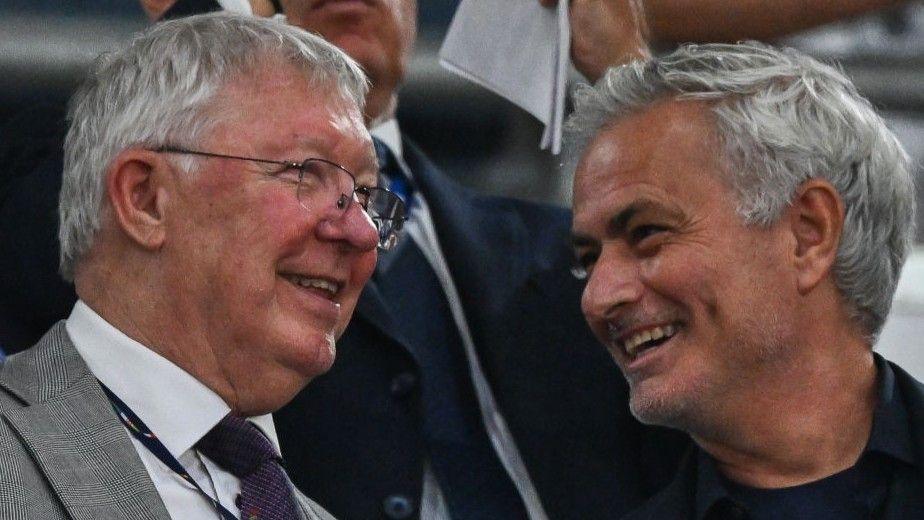 Image source, Getty Images
Manchester United wanted Jose Mourinho (right) to replace Sir Alex Ferguson in 2013
By
Manchester United reporter
"Sliding doors".
The description from more than one person connected to Manchester United in 2013 about the failure to secure Jose Mourinho as Sir Alex Ferguson's replacement.
Confirmation of something that has been rumoured for many years has come in a new documentary series about Mourinho's career, which is on Netflix from 11 August.
The actual decision reversal was fast, "days", one source has told BBC Sport.
However, another has explained the process to secure Mourinho's services had been going on for weeks.
Meetings had been held in Madrid and London, with Ferguson stunning Mourinho, someone he liked and had plenty of admiration for, by telling the charismatic Portuguese he was going to stand down at the end of the 2012-13 campaign.
Very quickly, the negotiations moved to terms. Agreement was reached. Then it wasn't.
Ferguson said: "One night, he phoned me and he was crying and he says: 'Alex, I can't take it. I've given my word to Chelsea and I'm not going to break my word'."
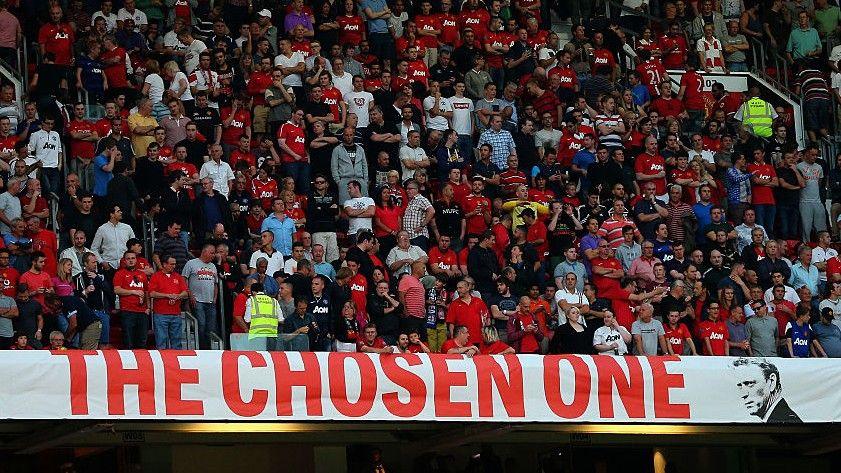 Image source, Getty Images
The Chosen One banner supporting David Moyes as Manchester United manager; but he wasn't
Mourinho cited family reasons for his decision. Some connected to United are still dubious that is true.
It is correct the 63-year-old has a family home in London and had promised to return when he was initially sacked by Chelsea in 2007.
He also had a positive relationship with Chelsea's former owner Roman Abramovich, which presumably had an impact.
For a short time, though, United thought they had got their man.
It is still viewed as a significant turning point in their history.
Ferguson was leaving in the same summer as highly respected chief executive David Gill.
It was felt Mourinho had the broad shoulders needed to manage the transition.
Senior United figures at the time believed it was not just a succession they needed to manage; they also had to introduce a different structure to the club.
Ferguson was a one-off, in control of virtually everything from a playing perspective. Another structure was needed and it had to be managed while the club still competed on the pitch.
With Mourinho out of the picture and Pep Guardiola committed to Bayern Munich, United pivoted to David Moyes.
The Everton boss shared many of Ferguson's traits as a manager but, significantly, had not operated at the same high level despite his relative success on Merseyside.
United announced Moyes as 'The Chosen One'. He just wasn't.
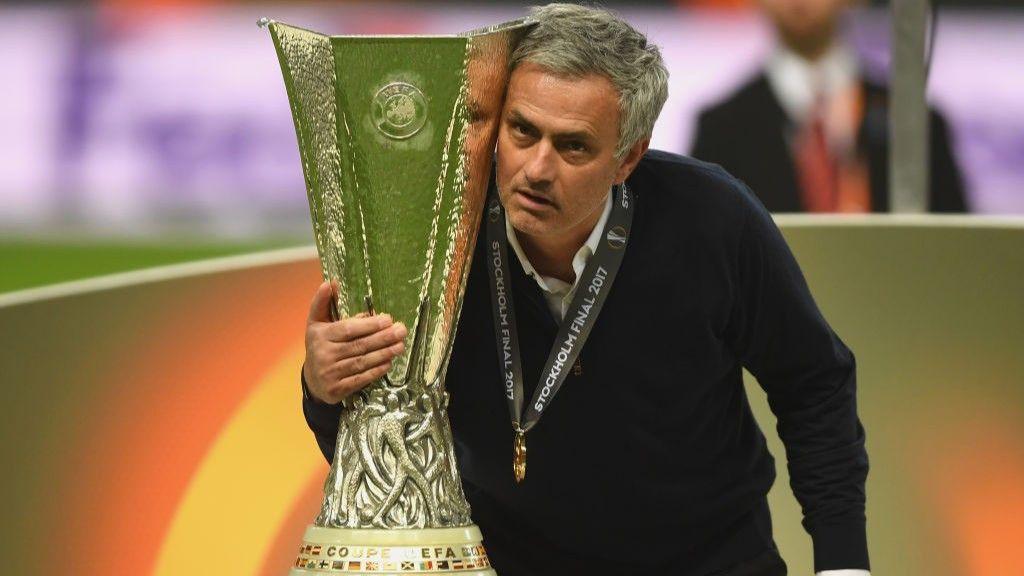 Image source, Getty Images
Mourinho is the only Manchester United manager to win a European trophy since Ferguson retired in 2013
In 2016, Mourinho did become United manager, replacing Louis van Gaal, who was sacked 48 hours after his side had beaten Crystal Palace to win the FA Cup.
But Mourinho was evolving as a manager, and the Old Trafford dressing room was not the same place as it had been three years previously.
Of the 18 players that had started 10 or more Premier League games in the 2012-13 title-winning campaign, only six – David de Gea, Phil Jones, Wayne Rooney, Chris Smalling, Michael Carrick and Antonio Valencia – did so in Mourinho's first season.
Mourinho had also changed. He won the title in his second stint at Stamford Bridge but left under a cloud in December 2015, with the club 16th in the table, one point above the relegation places.
Depending on how you look at it, Mourinho was either a major success at Manchester United, or someone who didn't deliver what was promised and left the club in chaos.
He won the Europa League and EFL Cup in his first season, and twice qualified for the Champions League. He has described finishing second – 19 points behind champions Manchester City – as one of the 'best achievements' of his career.
United's 81 points that season is, by some distance, their most in a post-Ferguson Premier League campaign.
However, he fell out with players, including record signing Paul Pogba, and accused the club's hierarchy of failing to back him over striker Anthony Martial, who he wanted to sell.
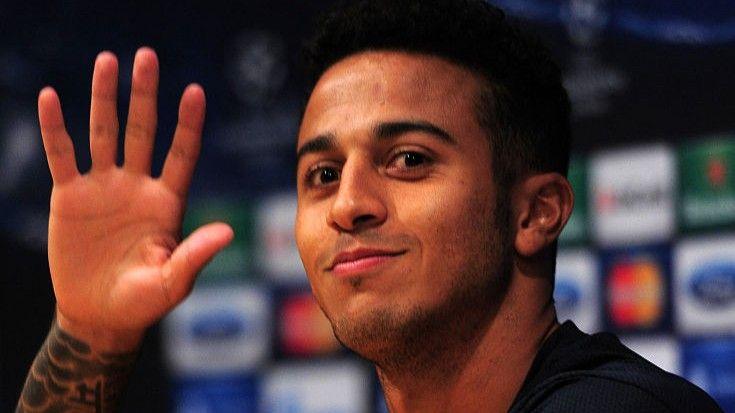 Image source, Getty Images
Man Utd chiefs felt they had a deal in place to sign Thiago Alcantara from Barcelona in the summer of 2013 but it was never executed
It is felt now that Mourinho would have had a greater impact if he had directly followed Ferguson.
For a start, his personality suggested he would have taken on the task of succeeding the Scot by believing he could do better.
Whereas under Moyes, there was hesitation in the transfer market, it is hard to imagine Mourinho being similarly reluctant to execute deals.
Thiago Alcantara's agreed move from Barcelona would have been completed, sources stress.
United would also have avoided the mess they got into around Marouane Fellaini – who moved from Everton for £27.5m on deadline day, but only after the club had missed out on a lower release fee.
Fellaini, it is claimed, simply would not have been signed.
Mourinho went so far as giving United his view on a number of players, including Italy midfielder Daniele de Rossi.
Not only it is safe to assume Mourinho would have signed players, the feeling is he would also have got more from the experienced ones he was inheriting.
It is generally accepted now that no-one could have extracted more from Ferguson's final title-winning squad than the Scot, and they significantly overperformed. But the fall off, to seventh, was dramatic and unexpected.
Even the players themselves have struggled to identify specific reasons. The feeling remains that Mourinho's presence would have pushed them.
With clarity and expression, Ferguson uses the documentary to recount Mourinho's tears as he explained why he could not join.
It was a huge blow to Manchester United. Arguably, they are still to fully recover.
Follow Manchester United on BBC Sounds
Pre-match, post-match and topical United content
Subscribe and listen for everything you love about the Red Devils