4 months ago
22
4 months ago
22


 Getty Images
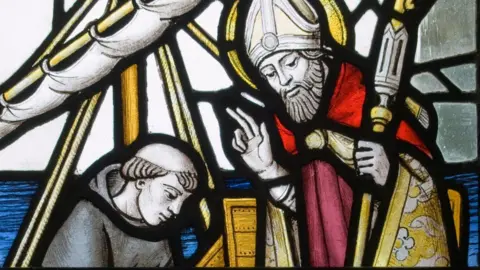
How accurate is this image of St David?
Every year on 1 March, Wales celebrates St David's Day - but how much do we actually know about the country's patron saint?
Events across Wales today will celebrate the greatest figure in the Welsh Age of Saints.
He established many religious communities and gives his name to the smallest city in Britain.
But much of what we "know" is based on the Latin writings of Rhygyfarch, some 500 years after St David lived.
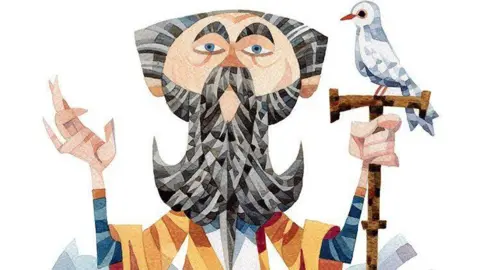
Even the image of St David has changed over the centuries.
"Much of the early images are based upon what we see in stained glass windows where he's portrayed as a very powerful archbishop," said author Martin Crampin.
"But that was never the case at the time of his life.
"It's not until last century that we see him as a hermit, or a more scholarly, humble and down-to-earth figure that perhaps fits in more with what we want to see St David."
So meek or mighty, here are 10 "facts" to ponder.
 Jonathan Edwards
Modern imagery of St David is of a simpler, humble figure
1) His birthday is a mystery
An angel is thought to have foretold his birth to St Patrick, 30 years before it happened - although the exact date is believed to be some time between 462 and 515 AD.
Some say he lived more than 100 years and died on 1 March 589 - hence St David's Day.
2) He was born in a storm
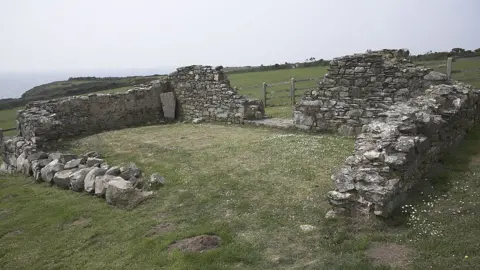
Whenever it was, legend has it St David's mother Non gave birth on a clifftop in Pembrokeshire during a fierce storm.
At that exact moment, a bolt of lightning from heaven is said to have struck the rock, splitting it in two.
A nearby holy well is said to have healing powers.
 Getty Images
The spot of David's birth is marked by the ruins of Non's Chapel
It's believed that he was not only aristocratic but that he had royal lineage.
According to legend, St David's father was Sant, the Prince of Powys, while his grandfather was King Ceredig, who founded Ceredigion.
Non was a nun and later canonised herself.
That was the name he was baptised with.
But Non named her son Dewidd, or Dewi to the locals.
 Cadw
Cadw
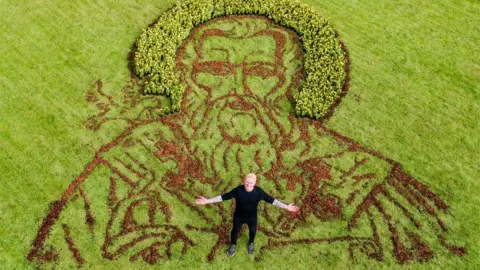
Welsh artist and Britain's Got Talent finalist, Nathan Wyburn, created this portrait using 1,000 daffodils
5) He took centre stage at Glasto
Educated at a monastery, he became a missionary, spreading Christianity.
Dewi was a renowned preacher, founding monastic settlements and churches in Wales, Brittany and south-west England.
He visited Glastonbury to rededicate the abbey and donated a travelling altar that included a great sapphire - pinched 1,000 years later.
Like any seaside tourist, David reputedly brought back a rock - though not the pink boiled sugar kind - from his pilgrimage to Jerusalem.
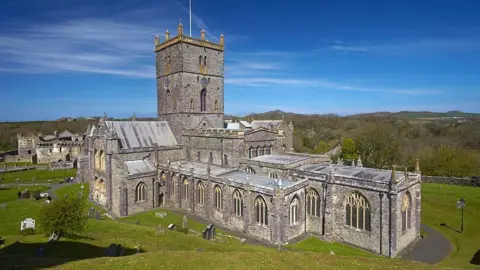
That stone now sits in an altar at St Davids Cathedral, built on the site of his original monastery.
 Loop Images
St Davids is the UK's smallest city
7) He was a teetotal vegetarian
St David and his monks led a very simple and austere life, living off only leeks and water.
They even refused to use oxen to plough their fields, preferring to do it by hand.
He is said to have cured his tutor of blindness with the sign of the cross and brought a dead boy back to life by splashing the child's face with tears.
It is also said that the ground beneath his feet rose up to form a hill so people at the back of a large crowd in Llanddewi Brefi could hear him speak before a white dove, sent by God, settled on his shoulder.
 Getty Images
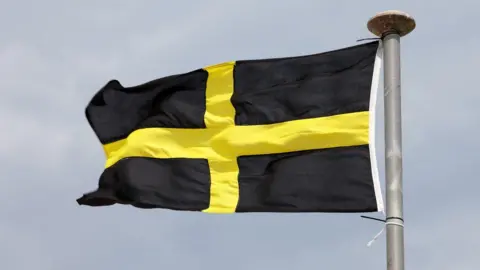
The flag of St David
9) A celebrity of the Middle Ages
He has been the patron saint of Wales since the 12th Century, at a time when there were more than 60 churches in Wales dedicated to him.
His shrine was so important that Pope Callistus II said two pilgrimages to St Davids were worth one to the Vatican.
Vikings regularly raided the cathedral while the shrine was stripped of its jewels during the reformation in the 16th Century.
 Getty Images
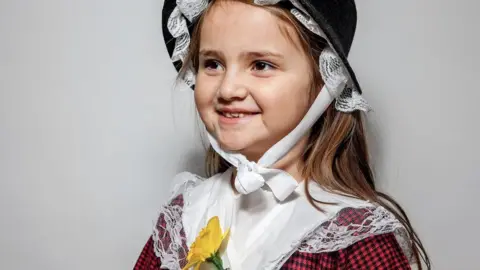
Children across the country take part in dances and events wearing traditional Welsh clothing
His last words to his followers came from a sermon he gave on the previous Sunday: "Be joyful, keep the faith, and do the little things that you have heard and seen me do."
The phrase "Gwnewch y pethau bychain" - "do the little things" - is still well-known in Wales.