
 6 months ago
40
6 months ago
40

Henry ZeffmanChief political correspondent

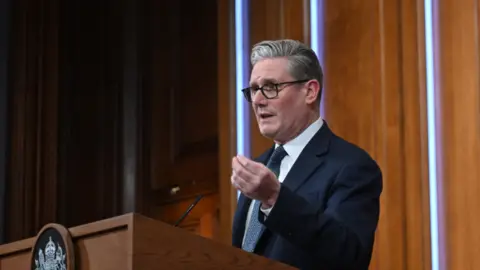 PA Media
They are not the words a prime minister wants to be using from the Downing Street podium to describe the emotional state of their country.
Sir Keir Starmer identified three ways in which the public are worrying: about their family and friends, about the impact of this war on the British economy, and about the potential for greater escalation.
This press conference appeared to be primarily for the purpose of reassuring Britons.
But - as he acknowledged - there was only so much reassurance he could offer.
For those with family and friends stranded in the Middle East, the prime minister sought to manage expectations.
He announced that the repatriation flight from Oman that was meant to take off on Wednesday but was scuppered by technical issues is now in the air, and around 4,000 Britons had already made it home.
However, that is just a tiny fraction of the 140,000 British nationals who have told the government they are in the Middle East.
"This is a huge undertaking," he said, describing it as many times bigger than the much-criticised evacuation of Afghanistan in 2021.
"It's not going to happen overnight," he said.
The government's private hope - but it is just a hope, not an expectation - is that the conflict will calm in time for the government not to have to find a way to evacuate all of those people.
They also know that, as Afghanistan showed, those complex consular issues can become for much of the public the most vivid way of judging how competently the government is handling an international crisis.
When it came to the economy, the prime minister was again fairly downbeat.
Like Rachel Reeves earlier this week, he talked of how the UK had the right plan for the economy, which the current uncertainty only strengthened the case for.
But there was an acknowledgement that questions of energy security are now coming to the fore, and it would not be a surprise to hear the prime minister asked again over the coming days whether he will consider subsidising household energy bills if the conflict persists.
On the potential for greater escalation, the prime minister warned people that the conflict "could continue for some time".
In addressing these strands of the war, the prime minister - who has often seemed more comfortable handling foreign policy than domestic politics - was implicitly defending his handling of the war so far.
At one point, he was explicitly doing that.
He said it was the UK's longstanding position that getting Iran to give up its nuclear ambitions was a matter for a "negotiated settlement" with the country.
He added that this was why he took the decision that the UK would not join the initial strike.
It was notable that this framed the decision entirely as a matter of policy, compared to his Commons statement at the start of this week in which he said not only that he did not believe there was a thought-through plan, but also strongly suggested he believed the strikes were illegal.
Evidence of public opinion so far suggests that, had Starmer decided to join or assist the early strikes, it would have been an unpopular decision.
There is a perceptible confidence among ministers at the moment that they have navigated a thorny few days fairly well.
But if the economic impact is severe, tens of thousands of Brits remain stranded, and the conflict escalates, then there are plenty in government who will be worried sick too.



