
 7 months ago
27
7 months ago
27

Shiona McCallumSenior technology reporter

 BBC
BBC
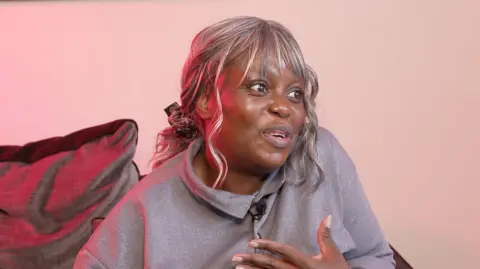
Amanda James-Hammett was just 37 when she had a stroke while doing the dishes at home.
"I heard a pop in my head, like a big bubble," she said.
"I tried to scream, but it wasn't a normal scream. I knew something wasn't right."
Within hours, Amanda had lost the ability to speak and move her right arm. She would later have to relearn how to talk, read and carry out everyday tasks.
Six years on, she has participated in a nationwide NHS trial testing a new "at home" device that it's hoped could help stroke survivors regain hand and arm movement.
"It's about freedom," Amanda says. "It's given me my freedom back."
The technology is being tested at 19 NHS sites across the UK, led by Sheffield Teaching Hospitals NHS Foundation Trust in partnership with the University of Sheffield.
Researchers behind the £2m study - known as the Triceps trial - say it is the largest trial of brain stimulation and stroke ever conducted. It aims to recruit around 270 people.
"Stroke is an interruption to the blood supply to the brain," says Dr Sheharyar Baig, a neurologist at Sheffield's Royal Hallamshire Hospital.
"When the blood supply is interrupted, unfortunately the brain stops functioning in a certain area. That can lead to all manner of symptoms, from weakness to visual problems and speech problems."
- Face weakness – it might be hard to smile, and one side of your face may droop
- Arm weakness – you may not be able to fully lift both arms and keep them there because of weakness or numbness in one arm
- Speech problems – you may slur your words or sound confused
People displaying any of these symptoms are advised to call 999.
Dr Baig says stroke is "the leading cause of adult-onset disability in the UK", affecting about 100,000 people a year.
More than a million people living with its long term effects, he says.
Around half of stroke survivors experience ongoing arm weakness, which can range from loss of dexterity to no movement at all.
It can make everyday tasks such as dressing, cooking and working difficult.
With a knock-on effect of adding to pressure on health and social care services, finding ways to help people shift their recovery from hospital to their own homes can be vital.
Participants in the Triceps trial use a small electrical device that sits inside the ear and stimulates the vagus nerve - a major nerve connecting the brain and abdomen - while carrying out rehabilitation exercises.
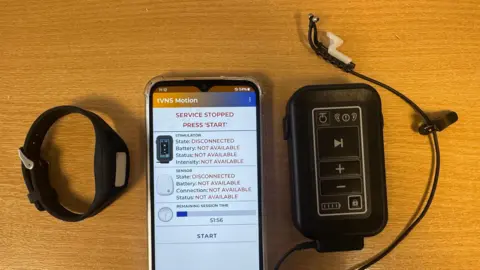
The device, resembling a wired earphone, sits in the ear. It works alongside a portable device worn on the wrist, connected to smartphone.
"The recovery process is unfortunately quite slow for many people," Dr Baig says, adding it can involve lots of effort and hours of rehabilitation.
"So we're interested in ways we can boost the effects of rehab and create a brain environment that's more responsive to it."
Unlike earlier versions of vagus nerve stimulation, which required surgery to implant a device, this treatment is non-invasive and can be used at home.
Dr Baig adds the pulses sent by the ear piece are set at a level to operate comfortably and without pain.
Amanda used the device for up to an hour a day as part of her rehab over 12 weeks, combining it with exercises and everyday tasks.
"At first I didn't think it was going to work at all," she says.
"But after a couple of weeks, I started to see changes in my hand."
One of the biggest milestones for her was returning to sewing – a passion she could not initially pursue after her stroke.
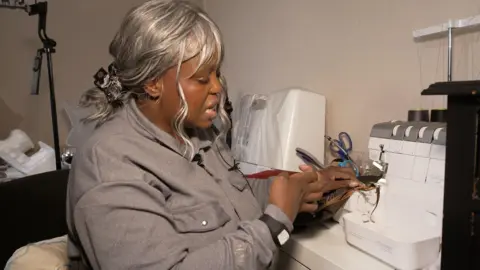
Amanda is back in the sewing room
Amanda says she feels like "a new woman" now that she can cut material and use her sewing machine again.
"I can put my socks on, I can do my shoes, I can do my house," she tells the BBC.
"I don't have to wait for anyone else."
So far, more than 200 people have taken part in the trial.
While researchers do not yet know who is receiving active stimulation and who is receiving placebo, they say early signs are promising.
"We have seen some wonderful improvements in people's arm function," Dr Baig says.
But he also stresses the treatment is not a cure, rather something they hope will help people in everyday life.
"Somebody who was unable to carry a cup of tea with one arm can now walk from room to room holding it stably," he says.
"Another person set their post-stroke personal best in a 5K run and noticed their arm function was better when they were running."
The results of the Triceps trial are also being closely monitored by the Stroke Association, which is part-funding the research.
"The team are doing brain imaging and taking blood tests because we know that some stroke patients really respond well to this technology while some don't," said Maeva May, the charity's associate director of systems engagement.
"We want to understand what patients respond best and how."
Dr Baig says if effective, the tech could be "quite scalable" because it is affordable, convenient and can be easily integrated into existing rehab services.
For Amanda, the impact is already clear.
"It's about being independent again," she says. "Those small things make a big difference."



