1 hour ago
5
1 hour ago
5

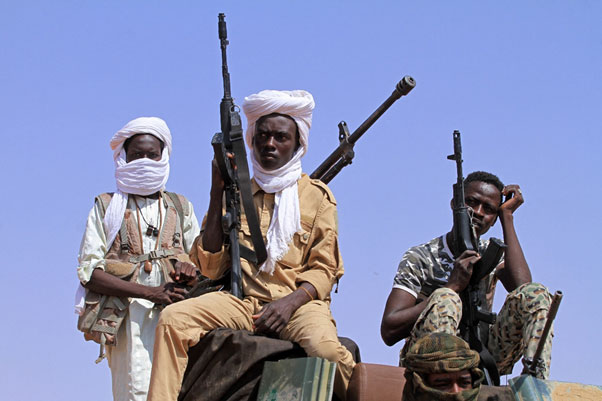 A group of armed defectors from the RSF arrives in the west of Omdurman on 19 August 2026. Credit: Ebrahim Hamid/AFP
LONDON, September 21 (IPS) - Sudan’s civil war grinds on. It’s close to three and a half years since the Sudanese Armed Forces (SAF) and the Rapid Support Forces (RSF) militia began their battle for supremacy, and the two forces and their allies continue to slaughter civilians with impunity. As a recent UN report makes clear, the killing is enabled by numerous foreign powers that continue to supply weapons, personnel and logistical support. They have made a civil conflict their proxy war, and their self-interest is sustaining the killing.
Drone warfare
Things are relatively quiet in the capital, Khartoum, where the curfew was recently lifted following its recapture by the SAF last year, but the RSF still controls significant areas, with fighting concentrated in the Darfur and Kordofan regions to the west and Blue Nile state in the southeast.
Both sides now extensively use drones to kill civilians. In February, a suspected RSF drone strike on an aid convoy in South Kordofan killed three humanitarian workers and wounded four more. In May, a suspected SAF drone strike on a crowded market in Ghubaysh, an RSF-controlled town in West Kordofan, killed 28 people as they shopped for food. In August, another likely SAF strike on a court session in an RSF-controlled village killed 35 people.
The RSF are attacking El Obeid, a city of around half a million people in North Kordofan. RSF drones have hit hospitals and schools. People fear a repeat of what happened when the RSF took the city of El Fasher last October. The UN’s Fact-Finding Mission concluded that the ensuing massacre, in which the RSF killed at least 60,000 people, bore the ‘hallmarks of genocide’, with ethnically targeted killings and widespread sexual violence.
Humanitarian and civic space emergency
The war has caused the world’s largest humanitarian crisis. Over 11 million people have been forcibly displaced within Sudan or to surrounding countries, and around 20 million are experiencing acute food insecurity.
There’s a great need for the help civil society offers, but it’s hard for humanitarian organisations to provide aid because of security dangers and access and movement restrictions. The Sudanese government is also attacking the ability of civil society organisations to operate. In February, authorities revoked the licences of four organisations with missions to provide aid, help victims and promote peace.
Journalists, particularly women journalists, are under attack, making it harder to tell the truth about what’s happening on the ground. In January, the Sudanese Journalists Syndicate recorded that 14 journalists and other media workers had been killed in 2025. In December 2025, it was reported that 40 per cent of women journalists had experienced sexual assault, physical violence, harassment or threats.
Foreign powers behind the war
Sudan’s people can expect little help from the deadlocked UN Security Council. In August, the US government proposed a resolution to expand an arms embargo that currently applies to Darfur to the whole country, explicitly including drones. The Sudanese government condemned the proposal and Russia rejected it, which, given its veto power as a permanent member, means the resolution won’t advance further unless significantly watered down.
Russia initially sold weapons to both the RSF and SAF but more recently has swung behind the SAF, becoming a major arms supplier in return for gold and a potential Red Sea naval base. It’s joined by several other states with a direct stake in the conflict. The UN’s Fact-Finding Mission has set out how the SAF are using foreign-supplied drones while transnational networks are keeping the RSF supplied.
Alongside Russia, states that supply arms or other military support to the SAF, or have done so at some point since the war began, include Egypt, Eritrea, Iran, Libya, Qatar, Saudi Arabia, Somalia, Turkey and Ukraine. Those that have backed the RSF in various ways include the Central African Republic, Chad, Ethiopia, Kenya, South Sudan, Uganda and, most notoriously, the United Arab Emirates (UAE). Weapons originating from countries including Canada, China, Israel and the UK have also been used. In most cases, states deny involvement.
There’s ample evidence that the UAE extensively supplies the RSF with mercenaries and weapons via African transit routes, in return for gold and in the hope of securing a regional foothold. The UAE funded Colombian mercenaries who played an active role alongside the RSF in the slaughter in El Fasher. It was recently revealed that individuals and entities linked to the RSF’s leader Mohamed Hamdan Dagalo, known as Hemedti, have acquired properties worth over US$24 million in Dubai, likely paid for with smuggled gold.
The UAE’s reliance on states that border Sudan to allow its convoys to cross brings the risk of conflict spillovers, as seen in alleged SAF airstrikes on a military convoy in Chad in August.
Push for accountability
A new initiative to hold foreign figures accountable offers some hope for justice. In June, the Raoul Wallenberg Centre for Human Rights and a group of civil society organisations made a legal submission to the International Criminal Court (ICC), asking it to investigate several foreign officials for aiding and abetting crimes against humanity, genocide and war crimes in Sudan. The submission provided evidence of the involvement of the governments of Egypt, Iran, Turkey and the UAE.
The ICC has an ongoing investigation into the situation in Darfur, scene of a 2003-2005 genocide. It has confirmed that human rights crimes committed during the current war fall under its jurisdiction as part of this investigation, and in June it announced it had ‘concrete evidence’ linking RSF leaders to atrocities in El Fasher.
It’s vital that leaders responsible for human rights crimes face justice, and this must include the leaders of the countries waging a proxy war. If there is to be peace and justice, the impunity of the foreign powers that are sustaining the war must be challenged.
Andrew Firmin is CIVICUS Editor-in-Chief, co-director and writer for CIVICUS Lens and co-author of the State of Civil Society Report.
For interviews or more information, please contact [email protected]



© Inter Press Service (20260921044926) — All Rights Reserved. Original source: Inter Press Service