5 months ago
31
5 months ago
31

Jonathan GeddesBBC Glasgow and West reporter

 Michael McGurk
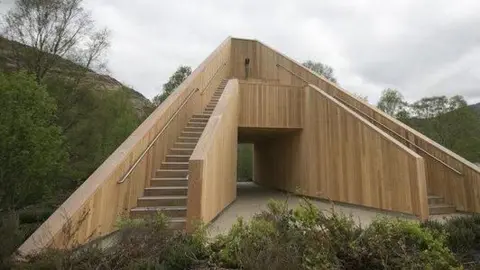
An Ceann Mor has now been removed entirely due to structural concerns
A pyramid-shaped viewpoint on Loch Lomond that was hailed for its "sustainable timber" has been removed because the wood rotted away.
The £280,000 structure - named An Ceann Mor - was placed at a secluded spot at Inveruglas, on the west of the loch, in 2015 to offer views of the Arrochar Alps and Ben Lomond.
However Loch Lomond and the Trossachs park authority said "significant structural issues" were found with the tower due to a design flaw that did not include enough room for drains and ventilation.
Water and moisture then became trapped within, rotting the timber, and the damage was so substantial that planned repairs were scrapped due to the cost.
The site itself has been cleared, and mentions of the tower have been removed from the park authority's website.
The designers told BBC Scotland News the plans were overseen and signed off by the authority's senior architect.
An Ceann Mor - which means large headland in Gaelic - was opened by the Scottish government's then rural affairs minister Richard Lochhead.
At the time it was described as being "clad in sustainable timber which, over time, will fade to a silver-grey to blend in with the landscape."
However the timber itself showed signs of degradation within several years of the tower opening to the public.
The top of the structure was closed to the public in 2023.
Nick Kempe, who runs the Parkwatch website and blog that aims to monitor Scotland's national parks, first wrote about problems developing at the site three years ago.
He told BBC Scotland News: "From a lay perspective, the wood was rotting, and the reason it was rotting was almost certainly down to the timber used, how it had been treated and how it had been maintained.
"There were similar issues with the Bracklinn Falls bridge in Callander."
A 20-tonne wood and copper bridge costing £110,000 was installed there in 2010, but was deemed unsafe about a decade later.
A new steel bridge replaced it in 2023.
 Nick Kempe
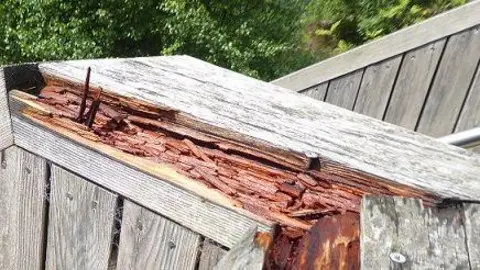
Rotting timber had been spotted at the site in recent years
Pictures taken three years ago at the An Ceann Mor showed steps rotting away considerably.
Kempe said continual investment was needed to keep sculptures like An Ceann Mor in use, beyond initial government funding used to establish the project.
A spokesperson for the national park authority said it had originally scheduled repairs in the 2024/25 financial year.
They added: "Following further investigation into the condition of the structure ahead of planned repairs going ahead, significant structural issues were identified, indicating that the repairs required would be substantial and economically unviable."
When asked what had caused the timber to rot, the spokesperson said: "The primary cause of the structural deterioration was a design issue which did not include adequate drainage and ventilation provision.
"As a result, water ingress occurred, leading to pooling and moisture becoming trapped within the structure, which resulted in timber rot."
The national park authority said it would learn from the experience and remain committed to sustainable design, and that there had been "significant public value and enjoyment" in An Ceann Mor during its lifespan.
Alternative proposals for the site will now be developed.
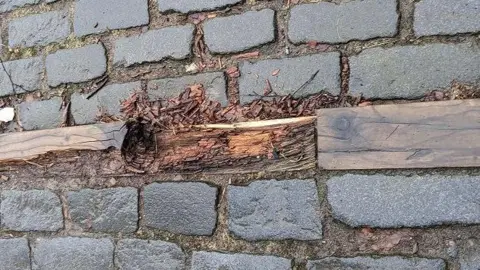 Nick Kempe
A design issue was blamed for the structure rotting away
BBC Scotland News was also contacted by a resident in the area, who queried the lack of information being shared about the closure of the tower.
The person, who did not want to be named, said: "I would have expected some sort of press release by the park authority to the public or at least to the travel trade.
"I had to find out by chance. Why wasn't this news brought to public attention?"
The park authority said it had contacted stakeholders, including SSE as the landowner, local businesses and its own destination management group - which includes tourism businesses across the park - about the closure.
The pyramid was part of a a pilot project for the Scottish government's Scottish Scenic Routes initiative, which was aimed at encouraging visitors travelling along picturesque tourist routes to stop and see much-loved views in a new way.
It was designed by Daniel Bar, Stephane Toussaint and Sean Edwards, who formed the company BTE Architecture Ltd in 2014, a year before the structure was opened.
The company was then dissolved three years later, according to Companies House records.
A spokesperson for former BTE Architecture said its design was amended before and during construction, and the completed structure "did not fully reflect our original proposals".
They added: "The Scottish Scenic Routes competition supported emerging architects working with a mentor from the Loch Lomond & The Trossachs National Park Authority.
"In line with the brief, none of our team were registered architects at the time, and the design - including drainage and ventilation provisions - was overseen and signed off by the authority's senior architect.
"BTE Architecture had no involvement in construction, supervision or delivery."
BBC Scotland News has asked the Scottish government for comment.