52 minutes ago
4
52 minutes ago
4

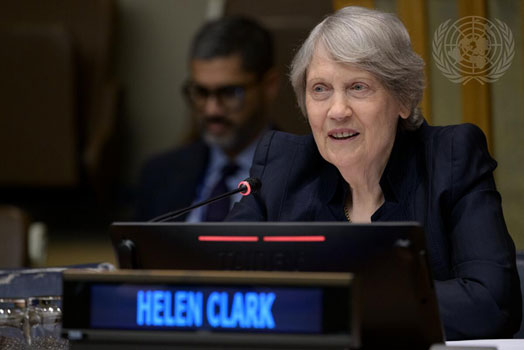 Helen Clark, Chair of the Board of Partners for the Partnership for Maternal, Newborn and Child Health (PMNCH), moderates the event "Financing for Women's, Children's and Adolescents' Health in a Time of Austerity", hosted by the Global Leaders Network. Credit: UN Photo/Manuel Elías
UNITED NATIONS, September 28 (IPS) - In the wake of the largest decline in global health financing on record, the Global Leaders Network (GLN) for Women’s, Children’s and Adolescent Health convened a high-level meeting on September 22 to sustain political momentum for women and children’s health financing. The event, Financing for Women’s, Children’s and Adolescent’s Health in a Time of Austerity, was co-hosted by the Governments of South Africa, Spain, and Tanzania, in addition to the Partnership for Maternal, Newborn, and Child Health (PMMCH).
Throughout the meeting, GLN members repeatedly called for a financing reset for women’s, children’s, and adolescent health (WCAH), warning that reduced global assistance and rising debt could reverse decades of progress. In 2025, official development assistance (ODA) fell to USD 174.3 billion, a 23.1 percent drop from 2024 and the largest annual decline on record. Simultaneously, the external debt in low- and middle-income countries reached a record USD 8.9 trillion, with debt-servicing costs remaining at a historic high. The reduction in assistance, with the increase in debt, has limited governments’ abilities to invest in essential services, leading to consequences for WCAH.
In low- and middle-income countries, an estimated 260,000 women died in 2023 from preventable causes related to pregnancy and childbirth. In 2024, an estimated 4.9 million children died before their 5th birthday from deaths that are preventable with low-cost interventions and access to quality health care. Members of the GLN framed this challenge less as finding replacement funds for the declining aid, but instead, governments need to ensure that existing resources are allocated, protected, and used effectively to deliver improvements in WCAH.
“We know that issues of women, children, adolescent health and well-being can’t be solved by ministers of health alone. They need head of state support, they need minister of finance support, and there are always political choices to be made about what we protect when the resources are scarce,” said Helen Clark, chair of the board of the PMNCH and moderator of the meeting.
Dr. Tedros Adhanom Chebreyesus, WHO Director-General, also called for the protection of health budget lines for WCAH, in particular the protection of sexual and reproductive health in humanitarian settings, and stronger accountability and reporting of results. “A policy without a budget is a press release. A commitment without financing is a promise already broken,” he said.
During Tuesday’s meeting, representatives continued to stress the point of investing in primary health care. In particular, the importance of midwives, community health workers, vaccines, medications, nutrition services, clinics, and referral systems that women, children, and adolescents depend upon. Helga Fogstad, Director of the UNICEF Health Programme, urged governments to protect these foundations when preparing the 2027 budgets. Fogstad urged the prioritization of “domestic resources for what has the greatest impact, ensuring essential medicines, vaccines, and nutrition supplies are available where they are needed and investing in enough trained, equipped, and paid healthcare workers to reach every community”.
Diene Keita, Executive Director of UNFPA, stressed the importance of investing in maternal care and family planning: “World leaders and financial experts agree, investing in women and girls delivers unbeatable returns.”
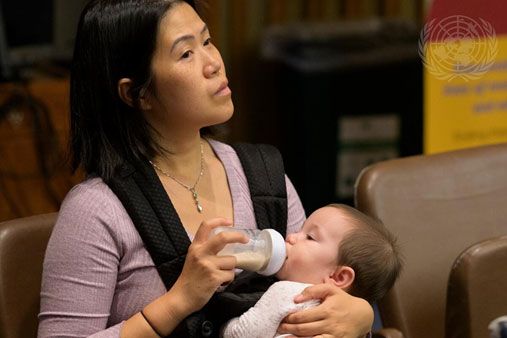 An audience member at the event “Financing for Women’s, Children’s and Adolescents’ Health in a Time of Austerity”, hosted by the Global Leaders Network. Credit: UN Photo/Manuel Elías
Country examples presented during the session illustrated how investing in WCAH has been translated into policy. For example, under Nigeria’s Health Sector Renewal Investment Initiative, Nigeria has moved away from fragmented donor-led programs towards greater country ownership, stronger alignment of resources and accountability for results. Nigeria has already committed nearly $3 billion in domestic health financing over five years in addition to USD 2 billion of US support. The result of this has been revitalizing more than 4,000 primary health centers, retraining 80,000 frontline health workers, a 34 percent increase in deliveries by skilled birth attendants, and a 22 percent reduction in maternal mortality among women delivered in the facilities.
A tension emerged during the session between greater national ownership for countries and the continuing need for international solidarity. Speakers across the board discussed the need for blended finance, pooled funding, and debt-for-health swaps, while institutions like the World Bank and Islamic Development Bank advocated for moving isolated projects into integrated national systems. Issa Faye, Director General for Global Practices and Partnerships at the Islamic Development Bank, stressed how the “challenge now is to help the countries move beyond the short-term responses”.
“We should go away from project by project to really act in a more massive way through the system. We need to talk about the system, not the project,” said Faye.
In closing, the GLN committed to stronger country-led financing, domestic resource mobilization, and appropriately designed financing mechanisms. In addition, donors were called upon to align assistance with countries’ national plans. The focus was that austerity cannot become health austerity; instead, political declarations and financing plans must protect frontline services and lead to a measurable reduction in preventable deaths.
IPS UN Bureau Report



© Inter Press Service (20260928043411) — All Rights Reserved. Original source: Inter Press Service