1 hour ago
2
1 hour ago
2

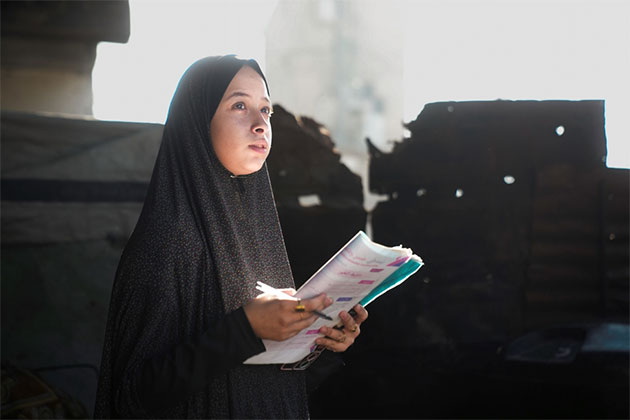 Mariam Daher preparing for her Tawjihi examinations in the temporary learning spaces in Gaza. Credit: Education Above All Foundation
DOHA, Qatar, October 2 (IPS) - In the 21st century, getting a pencil into Gaza became international news. In January, after more than two years of restrictions, UNICEF finally brought in learning kits with pencils and exercise books. Textbooks stayed out. By then, the UN had recorded damage to 97.5 per cent of Gaza’s schools.
If a pencil makes headlines, consider what a national examination demands: question papers printed for thousands of students, answer sheets scanned, halls furnished and staffed. In Gaza, education officials started by pulling damaged photocopiers from beneath the rubble, stripping their usable parts and rebuilding enough machines to keep the exam alive. It worked. More than 95,000 students have sat the Tawjihi, the national secondary school examination that decides who can compete for a university place.
This week, world leaders gathered at the UN General Assembly under the banner of “a United Nations that delivers for all“. The effort behind Gaza’s examination poses an uncomfortable question to that promise: when does celebrating a solution make it easier to tolerate the problem? Scholars writing from Gaza have warned that praising Palestinian resilience reassures outside observers and releases them from the duty to act.
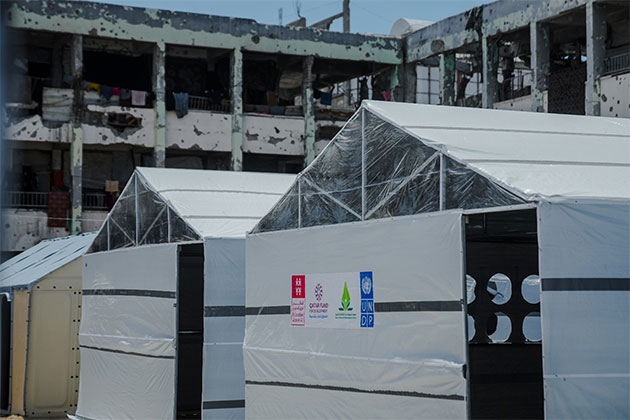 At a school damaged by the war near Mashrou’ Amer in southwestern Gaza City, Education Above All Foundation and UNDP have established 10 temporary learning spaces. Credit: Education Above All Foundation
Israel classifies thousands of items as “dual-use“, spare parts among them, and bars or limits their entry. Technicians harvested parts from other machines. Repairing the printers and scanners took more than 90 days. The printers ran on old ink stocks, because new ink faced restrictions too. Until recently, paper itself could not enter Gaza.” and drop the fallback plan after it.
Exam halls also needed seats and desks. Little wood reaches Gaza. Carpenters build tables from scrap and shipping pallets, and families burn whatever they find to cook and keep warm. Staff repaired chairs and desks with timber from the pallets that carry aid. Every liter of fuel for an examination center required coordination. All of it happened under strikes that never fully stopped, which have killed more than 1,300 Palestinians in Gaza since the ceasefire took effect.
An examination also needs people. Every center needed invigilators while many education staff receive only a fraction of their salary. Before assigning anyone, the ministry first had to establish who was still alive. The war has killed more than 21,000 students and educational staff since October 2023.
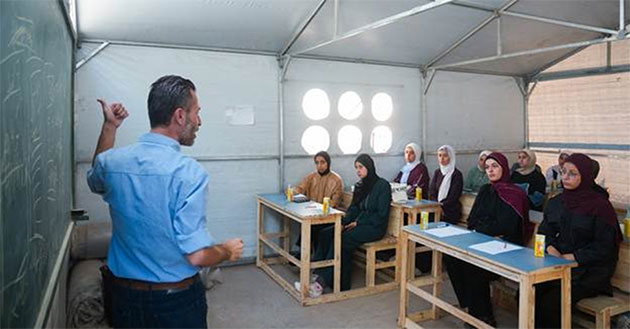 A school teacher leads a lesson inside one of Gaza’s temporary learning spaces established by Education Above All Foundation and UNDP.
Credit: Education Above All Foundation
This year, Gaza’s candidates took the Tawjihi online, many on phones in tents and cafés, while the ministry worked to bring the exam back into halls. With support from the State of Qatar, Education Above All Foundation, UNDP and the ministry have set up 110 learning spaces, partly for that purpose. Planners intended these spaces, a mix of prefabricated units and tents, as a transition. Gaza’s students are using them for years, while sun, heat, humidity and cold wear them down.
Gaza’s people now crowd into less than 40 per cent of the Strip. Crews must clear rubble and check for unexploded ordnance before they can build. When they clear land for a learning space, displaced families can move onto it and stay. Others shelter in partly destroyed buildings. A school site now competes with the most basic need of all: somewhere to live.
Picture one of those 95,000 candidates. She has studied for this exam for years, first at a desk at home, then by phone light in a tent. The war has taken her father, perhaps her mother too, and most of the family who would have waited for her results. She may walk on crutches where a leg used to be. Strikes still fall at night, and she revises anyway. All she wants is the chance to sit the exam. Behind that chance stand a salvaged photocopier, a rebuilt desk and a negotiated liter of fuel, each one liable to fail. The UN reports that shortages once managed through reuse have become unmanageable, and critical systems are failing. Judged against a cancelled examination, against a school able to order a replacement part, it reveals an avoidable burden.
I am from Gaza, and I work for one of the foundations that funds this response. That makes the question personal: have we become so used to celebrating what Palestinians can salvage that we no longer ask why they must salvage it? An examination held amid continuing strikes is an achievement. It is also evidence of a world that has allowed the conditions for education to be dismantled.
As the speeches in New York wind down, leaders can measure their words against practical tests. Let paper, printer parts, school furniture and textbooks into Gaza without months of negotiation. Fund classrooms built to last years, not seasons. Pay the teachers who keep the system running. Gaza’s educators have shown what they will do to keep education alive. The question before the world is what it would take for Gaza’s schools to stop needing miracles.
Hani Shehada, Palestinian from the Gaza Strip, and is Regional Manager at Education Above All Foundation’s Al Fakhoora programme.
IPS UN Bureau



© Inter Press Service (20261002055448) — All Rights Reserved. Original source: Inter Press Service