1 month ago
21
1 month ago
21

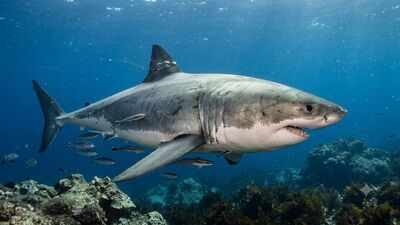
The Atlantic's largest satellite-tagged male great white shark has surfaced again near North Carolina's Outer Banks, offering marine scientists another glimpse into one of the ocean's most remarkable migrations.
Known as Contender, the 14-foot, 1,700-pound shark briefly triggered its satellite tag after travelling more than 7,000 miles since being tagged in 2025. Although the transmission was too short to pinpoint his exact location, researchers believe he is continuing his annual journey towards northern feeding grounds.The latest detection also highlights how satellite tracking is helping scientists better understand the movements, habitats and long-term recovery of great white sharks, while putting Contender's impressive size into perspective alongside Deep Blue, the world's largest known great white shark.
The largest satellite-tagged male great white shark continues its Atlantic migration
The latest update arrived when Contender's satellite tag briefly broke the water's surface, allowing it to communicate with orbiting satellites before disappearing beneath the sea again. The transmission lasted only moments, leaving scientists unable to determine the shark's precise location.Even so, the detection was enough to indicate that the animal is moving along the eastern coastline of the United States.
Marine biologists following the project believe the shark is continuing the familiar northward journey that many adult great whites undertake as summer progresses.Adult white sharks do not remain in one place for long. As ocean temperatures shift through the seasons, they regularly travel between warmer southern waters and richer feeding grounds farther north.The waters around Cape Cod and Atlantic Canada become attractive destinations during late spring and summer because they provide abundant prey and conditions that suit the species.
Grey seals, along with large shoals of fish, form an important part of the food available in these regions.Closer to the US northeast coast, white sharks are also known to feed on schools of menhaden gathering near shorelines, including areas around Long Island. Tracking individual sharks helps scientists understand how these seasonal movements connect different parts of the Atlantic ecosystem.
A shark that has travelled thousands of miles
Contender was fitted with a satellite tag during a research expedition off the coasts of Florida and Georgia in January 2025 as reported by The Sun.
At the time, the mature male measured roughly 14 feet in length and weighed close to 1,700 pounds, making him the largest male white shark ever tagged by researchers working in the western North Atlantic.Since then, his recorded route has stretched for more than 7,000 miles. The shark has travelled between waters off Florida and the Gulf of St. Lawrence in Canada, reflecting the remarkable distances adult great whites routinely cover during their lives.The tracking device attached to Contender is expected to continue sending data for several years whenever it surfaces long enough to connect with satellites. Each successful transmission allows researchers to build a more detailed record of his movements.
Why scientists keep watching
Satellite-tagged sharks provide information that would otherwise be almost impossible to collect. Their journeys reveal where mature animals spend different parts of the year, which habitats they rely on and how they respond to changing environmental conditions.Researchers also use these long-term records to improve understanding of breeding populations and recovery trends. Every new location contributes to a growing dataset that can support future conservation work and improve knowledge of one of the Atlantic's most closely studied marine predators.
Why Deep Blue is still the biggest great white shark ever recorded
Although Contender is an exceptionally large male, he is not considered the biggest great white known to science.That distinction is widely associated with Deep Blue, a famous female great white estimated to measure around 20 feet in length and weigh roughly 4,500 pounds.
Deep Blue has been photographed and filmed in waters near Hawaii and has become one of the most recognisable individual sharks ever recorded.The difference also reflects the species' biology. Female great white sharks typically grow considerably larger than males, sometimes reaching sizes that are rarely matched by their male counterparts.
Tracking a species that still holds many mysteries
Great white sharks remain among the ocean's most wide-ranging predators, capable of travelling vast distances across entire coastlines and even between ocean basins.
Despite decades of research, many aspects of their movements and behaviour are still being pieced together through satellite tracking projects.Contender's latest appearance near North Carolina adds another waypoint to a journey that is far from finished. Although the exact spot where he surfaced remains unknown, the brief signal suggests his seasonal migration is continuing much as scientists expected, offering another valuable insight into the life of one of the Atlantic's most impressive marine animals.