
 5 months ago
39
5 months ago
39


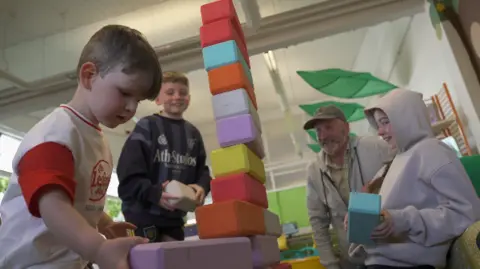 Hannah Karpel / BBC
Recently the UK government announced new guidance which states children under the age of five should be limited to one hour of screen time a day, while under-twos should not be watching screens alone.
The guidance suggests "screen swaps" - taking screens away to read stories together or playing games.
But is that easier said than done? Parents have told the BBC about how they try to prioritise meaningful ways to connect with their children, as busy schedules, rising living costs and the pull of technology continue to dominate family life.
For Errol Murray, founder of Leeds Dads, helping families reconnect has become a personal mission.
 Hannah Karpel / BBC
Errol and son Isaac have been encouraging more dads in the community to join them in their weekend adventures
Every Saturday morning, he heads out with his 10-year-old son Isaac and a group of local fathers to try something new - from discovering insects at a nearby lake to attending soft play sessions that include a free breakfast.
It makes a nice change from being on screens, says Errol, describing the change in his son's behaviour: "When you give them a five or 10-minute warning to come off the screens, we find the response is still the same. They get angry, they get upset, they get agitated.
"You've got to find something that makes them turn away from phones, screens and tablets, because you get trapped there."
The father-son duo particularly enjoy group walks in the park, especially when Isaac can take his remote-control car along too.
"Doing something with your kids, instead of saying 'see you when you get back', means you're able to actively build a connection," he says.
As Errol's network of Leeds Dads continues to grow, many parents admit to grappling with how to limit technology and build a connection with their children.
New research from the National Literacy Trust has found a 25% drop in the number of parents who play with their children daily since 2019.
Experts say these interactions are vital, and not just emotionally, but biologically too.
Research led by Dr Samuel Forbes at Durham University and Prof John Spencer at the University of East Anglia recorded more than 6,000 hours of language exposure among 163 babies and toddlers over a seven-day period.
The study focused on the quality of language children were hearing, particularly in-person human interaction and conversation, rather than just watching or listening to speech on a screen.
The researchers used recording devices to monitor the interactions the children engaged in over the course of a week, and then, using MRI scans, examined their levels of myelin - a substance that helps signals travel efficiently between nerve cells.
They found that children exposed to better interactions and more engaging language had greater myelination, suggesting they could process language more quickly and effectively.
"The number of words a child hears at these early ages is literally shaping their brain," says Forbes.
"Every interaction is crucial. It's never too late to begin talking to your child, and it's never too late to interact in different ways. We can see what it's doing to the brain."
Kirsty MacDonald, head of early years at the National Literacy Trust, says many families, "particularly those experiencing poverty, can lack the support, information and resources needed to confidently nurture their child's language, communication and literacy development".
MacDonald says there are several key factors which hinder parents from restricting their children's screen time adequately, including limited time due to work commitments, as well as the cost and availability of local activities.
Watch: The government's advice on screen time for under-fives explained
For some parents, screens can still play a role in bonding with their children.
Sam, another father in the Leeds Dads group, says his family does use screens at home, but with a creative twist.
In his spare time, he produces music using a digital synthesiser on his tablet, a hobby he now shares with his children, aged five and six.
"I've always really loved music," he says. "But when I became a dad, I struggled to find things I could do for myself.
"Now the kids are old enough to enjoy and appreciate it, it's become a really beautiful thing."
 Hannah Karpel/ BBC
Sam found new ways of engaging with his children by involving them in his own hobby of music production
But introducing new activities to their routine isn't always easy, he admits, particularly when everyone is tired after work or school.
"You have to just seize your moments", he says.
"There are definitely times where you have to just go, 'Look, everybody is tired, everyone needs a rest, the best thing for us to do is just watch some TV together.'"
Despite these challenges, some communities are finding creative ways to help.
Local libraries are seeing a resurgence in popularity, helped by new spaces being adapted to encourage interactive learning.
At Irlam Library in Salford, the outdoor area now includes "story nooks" and immersive play-based reading activities.
Teacher Abigail has begun taking her two daughters, aged two and seven, to explore the space together.
Watching them both play, socialise and build their bond has been a particular highlight for Abigail.
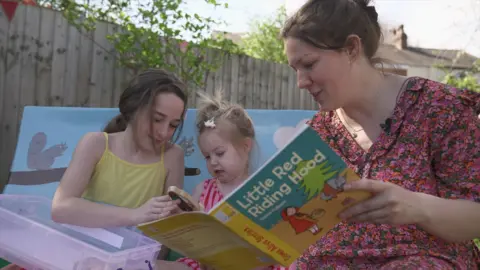 Hannah Karpel / BBC
Abigail took her young daughters to the local library's reading garden during the half term
"It's just about trying your best," she says.
Her eldest daughter Ava has her own tablet, but Abigail has tried to focus on discovering her interests away from tech instead - with painting, for example.
Listening to her children and following their ideas for activities has brought its own surprising list of experiences too.
"We had a picnic in our front garden, which was their idea," she says.
"You often don't even have to think of things to do if you ask them. It might be a little bit bizarre, but it takes the choice out of your hands."


