
 7 months ago
30
7 months ago
30

Pallab GhoshScience Correspondent
 BBC
BBC
On Valentine's Day, there's the temptation to believe that somewhere out there is "The One": a soulmate, a perfect match, the person you were meant to be with.
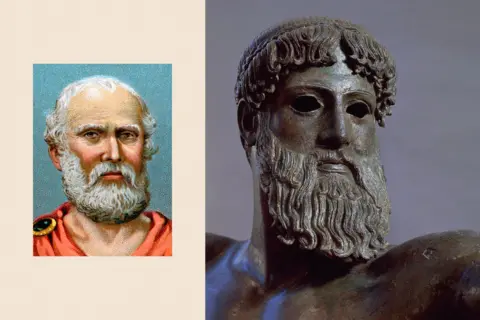
Across history, humans have always been drawn to the idea that love isn't random. In ancient Greece, Plato imagined that we were once whole beings with four arms, four legs and two faces, so radiant that Zeus split us in two; ever since, each half has roamed the earth searching for its missing other, a myth that gives the modern soulmate its poetic pedigree and the promise that somewhere, someone will finally make us feel complete.
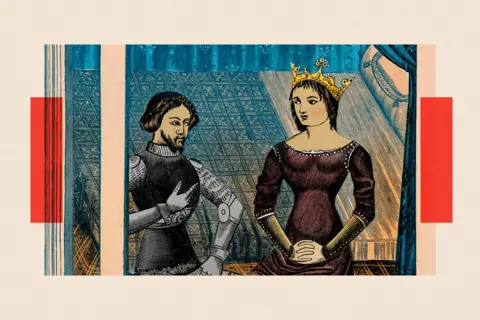
In the Middle Ages, troubadours and Arthurian tales recast that longing as "courtly love", a fierce, often forbidden devotion like Lancelot's for Guinevere, in which a knight proved his worth through self-sacrifice for a beloved he might never openly declare.
 Getty Images
Plato (left) imagined humans were once whole, with four arms, four legs and two faces, before Zeus (right) split them, leaving each half searching for its other
By the Renaissance, writers such as Shakespeare were talking of "star-crossed lovers", couples bound together by an overwhelming connection yet pulled apart by family, fortune or fate, as if the universe itself both wrote their love story and barred them from a happy ending.
In more recent times, Hollywood and romance novels have sold us fairy tale love stories.
But what does the latest science say about soulmates? Is there a particular special someone out there for us?
How we fall for 'The One'
Viren Swami, Professor of Social Psychology at Anglia Ruskin University (ARU), in Cambridge, has traced our contemporary European understanding of romantic love back to medieval Europe and those stories of Camelot, Lancelot, Guinevere and the chivalry of the knights of the round table that swept across the continent.
"These stories first pushed the idea that you should choose one other individual as your companion and that companion is for life," he says.
"Before that, in much of Europe, you could love as many people as you like, and love was fluid, and it was often not about sex."
Over time, as people are uprooted from their agricultural communities as industrialisation tears apart people's familiar attachments, individuals become "alienated", he says. "They start looking for one other individual to save them, to save them from the wretchedness of their lives."
 Getty Images
Viren Swami believes today's ideas about romantic love can be traced back to medieval European stories like Lancelot and Guinevere
Today's dating apps turn that story into an algorithm, which Swami calls "relation-shopping". The search for a soulmate turns into the opposite of what they are looking for: "For many people, that's a really soulless experience.
"You're shopping for a partner… going through possibly dozens of people on the dating app until you get to a point where you go… I need to stop," he says.
Jason Carroll, Professor of Marriage and Family Studies at the US Brigham Young University, based in Provo, Utah, is sympathetic to the longing for "The One".
"We are attachment-based creatures," he says. "We desire that bond." But in his lectures, he tells students they need to leave the idea of a soulmate, without giving up their desire for The One.
It sounds like a contradiction, but for Carroll, it's the difference between destiny and graft.
"A soulmate is just simply found. It's already pre‑made. But a one and only is something two people carve out together over years of adapting, apologising, and occasionally gritting their teeth," he says.
Carroll's argument draws on decades of research, which he put together in his report, The Soulmate Trap, much of which distinguishes between what psychologists call "destiny beliefs" - the idea that the right relationship should feel effortless - and "growth beliefs", which focus on what partners can do to make things work.
In a widely cited series of studies in the late 1990s and early 2000s led by Professor C. Raymond Knee at the University of Houston, researchers found that people who believed relationships were "meant to be" were far more likely to doubt their commitment after conflict. Those with more growth-minded views tended to stay more committed, even on days when they argued.
Those with growth-based views, Carroll argues, still want something special, but expect rough patches. "They ask… what can they do to make their relationship better, have improvement and have growth?"
 Getty Images
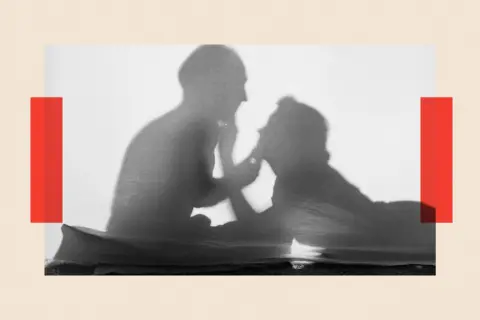
Research suggests people with "growth" beliefs about relationships still want something special, but expect challenges along the way
In his view, the soulmate belief is a trap - not the romance itself, but the expectation that love should never be hard. The most "soulful" part of a long relationship, he says, is not a cinematic charge, but having "front-row seats not only for each other's strengths, but... [their] challenges and weaknesses".
"That's a pretty sacred space," he says. "We only know those things because they've let us be there."
For Carroll, when love is treated as fate, people become less willing to do the unshowy work that actually keeps love alive. Carroll says the soulmate trap makes it much harder when a relationship hits its first serious snag.
"The first time there's any type of struggle, the immediate thought is, 'well, I thought you were my soulmate. But maybe you're not, because soulmates aren't supposed to deal with things'," he says. "But if relationships are going to go long term, it's never just going to be a downhill run."
Vicki Pavitt, a London-based love coach, often helps people who thought they'd found their soulmate, only to discover that the fairy tale came with emotional manipulation, flakiness, and a constant sense of anxiety.
"When there is a lot of chemistry and the spark, I think that can sometimes be about opening old unhealthy patterns, like old wounds", she says.
"A person who is inconsistent or plays a bit hot and cold can make you feel 'I can't wait to see them again', but what's really happening is they're giving you so much anxiety and that it has you wanting more".
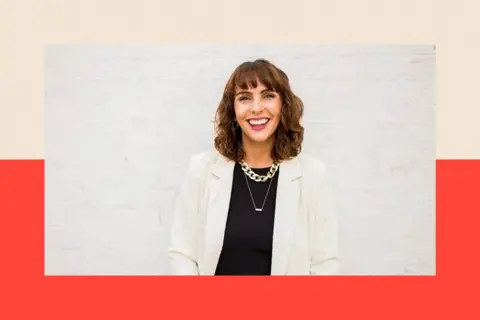 Vicki Pavitt
Love coach Vicki Pavitt often works with people who thought they'd found a soulmate, only to find the relationship brought anxiety
Pavitt says what we feel to be destiny may be a pull from our nervous system recognising something that hurt us before and trying to fix it, a pattern therapists call a trauma bond.
This bond can seem like love, she says, and leads to people magnetically drawn into unhealthy dynamics because they are familiar, not because they are the perfect match.
One study often cited is by Canadian psychologists Donald Dutton and Susan Painter. In research published in 1993 while they were at the University of British Columbia, they followed 75 women after they had left abusive partners.
The team measured how strongly the women still felt attached to their exes and compared this with what their relationships had been like.
They found the strongest bonds were not in women who had consistently been abused, but in those whose partners alternated between charm and cruelty.
 Getty Images
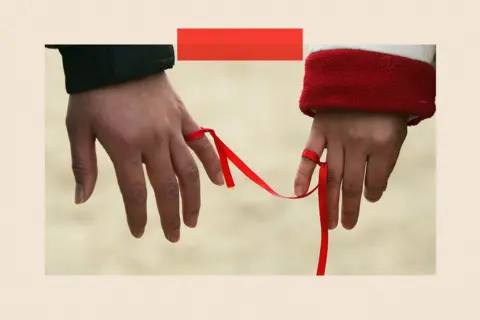
Pavitt says what feels like destiny can sometimes be a trauma bond
Dutton and Painter argue that this trauma bond helps explain why people can feel magnetised back to relationships that are objectively bad for them – because the mix of danger and affection is familiar, not because it is healthy.
It is that distinction Pavitt tries to surface in coaching: "It's about discerning whether the chemistry you feel is showing me this person's compatible with me or if it is a familiar sense of anxiety.
"In my language, I never talk about soulmates," she says. "I don't personally believe that there is one person for everybody... but I do believe that we become "The One" for someone."
If ruling out the existence of a soulmate sounds unromantic, the biology of attraction points in the same direction.
Hormonal contraceptives may subtly reshape how partners feel about each other. Research suggests that pills which flatten the natural ebb and flow of fertility can dampen shifts in attraction that typically occur across the menstrual cycle, potentially altering initial mate choice.
 PA Wire
Some research suggests hormonal contraception may subtly influence attraction in partners
One large study of 365 hetrosexual couples found that women's sexual satisfaction was higher when their current contraceptive status matched what it was when they first chose their partner, hinting that changes in pill use can change how a partner is experienced. These effects are small but could help explain some couples' puzzling shifts in chemistry over time.
If hormones and pills can tilt who feels like "The One", then it becomes harder to argue there is a single, pre‑ordained match – which is where the mathematicians come in.
Psychology and biology offer one way of thinking about "The One", but mathematics puts forward another.
Dr Greg Leo, an economist at Vanderbilt University in Nashville, Tennessee, has come up with a compatibility algorithm. It finds that not only might you have a "One" you have lots of "Ones".
In his Matching Soulmates paper in the journal of Public Economic Theory, everyone is in a computer simulated dating pool, where thousands of digitally created daters rank each other. His algorithm picks "first‑order soulmates": pairs who choose each other in a stable matching. It removes them, and runs it again with those left, and you get second‑order soulmates, and so on.
In his simulations, it was extremely rare for someone to have their mutual first picks; but many people had those that were second or third picks. In this scenario a couple counts as happy if each is near the top of the other's list and neither can find someone they and that other person would both prefer more.
It may only be number crunching, but the love algorithm tells us that there are many viable partners, not just The One.
So how can a couple co-create their Ones?
Jacqui Gabb, Professor of Sociology and Intimacy at The Open University, assessed this in her Enduring Love project, published in the journal Sociology in 2015.
It surveyed around 5,000 people and then followed 50 couples in forensic, sometimes intrusive detail, combining statistics with diaries, interviews and "emotion maps" of what happened in the home.
When she asked people what made them feel appreciated, it wasn't sunset proposals or surprise trips to Paris.
It was "surprise gifts, thoughtful gestures and the kindness of a cup of tea in bed". Warming the car on a cold morning. Picking wildflowers and putting them in a vase. Sharing a private smile at a party.
Quantitatively, what she describes as these "everyday attentive acts" turned out to be much more powerful than grand romantic gestures.
In her survey, 22% of mothers and 20% of childless women picked such small gestures as one of the top two things that made them feel valued – more than big nights out or expensive presents.
Relationship satisfaction in the data wasn't primarily about money or romance; it was about "intimate couple knowledge" and its expression in daily life.
In one young couple's diary given to them for the project, Sumaira describes her partner coming home, the dinner she has cooked, the hug in the hallway, the two of them eating together at the table.
"It's perfect," she writes in her research diary. "Just us and food. What more could I want?"
Then there is a spontaneous dance in the living room, a walk in long grass where she gets scared of the dark, and a photo her partner loves so much he makes it the background on his phone.
It reads like a lovely every day tale, not a fairy tale: no glass slippers, but wellies.
Yet Gabb points out that woven through the sweetness are money worries, family obligations and a history of depression that the couple are learning to manage together.
"The soulmate feeling here doesn't float above life; it is made, inch by inch, by life, in the way the pair meet those pressures," she says.
The science doesn't steal the romance – rather it's there to help it bloom, in good times and bad, according to Carroll.
"I'm pretty comfortable with the aspiration to be in a unique special relationship as long as we remember it needs to be created," he says.
Pavitt thinks "it's fine, helpful, even to have faith that your person is out there, so long as you know there are many people that you could form a really great connection with and stop expecting anyone to be perfect".
As for soulmates, the science points to a paradox. The people who end up with relationships that feel uniquely "meant to be" are often the ones who stopped waiting for fate, turned towards the flawed person in front of them and said, in effect: shall we make something of this?
Additional reporting by Florence Freeman
Top image credit: Getty Images

BBC InDepth is the home on the website and app for the best analysis, with fresh perspectives that challenge assumptions and deep reporting on the biggest issues of the day. Emma Barnett and John Simpson bring their pick of the most thought-provoking deep reads and analysis, every Saturday. Sign up for the newsletter here


