3 months ago
28
3 months ago
28

Priti GuptaTechnology Reporter, Mumbai

 Getty Images
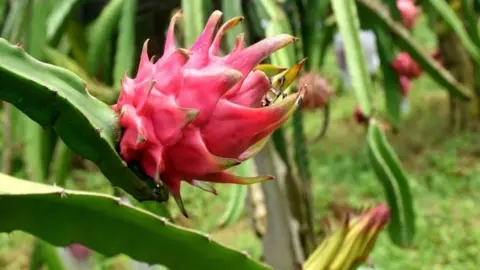
Indian farmers are switching to more profitable dragon fruit
"It was a do-or-die decision," says Arun Srinivas.
In 2020 he abandoned his career in finance, sold all his shares and gold and invested the money in the family farm, in the southern Indian state of Karnataka.
"I wanted to do something on our land that would benefit me both mentally and financially," he explains.
The family farm had been growing coconuts and mango, but he had another crop in mind - dragon fruit.
A little research convinced Srinivas that it might be a good bet.
"It was not just good financial return crop, it also requires very little water and has lower disease risk compared to crops like other fruits, I felt it was the right crop for my land," he explains.
Srinivas approached his new career like an investment project, collecting data and making detailed plans.
"I visited nearly 80 to 100 farms. Spoke to farmers, understood the challenges, profits and risks, and made my own analysis — almost like analysing stocks," he says.
The work paid off. He now cultivates dragon fruit on 11 acres producing around 220 tonnes a year.
 Cheradeep Ma
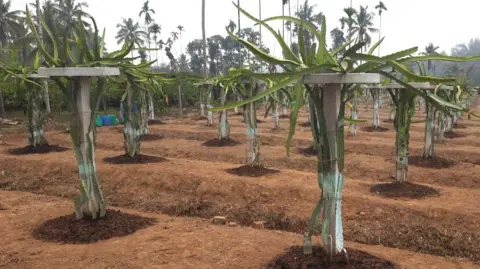
Dragon fruit are a climbing cactus, making for unusual cultivation
Dragon fruit is a climbing cactus, making it an unusual fruit to cultivate.
Usually it is grown on concrete pillars with a circular ring (sometimes a tyre) at the top for the vines to hang over.
Originally from Central America, Vietnam has become the world's leading producer, but India has plans to catch up.
Compared to traditional crops dragon fruit promises higher returns and relatively stable prices.
In 2020, the industry was given a boost when Prime Minister Modi congratulated the farmers of Kutch in Gujarat for their success in cultivating and exporting the fruit.
"Dragon fruit entered India around 2009. At that time, we knew very little about the crop or how to cultivate it," says Dr G Karunakaran, the principal scientist and head of the Centre of Excellence for Dragon Fruit at the Indian Institute of Horticultural Research in Bengaluru.
"Serious research on dragon fruit in India started around 2013–14 when we began systematic studies on its cultivation."
But cultivation really took off after 2021, thanks to media coverage.
"Dragon fruit adoption in India spread like mobile phones, once farmers saw the income potential, everyone wanted to grow it," says Karunakaran.
Unlike mangoes, which have a short harvest season, dragon fruit can be harvested continuously for six months.
"Farmers harvest small quantities every month, which provides a steady income. A family can manage one acre and produce up to 15 tonnes of fruit annually," says Karunakaran.
 Chiradeep Ma
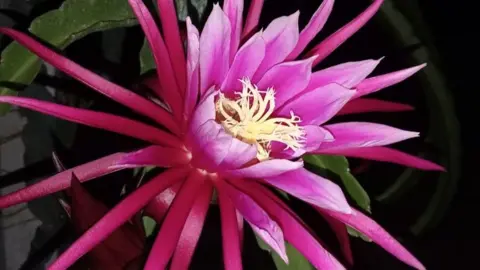
Cactus fruit flowers bloom at night
One quirk of dragon fruit farming is that its flowers only bloom at night and into the early hours of the morning. For many varieties, if you want a crop, then the flowers have to pollinated in the dark, often by hand.
In Karnataka, Srinivas solved that problem by using honey bees.
"Nature has already designed the perfect pollination system. When humans interfere too much, it often disturbs that balance," he says.
For Cheradeep Ma venturing out at night to pollinate dragon fruit plants at his farm in Wayanad, in the southern state of Kerala, could be deadly.
"In Wayanad, going into the plantation at night is risky. We have snakes, wild boars, sometimes even leopards and elephants," he says.
To avoid potentially deadly wildlife he focused on self-pollinating varieties.
Ma moved into dragon fruit in 2020, as an alternative to coffee and pepper cultivation.
Today he has between 80 and 100 varieties on his farm, the ones that perform best in the local climate he sells to other farmers.
That income, plus selling his fruit, has made the farm more financially sustainable.
"Dragon fruit has helped me diversify the farm income. If coffee prices fall or pepper prices fluctuate, crops like dragon fruit helped me sustain the estate," he says.
 Getty Images
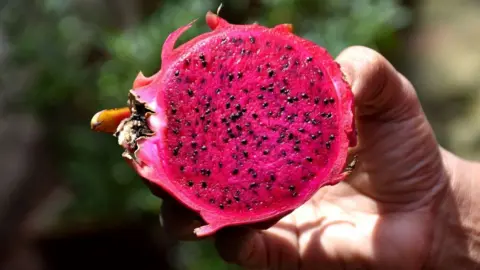
Indian consumer prefer dragon fruit with red flesh
Dr Sunila Kumari, is also on a mission to find the most promising varieties of dragon fruit for Indian farmers.
In 2019 she traveled across India collecting samples and bought them back to her base in Haryana, in the northwestern state of Punjab, to compare their performance.
""From these variants, we identified the plants that consistently produced larger fruits and better yields, and selected them as elite mother plants," says Kumari.
Her company, Dragonflora Farms, now has two "promising" elite lines he says.
Globally, dragon fruit production includes several categories, including varieties with a red skin and white flesh, fruit with red skin and red flesh and yellow-skinned types.
However, the Indian market has developed a clear preference - consumers strongly prefer large-sized red-flesh fruits.
"These varieties are visually attractive, have a richer flavor profile, and generally command a better market price," Kumari explains.
In addition to finding the right varieties for the Indian climate and customer tastes, farmers also have to modernise growing and storage techniques, says Kumari.
"We are currently at a critical crossroads. To move from being a curious newcomer to a global powerhouse like Vietnam. We must pivot from a volume-focused approach to a precision-driven export strategy," she says.
Indian yields of between 15 and 25 tonnes per hectare are well behind the international standard of more than 30 tonnes, Kumari points out.
Indian farms need to move beyond "simple pole and tyre" fields and instead build higher density trellis systems where the canopy can be better managed, she says.
Keeping the fruit in good condition after harvest also needs investment.
"Without an integrated network of solar-powered, on-farm, pre-cooling units and specialized cold-chain logistics, our fruit will never reach premium European or North American markets in peak condition," she says.
A shift in mindset is needed, says Kumari.
"We must treat dragon fruit not as a hardy cactus that survives neglect, but as a high-value horticultural asset."
More Technology of Business