4 months ago
45
4 months ago
45

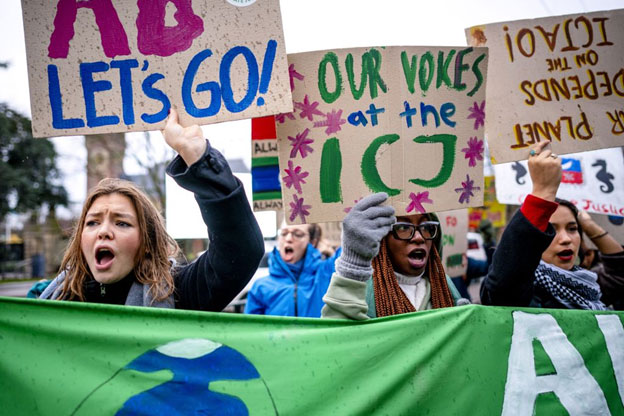 Credit: Amnesty International
| Vanuatu has spearheaded a UN General Assembly resolution, expected to be tabled on May 20, 2026, to endorse and operationalize the 2025 International Court of Justice (ICJ) Advisory Opinion, which confirmed that nations have binding legal duties to prevent and repair climate-related harm. The resolution, supported by a core group including Singapore and the Netherlands, calls for implementing these legal standards to protect vulnerable states from climate disasters, despite resistance from major polluters.
Credit: Amnesty International
| Vanuatu has spearheaded a UN General Assembly resolution, expected to be tabled on May 20, 2026, to endorse and operationalize the 2025 International Court of Justice (ICJ) Advisory Opinion, which confirmed that nations have binding legal duties to prevent and repair climate-related harm. The resolution, supported by a core group including Singapore and the Netherlands, calls for implementing these legal standards to protect vulnerable states from climate disasters, despite resistance from major polluters. KATHMANDU, Nepal, May 20 (IPS) - Normally, resolutions voted at the United Nations General Assembly do not make the headlines.As nonbinding and mostly symbolic, rich in principles yet empty and lacking the power to carry consequences, these statements are shrugged off and ignored.
But there are exceptions, and today’s (May 20) UNGA vote is one of them. The reason is that a positive vote would constitute a significant development in the evolution of international environmental law. To understand what we are referring to, let us allow a small flashback.
Far from South Asia, a trailblazing effort to hold a private corporation accountable for climate-damaging harm played out in a German court in recent years. For the first time, a Peruvian farmer filed a case against a major German energy company, accusing it of gravely damaging his livelihood due to its contributions to climate warming.
Even though this case, known as Lliuya v. RWE, was ultimately rejected in May 2025, it opened a new era in one of the most promising fields for achieving climate justice: climate litigation.
In the words of experts from the Grantham Research Institute, Lliuya v. RWE “established a powerful legal precedent that can be replicated in courts worldwide and will shape the trajectory for future climate litigation: corporate greenhouse gas emitters can, in principle, be held liable for their contribution to climate change impacts.”
Climate litigation, as an approach to pursue justice, is relatively new but is on the rise worldwide. There are more and more legal cases being filed in courts of law to uphold the principles of climate equity and climate justice and to pursue the right to a clean, healthy, and sustainable environment, a precondition to the enjoyment of other rights, such as the right to life, health, and an adequate standard of living.
After years of litigation, the Dutch Supreme Court ruled in 2019 that the state has an obligation to reduce emissions because adaptive efforts alone are insufficient. More groundbreaking cases followed. In the Los Cedros case, the Ecuadorian Constitutional Court established another pioneering precedent, affirming the primacy of the Right of Nature over mining concessions.
These rulings created momentum for bolder climate action, both in courts and in the streets, where millions of people across the Global South and North protested vigorously against climate injustice.
Within the international climate regime established by the Paris Agreement in 2015, the voices of developing nations, especially small island developing states, grew louder in opposition to unchecked greenhouse gas pollution, mostly from the Global North.
Unfortunately, there have been only very partial advancements within the UNFCCC framework. Last year, Climate COP 30, chaired by Brazil in Belém and supposed to be the COP of action and implementation, ended in another major disappointment. It is difficult to find optimism that the upcoming COP 31 in Türkiye will bear the transformative results humanity so desperately needs.
But an extraordinary legal effort, initially launched by law students from the Pacific in 2021 and later embraced by the Government of Vanuatu, paid off. On 23 July last year, the International Court of Justice issued the landmark Advisory Opinion on the Obligations of States in Respect of Climate Change. It was a truly game-changing moment for the fight for climate justice, even if the AO is non-binding.
Among its several remarkable aspects, the Paris Agreement’s obligations are not only procedural but also substantive, and states have stringent due diligence obligations. The ICJ also rejected the concept of “Lex Specialis,” clarifying that states’ obligations extend beyond the Paris Agreement, which, as a treaty, does not take precedence over other sources of law.
In plain terms, governments cannot hide behind the negotiations within the various climate COPs. They must do more. The ruling explicitly demands that states do whatever they can, within their means, to meet their commitments to reduce climate change.
It is not enough for a state to submit a Nationally Determined Contribution, its national plan to mitigate greenhouse emissions. A state may also be considered responsible for failing to take regulatory and legislative measures to limit not only its own emissions but also greenhouse gases produced by the private sector within its own borders.
The AO could not be clearer: “A breach by a State of any of the obligations identified by the Court in relation to climate change constitutes an internationally wrongful act entailing the responsibility of that State.”
Today, the Pacific island of Vanuatu, a true trailblazer showing that small developing nations can punch above their weight with moral leadership, is once again attempting to make history by bringing a UNGA Resolution on the AO.
Even without enforceable power, this resolution wants to reaffirm the principles enshrined in the Advisory Opinion, marking another step toward states’ accountability under international law.
According to the Climate Litigation Database, hosted by the Sabin Center for Climate Change Law, more than 3,000 lawsuits have been filed against governments and private-sector carbon emitters, including banks and asset management companies.
Today’s UNGA Resolution was supported by a diverse coalition including the Netherlands, Kenya, Sierra Leone, Singapore, Barbados, the Marshall Islands, Micronesia, Palau, Jamaica, the Philippines, and Burkina Faso.
Despite Nepal’s limited international engagement in recent months due to its own political transitions and elections, the new government led by Prime Minister Balendra Shah must join this group of nations.
Nepal must devise a strategy to revamp its climate efforts at the international level and, critically, do so beyond the Paris Agreement negotiations. There must be recognition that future negotiations within the UNFCCC will not be less fraught or complicated.
A series of policy papers published by the British think tank ODI exposed the hypocrisy of many governments that, in theory, are sympathetic and supportive of the climate fight of small island developing states, yet in their own submissions before the ICJ, resisted and opposed further legal obligations beyond the Paris Agreement.
This duplicity is embraced not only by developed nations but also by India and China, two of the most vocal defenders of the rights of developing nations within the Paris Agreement framework.
The incredibly complex politics of climate negotiations mean only one thing: courts of law may end up offering the only realistic venue for climate-vulnerable nations to pursue redress. As explained by The Guardian, Vanuatu was even forced to compromise some of the most progressive and climate-justice-centered aspects of this resolution in order to build the widest possible coalition of supporting nations.
Meanwhile, the ongoing tensions in the Gulf are offering a silver lining: more and more nations are realizing that phasing out carbon emissions is becoming irreversible. A few weeks ago, a pioneering gathering was held in Santa Marta, Colombia, the first-ever conference on transitioning away from fossil fuels. Although Nepal was invited, there was no news of the government’s participation.
While climate negotiations within the UNFCCC should not be dismissed, it is time to embrace another approach to seeking climate justice. The pursuit of climate justice through local and international courts may offer the most effective remedy to ensure the primary goal of the Paris Agreement, limiting climate warming to 1.5°C, is realistically pursued.
Nepal’s government will surely cast the right vote at the UNGA today. At the same time, we hope the new federal government will do whatever it takes to reiterate and expand its commitment to international law to stop climate change in the highest courts and global forums. We also hope it will create a conducive environment for climate litigation to thrive and become a tool for climate accountability that reaches everyone.
Shristi Gautam is the Past Co-Lead of World’s Youth for Climate Justice, Nepal, and Founder of Nyaya Vatika; Simone Galimberti is the pro bono co-founder of The Good Leadership.
IPS UN Bureau
© Inter Press Service (20260520072615) — All Rights Reserved. Original source: Inter Press Service