4 months ago
28
4 months ago
28

Rachel ClunBusiness reporter

 EPA
EPA
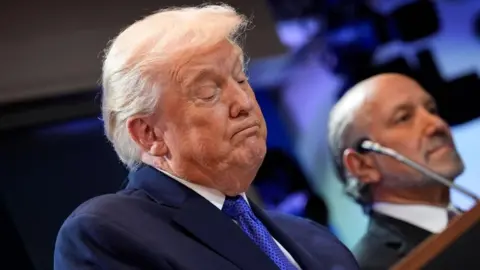
US President Donald Trump's latest tariff changes have heightened uncertainty for businesses and consumers, industry experts and economists say.
The changes followed a Supreme Court ruling on Friday that Trump could not use a 1977 law - the International Emergency Economic Powers Act - to levy taxes on imports from nearly every country in the world.
On Saturday, Trump signed a proclamation using an alternative law, Section 122 of 1974's Trade Act, that would let him put a new 10% temporary tariff on goods from all countries. Then on Saturday he posted on social media that he would be increasing these tariffs to 15%.
The latest announcement raises uncertainties for countries, including the UK and Australia who had previously negotiated 10% tariff deals with the US.
While other comments from Trump have heightened fears that new levies could be imposed on goods that have been exempted until now.
Many questions about what might happen next remain unanswered, said William Bain, head of trade policy at the British Chambers of Commerce (BCC).
"There is a weariness about the constant changes, the lack of any clarity and certainty in terms of tariffs, and therefore the prices that companies can charge for the goods in terms of customers in the US," he said.
"[Businesses] are frustrated and exasperated at the constant changes in policy."
Here are some of the remaining issues businesses and consumers face following Trump's latest announcement.
Clarity needed on existing tariff deals
But on Friday, an official said countries that previously reached trade deals would face the Section 122 global tariff, rather than the rate they had initially negotiated.
The White House also said it would "continue to honour its legally binding agreements on reciprocal trade".
Therefore, it remains unclear whether the US expectation is for countries to pay higher tariffs, but retain parts of existing deals too. There has not been an update since Trump announced the rise to 15%.
Paul Ashworth, chief North America economist for Capital Economics, noted the new rate was being applied under Section 122 of the Trade Act 1974, which "explicitly notes that any tariff must be applied in a non-discriminatory manner", meaning previous deals would likely be affected.
"Some of America's biggest trading partners, like the EU and Japan, will find themselves exactly back where they were last week," he said.
Section 122 gives Trump the power to put in place tariffs of up to 15% for 150 days, at which point Congress must step in.
Businesses fear higher levies
The BCC estimates that the higher 15% tariff rate will increase tariff costs on UK goods exported to the US by between £2-3bn ($2.7-4bn).
About 40,000 UK companies export to the US, Bain said, and that 5% increase in levies is paid either by the exporters or their customers in the US.
"That again is going to be very much a fact of discouraging businesses from trading at the levels they have in in the US market," he said.
The uncertainty was particularly strong, Bain said, in areas including food and drink, textiles, industrial goods and electrical goods "who suddenly overnight are facing this big increase in export costs to the US".
Tim Doggett is the chief executive of the Chemical Business Association which represents the chemical supply chain from manufacturers to distributors, transporters and traders, and director of the Trade Association Forum in the UK.
He said the added costs are generally borne by end users and consumers, "contributing to higher prices and, ultimately, inflationary pressure".
Tariff refunds a big question for firms
The Supreme Court ruling that Trump's so-called reciprocal tariffs were unlawful paves the way for companies to claw back the roughly $130bn (£96bn) in levies that have already been paid since about April last year.
But the decision did not mention refunds directly, and any process would likely take a number of years.
It's been reported that hundreds of firms have filed lawsuits in recent weeks to try and get in line for a refund.
The White House has not commented on the possibility of refunds directly, and Doggett said this was not a straight-forward issue.
"That creates further legal and contractual uncertainty, placing suppliers and customers in extremely difficult positions as they attempt to determine where liability ultimately sits - a costly and potentially protracted process that could take years to resolve," he said.
Bob Schwartz, a senior economist with Oxford Economics, said the Trump administration could use other tariff tools at their disposal - including the Section 122 replacement tariff - to avoid paying large-scale refunds.
Concerns over further tariffs
On Friday, the White House said some goods would not be subject to the new duty because they were important for the US economy, including critical minerals, energy products, resources that cannot be produced in the US and some agricultural products, including beef and tomatoes and vehicles.
But businesses fear Trump could use other sections of the Trade Act to apply further tariffs on goods.
US economist Bernard Yaros pointed out that Trump has already used Section 232 of the Trade Expansion Act of 1962 to introduce industry-specific tariffs on sectors including vehicles, steel and aluminium, and noted that "the Department of Commerce has launched Section 232 investigations into pharmaceuticals, semiconductors, critical minerals, and aircraft".
"Additional sector-specific tariffs under Section 232 may gain even more prominence in 2026," he said.
Higher taxes on imports can be covered by a combination of the exporting business - the company that sells those imported products to US customers - and US consumers.
Working out the mix of who is paying for what can be complicated, but research centre The Budget Lab at Yale estimates that US consumers have already been paying a substantial portion of the higher tariffs first introduced last year.
Its estimate, published before the Supreme Court decision and Trump's changes, found between 31% and 63% of the additional tariff costs were being passed through to consumers in higher prices for imported goods.
While the impact of Trump's increase to the global tariff rate remains to be seen, it's likely much of it will be paid by US businesses and consumers.
Following the latest announcements, business groups also said the increased uncertainty would ultimately hurt US consumers when it comes to product choice as well, as exporters look to send more of their products elsewhere.
"Companies are looking at diversifying trade, perhaps more into the European market, into the Indo-Pacific markets which are fast growing, and that may be a lasting effect of the fluctuations we've seen in trade policy just in the last four weeks alone," Bain said.
Bain added that the increase in tariffs for those who continue to export to the US will either have to be absorbed by exporters or their customers in the US.