5 months ago
14
5 months ago
14

Makuochi OkaforBBC Africa, Lagos

 Reuters
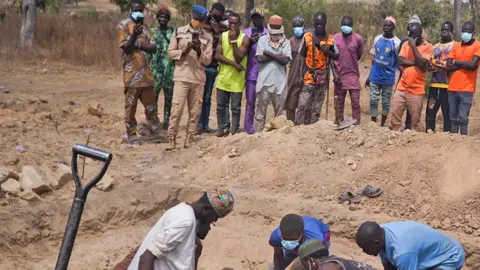
Mass burials have been taking place since Wednesday morning
More than 100 armed jihadists dressed in army fatigues rode into the neighbouring Muslim villages of Woro and Nuku in Nigeria's western state of Kwara on motorbikes - driven by revenge.
"They came en masse in the name of religion, and they decided to kill our people," Abdulla Umar Usman, a former teacher and resident of Woro, told the BBC, explaining how the attack, in which at least 75 people are so far known to have been killed, unfolded.
The mayhem started an hour before sunset on Tuesday as residents of the farming community were heading home from their fields, where they grow yams, maize and millet.
The militants headed straight to the home of traditional leader Umar Bio Salihu - because they had written to him asking if they could come and preach what is considered an extremist version of Islam, which the community did not welcome.
Salihu was not at his home in Woro at the time, so they set his compound alight and killed two of his children.
"Two of the community head's children, who were medical students, were killed in front of the house before they set it ablaze," Usman said.
The jihadists then went on a killing spree that lasted all night.
"They massacred everyone. It is just devastating," Mohammed Dauda, a local official, told the BBC.
Amnesty International said many of the dead had been found with their hands and feet tied - some had had their throats slit, others had been shot dead.
When the jihadists left in the morning, they took with them 38 women and children, including the rest of the traditional ruler's family.
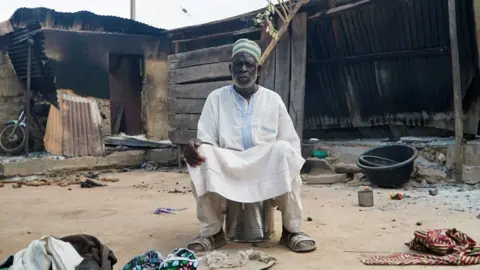
"They killed two of my children and abducted my wife and three children," Salihu told me.
The militants wanted residents to renounce the Nigerian government and its constitution and instead follow their teachings, effectively attempting to impose a parallel system of rule and government in the area.
This was "against what the Quran teaches", Salihu said, referring to Islam's holy book.
The attackers burned down shops and homes during the raid on Woro
The Nigerian government has blamed Boko Haram for the attack - the jihadist group has not issued any statement about it.
Boko Haram, which gained global attention in 2014 after abducting more than 200 schoolgirls from Chibok, is still operating in the north-east of the country but has since splintered.
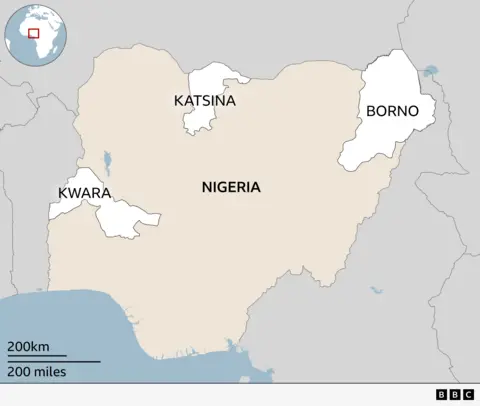
One of its factions, Mahmuda, is now active in rural parts of Kwara and the neighbouring state of Niger.
According to Amnesty, the jihadists had been leafleting the two villages for the last five months.
"These communities have been receiving these pamphlets, soliciting them to join the extremist views and preaching by these militants," Isa Sanusi, head of Amnesty International in Nigeria, told the BBC's Newsday programme.
"After they see a bit of resistance from the people, they then started sending them warnings," he added.
This correlates with Usman's account - that locals had received warnings days before the violence began.
Local MP Saidu Baba Ahmed told the BBC said the latest communication had been sent to Salihu, who had contacted the security forces about the letter.
The military went to the area briefly to investigate, but after they left, the jihadists launched their assault, he said.
Amnesty says this shows a "stunning security failure".
"We are wondering why this security lapse was allowed to happen, why the authorities could not take action," Sanusi said.
 Reuters
This 79-year-old man told Reuters his wife and four children had been abducted by the gunmen
He described how over many hours no-one went to the villagers' aid - and the militants were able to "take their time".
"In fact, they even went to the mosque and prayed there. They forced a few people to go and listen to their preaching. That means they had enough time… adequate time to do whatever they liked," Sanusi added.
The security forces did arrive the next day to find large parts of Woro and Nuku, which fall under the administrative area of Kaiama, in ruins.
Shops and homes had been burnt, abandoned motorcycles lined the streets and smoke still hung in the air.
The once-busy market stalls stood empty, as families gathered to comfort one another.
Then began the grim task of burying the bodies - first recovering them from the bushes.
Dauda, the local official, said he accompanied soldiers and helped bury dozens of victims.
"I was among those who buried 30 corpses," he said. "We have never experienced this before in Kaiama local government area."
Residents say the men assigned to dig graves for mass burials worked throughout the day until they became exhausted and were unable to continue.
It has left mourners in Woro and Nuku physically and emotionally broken.
Even now the dusty red-sand roads around the town remain deserted.
Kwara State Governor AbdulRahman AbdulRazaq, who visited the area on Wednesday night, said President Bola Tinubu had approved the immediate deployment of an army battalion to respond to the attack.
Usman suspects the attackers emerged from the forested areas near the Kainji Lake National Park, where the militants are known to operate.
He said the military had carried out operations in nearby forests months to target armed groups.
Communities in Kwara are also vulnerable to raids by criminal gangs - known locally as "bandits" - who loot and kidnap for ransom and have moved into the religiously diverse state fairly recently.
This has led most settlements in rural areas to set up vigilante groups – small bands of armed men who protect their villages.
In fact, according to the MP, the militants had tried to attack the villages last year but had been fought off by the vigilantes.
What leaves the residents of Woro and Nuku in such distress this time is that the jihadists knew exactly where the vigilantes lived - and picked them off not long after dealing with the house of the traditional leader.
"They knew where they were and they went straight to attack them," Salihu said.
"They burnt them into ashes… about eight of them."
You may also be interested in:
 Getty Images/BBC