
 6 months ago
23
6 months ago
23

Rachel ClunBusiness reporter

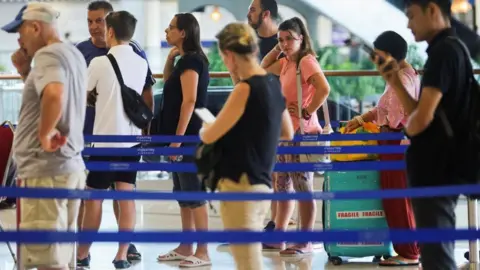 Reuters
Passengers queue to speak with Qatar Airways staff amid flight disruption at I Gusti Ngurah Rai International Airport in Bali, Indonesia
The majority of flights to Qatar and United Arab Emirates have been cancelled for Monday, as strikes continue in the joint Israeli and US war on Iran.
More than 4,000 flights a day have been cancelled across the region, according to flight tracking service Flightradar24 with hundreds of thousands of passengers affected.
The disruption "will only increase the longer the crisis continues" and it "will have enormous repercussions for the industry," director of communications Ian Petchenik said.
The ongoing airline disruption comes as more than 100,000 Britons have registered their presence in the Middle East with the UK government.
On Monday so far, 79% of global flights to Qatar and 71% of flights to the United Arab Emirates have been cancelled, according to aviation analytics firm Cirium, while 81% of flights to Israel and 92% of flights to Bahrain have also been grounded.
Qatar's national airline Qatar Airways said its flight operations remain temporarily suspended on Monday due to the closure of Qatari airspace.
"Qatar Airways will resume operations once the Qatar Civil Aviation Authority announces the safe reopening of Qatari airspace," the airline wrote on X.
From the UK, flights have also been cancelled for many Middle East destinations, including all flights to Israel and Bahrain, three quarters of the day's scheduled flights to the United Arab Emirates, and more than two thirds (69%) of flights to Qatar.
But some flights were still able to leave these destinations – according to FlightRadar24, an Etihad flight for London left from Abu Dhabi on Monday morning.
Ian Scott, from Wedmore in Somerset, told BBC Your Voice he had been travelling back from Melbourne to Venice when his Saturday morning flight out of Doha was forced to turn back mid-air due to the conflict.
"We were in airport for 15 hours before evacuation to a hotel. That was full and we had to shelter underground due to close explosions," he said.
Since then, Scott said he could hear blasts in the area, and is still waiting for an opportunity to leave.
Foreign Secretary Yvette Cooper told the BBC the situation was "deeply stressful" for those affected. She said many of those stuck were people travelling for holiday or business.
Asked if the government was considering launching an evacuation, she said it was in close contact with airlines, airports, Middle Eastern governments and the travel industry.
Cooper added that in previous situations similar to this, the government had worked with airlines to bring people home on normal flights.
Paul Charles, from travel consultancy firm the PC Agency, said the disruption in air travel in the Middle East was having a knock-on effect around the world.
"Indeed at Sao Paolo airport yesterday I saw two Qatar airways planes still on the ground there because they can't fly to the Middle East at the moment," he said.
"Flights are entirely full via other countries because the passengers who were due to go to the Middle East have to reroute via somewhere else in order to find safe haven."
With additional reporting from Bernadette McCague


