
 3 months ago
36
3 months ago
36

Just now
Thomas Copeland and Shruti MenonBBC Verify

 BBC
BBC
Three tankers have been struck by the US military over the past three days, killing at least three people.
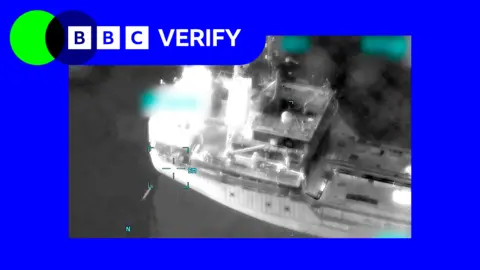
US forces fired a missile into the engine room of a tanker in the Gulf of Oman on Thursday morning - the third vessel to be targeted. US Central Command (Centcom) said the ship had violated a blockade of Iranian ports and refused to comply with its directions.
Three Indian sailors were killed on Wednesday after a strike by the US.
The Indian government condemned the attack, saying the "targeting of commercial shipping and civilian infrastructure in the region must end". India's foreign ministry summoned the deputy head of the US embassy in Delhi to lodge an official protest.
A further 24 Indian crew were rescued from a ship off Oman's southern coast on Monday after sending a distress call saying the vessel was on fire and sinking following a US strike.
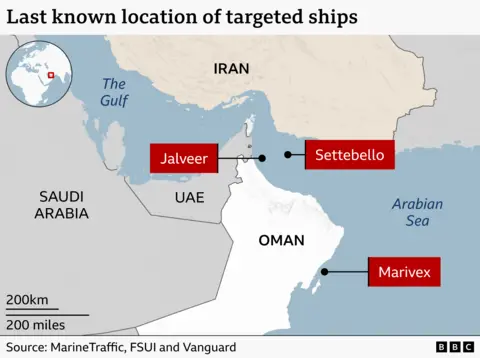
The US military has been blockading Iran's ports after Tehran effectively closed the busy Strait of Hormuz through which about 20% of the world's oil and gas supplies are usually transported.
Centcom says it had disabled nine vessels and redirected 135 more since since the blockade began on 13 April.
The tanker Jalveer reported that a fire had broken out in its engine room early on Thursday morning, according to maritime risk management company Vanguard.
Centcom later said a US aircraft fired two Hellfire missiles into the ship's engine room "after the crew repeatedly failed to comply with directions".
The crew contacted the Omani navy and another nearby vessel asking to be rescued, according to distress calls heard by BBC Verify.
A crew member also blames the US for the strike in the calls, saying it "just targets merchant ships".
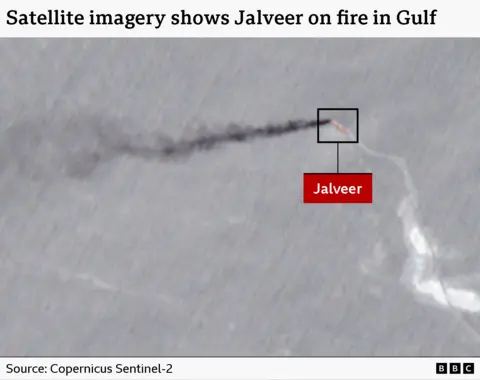
Satellite imagery seen by BBC Verify shows smoke billowing from Jalveer.
The ship had 20 Indian sailors on board, all of whom were safely evacuated with the assistance of the Royal Navy of Oman, according to Indian authorities.
Centcom said the vessel, which was laden with cargo, had "violated the blockade against Iran by attempting to transport Iranian oil".
Ship tracking data shows Jalveer has sailed between the Gulf and several Indian ports over the past year, but the ship has not been sanctioned by the US for links to Iran.
Three Indian sailors were killed and 21 had to be rescued after the US fired "precision munitions" into the engine room of a tanker called Settebello on Wednesday.
India's shipping minister Sarbananda Sonowal called the incident "deeply unfortunate" and said the bodies of the three men would quickly be repatriated.
The US says Settebello violated its blockade by "attempting to transport oil from Iran" and the crew had "repeatedly failed to comply with directions from American forces".
The company that manages Settebello, IOS Marine FZE, said it "categorically denies" the ship ignored directions and said it has "no affiliation with Iran or Iranian oil".
"No contact whatsoever was made with the vessel," the company said as it called on the US to release evidence of its communications with the ship.
Settebello, which is owned by an Indian company called Aqua Aurora Shipping Lines, has not been sanctioned by the US but is on the sanctions list of the campaign group United Against Nuclear Iran (UANI) which says it has been involved in transporting Iranian crude oil.
Ship tracking data shows Settebello has sailed from the Gulf to the Chinese port cities of Zhoushan and Lianyungang over the past six months.
Settebello's location tracker has been inactive since 31 May, data on ship-tracking website MarineTraffic shows, so it is not clear where the vessel was when it was hit.
IOS Marine FZE said the ship had been stationary for about 10 days before the strike.
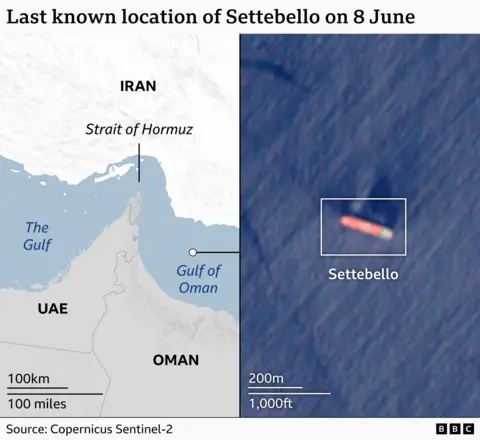
Satellite imagery analysed by BBC Verify from 8 June shows the ship about 80 miles (120km) from port of Sohar in Oman.
The Indian crew of a third tanker urged authorities to "please help" after the ship was struck by the US on Monday, saying it was on fire and sinking in a distress call shared with BBC Verify.
Marivex was sanctioned by the US for links with Iran under a previous name - Arihant. The US has also sanctioned the ship's owner, Arihant Shipping Inc, and has accused the ship of transporting "hundreds of thousands of barrels of Iranian fuel oil and bitumen within the Gulf since July 2025".
Ship-tracking data shows Marivex last stopped at the Iranian port of Bandar Abbas in early April where it loaded with cargo and then sailed to two cities on India's west coast - Mangaluru and Karwar, according to MarineTraffic data.
A fire broke out on the tanker on Monday, according to Indian authorities who did not initially comment on the cause of the fire.
Centcom later confirmed that an F-18 Super Hornet fighter jet from the aircraft carrier USS Abraham Lincoln "fired a precision munition into the ship's engineering and steering spaces".
With the ship's engine disabled, the crew began to send out distress calls saying it had "a fire onboard and vessel is sinking", according to a recording given to BBC Verify by the Forward Seaman's Union of India (FSUI).
Flight tracking data shows a Royal Air Force of Oman helicopter took off from an air base on Masirah Island and verified videos supplied by the FSUI show the crew later being lifted from the ship's deck.
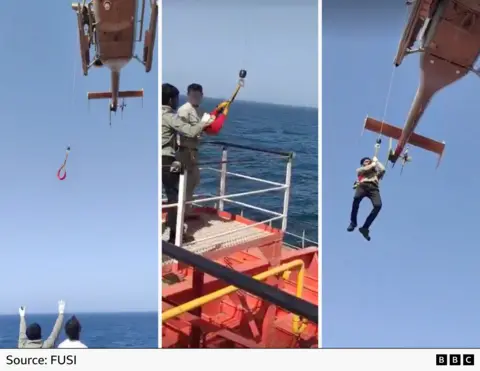
Centcom did not answer BBC Verify's question about whether it had contacted the Omani or Indian authorities before the strike.
The US strikes have sparked concern in India about the safety of India seafarers who constitute one of the largest maritime workforces, with nearly 300,000 serving on vessels across the globe.
"While seafarers are not completely detached from the realities of global trade, they are often the stakeholders with the least influence over geopolitical decisions and the greatest exposure to their consequences," said Harsh V Pant of the Observer Research Foundation in New Delhi.
"India-US relations are passing through a difficult phase and friction will increase if the attacks intensify but there won't be a fundamental rupture in the ties," he added.
Seafarers' unions have also expressed concern over safety in volatile regions and called for better protection.
"Seafarers are workers. They are not soldiers," the FSUI said on Thursday.
"The international community cannot remain a silent spectator while seafarers are forced to navigate through conditions resembling a war zone," the union said.
There are more than 18,000 Indian seafarers in the Gulf region and 13 Indian-flagged vessels are still stranded in the Strait of Hormuz, according to India's shipping ministry.



