1 hour ago
1
1 hour ago
1

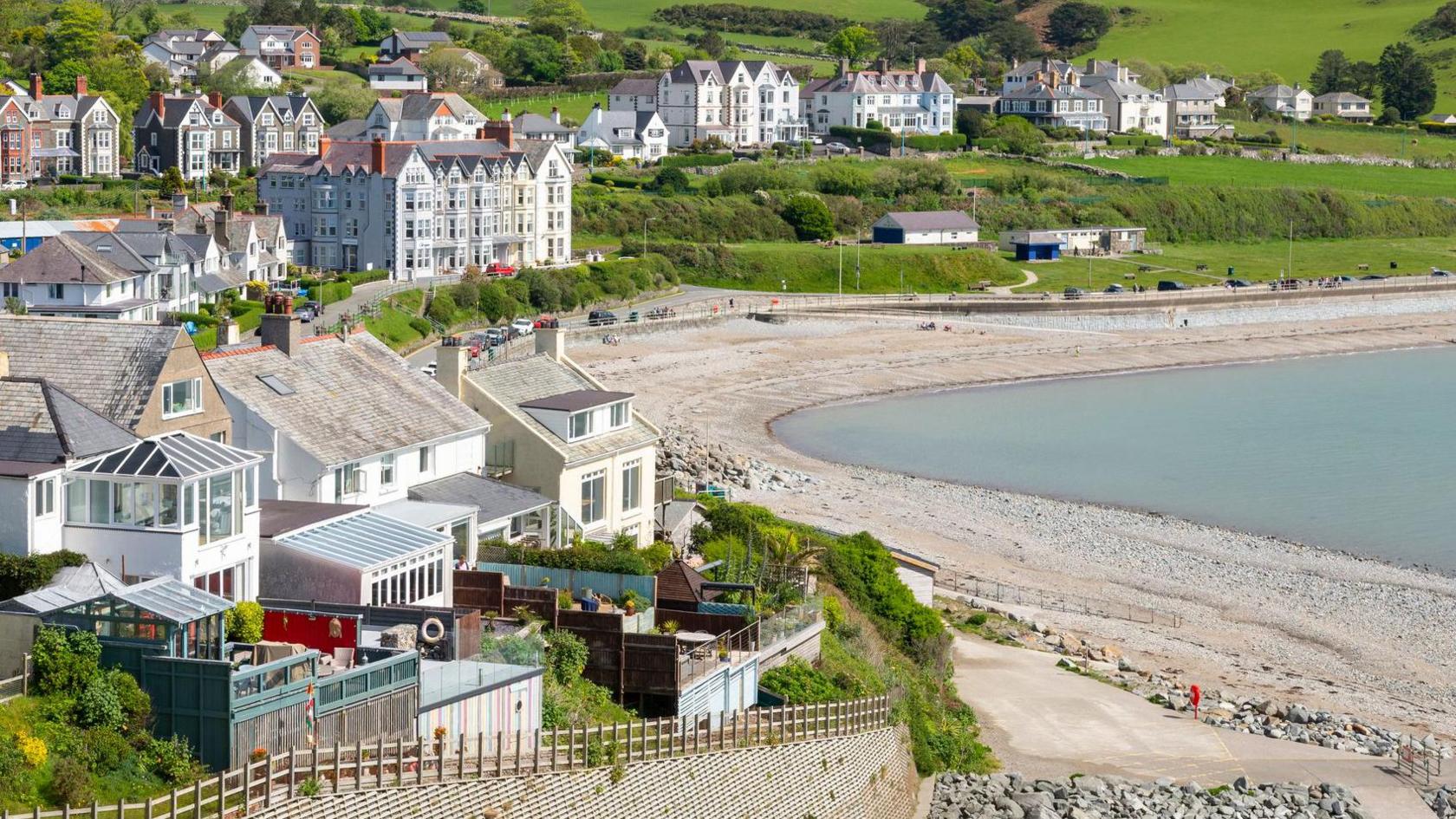 Image source, Getty Images
Gwynedd and Conwy have both postponed making any decisions on introducing a tourism tax
Wales' tourism tax needs to be more flexible, an expert has said.
Last week, Anglesey council rejected introducing the visitor levy for now, over concerns for its tourism industry, while Gwynedd and Conwy councils both postponed making any decision on the nightly fee.
It is down to local authorities to decide whether they want to introduce the Welsh government legislation, which means that from 2027 a fixed price can be charged per person, per night, external, and applies to both adults and children.
The Welsh government said the legislation allowed for decisions to be taken at a local level, with councils able to introduce the levy "to support investment in tourism services and facilities".
A tourism tax, or levy, is a charge which would need to be paid by anyone staying overnight in any area which introduces it.
The idea is that it covers, or contributes to, the costs which authorities face as a result of the tourism industry.
 Image source, Getty Images
Anglesy council says it will not be bringing in the levy at the moment, over concerns about the inpact on the tourism sector
If a local authority decides to introduce the tourism tax, fees for people staying in hostels, shared rooms and tent pitches would be 75p + VAT per person per night, while most other types of accommodation would be charged at £1.30 + VAT.
But according to Dr Linda Osti, senior tourism lecturer at Bangor University, decisions on how much is charged, and how a levy is brought in, should be made on a more local level instead of a one-size-fits-all approach.
"It's one legislation for every county and and it's applied at county level, when we should think about sub-county level," she said.
"Geographically, if we think about Gwynedd....we cannot have the same levy on Eryri or Porthmadog. The same legislation cannot work for Cardiff, or in Anglesey, on the coast.
"There are different visitors, there are also different conditions."
Osti also suggested there was a "mistrust" from tourism businesses on how local authorities would spend money generated from tourism tax, compared to places like the Italian alps where decisions are made through smaller co-operatives.
Dr Linda Osti believes a levy in specific areas would work in Wales
Earlier this month, it was announced that regional mayors in England would gain new powers to charge an uncapped levy on overnight stays for visitors.
Osti, who co-authored a 2024 report for the Welsh government studying how visitor levies worked in other countries, external, said: "If we compare what we know from England, which is very little at the moment, it appears to be much more flexible.
"So local authorities can decide the percentage to charge and whether to introduce exemptions, and it seems they may also decide for how many nights, and whether to charge children or not.
"I wish Wales would go back and think about flexibility and revisit the legislation."
On Thursday, Anglesey council confirmed it would not introduce the so-called tourism tax for now, "given the challenges already facing its tourism industry".
It said a public consultation received more than 2,000 responses, including from residents, businesses and tourism stakeholders, with concerns voiced about increased costs for visitors, and the island's "competitiveness" as a holiday destination.
Meanwhile, Cyngor Gywnedd agreed to delay its decision over the levy so more analysis could be done of almost 7,000 responses to its consultation - a number it said was "much higher" than other areas.
The local authority said initial figures showed a mixed reaction to the proposals, with more support from residents but higher levels of opposition from visitors and businesses.
In Conwy, council members also chose to defer a decision on implementing the levy until "further evidence and practical experience are available".
It said concerns from consultations included fears over reduced bookings, shorter stays and reduced visitor spend at a time when local businesses are facing economic pressures.
Bethan Evans says roads get blocked and car parks become full in tourist season
Bethan Evans, of family-run business Dolgamedd caravan park in Dolgellau, Gwynedd, is one of those in support of introducing a tourism tax in the county to help areas cope with busy roads and car parks at peak times.
She said she was "disappointed" that councils appeared to be "scared of a noisy, selfish minority" opposing the fee, and described the 75p per night levy for people camping as "nothing" compared to the rubbish that some visitors left behind at the site.
"You get people [with] brand new tents who can't be bothered to put a wet tent back in the car so they try and dump them in our bins, which we pay for," she said.
"There is such a lot of that happening, and the amount of food waste is just incredible. So it's ridiculous saying they can't afford it, oh yes they can."
But she added: "Some people are wonderful, and those people are happy to pay the tax. We want people who respect the area, who are willing to pay the tax, so that's the kind of tourist I'd like."
 Image source, Getty Images
Gwynedd saw almost 7,000 responses to its consultation on introducing a tourism tax
Nicky Williamson, of the Professional Association of Self-Caterers (PASC) UK Cymru, described the pause on introducing the levy across the three counties as a "welcome victory for common sense and for listening to the evidence".
She said: "Tourism businesses across Wales have been clear about the pressures they are already facing, and the response to these consultations shows the strength of concern about adding another cost to Welsh holidays.
"This is simply the wrong time to introduce another cost for either businesses or visitors. We welcome councils listening to the evidence and urge others to do the same before taking decisions that could have long-term consequences for Wales' visitor economy."
So far, Cardiff council looks set to become the only local authority in Wales to introduce the visitor levy next year, according to the Welsh government, external.
From 28 September, those staying in the county must pay the levy on bookings made for 1 April 2027 onwards.
According to Osti, Cardiff is an example of where the current tourism tax legislation should work well, especially with business tourists who are less "price sensitive".
"Why would it work in Cardiff? Because it's a typical city destination. People tend to go to Cardiff for a few nights," she said.
"For two people, two nights, it's not even £10 extra when they're paying £100, £140, £160 per night for a double bedroom.
"So it would work for Cardiff and then Cardiff can easily organise events as Manchester and Liverpool did in the past... they could do very good things with the charge."
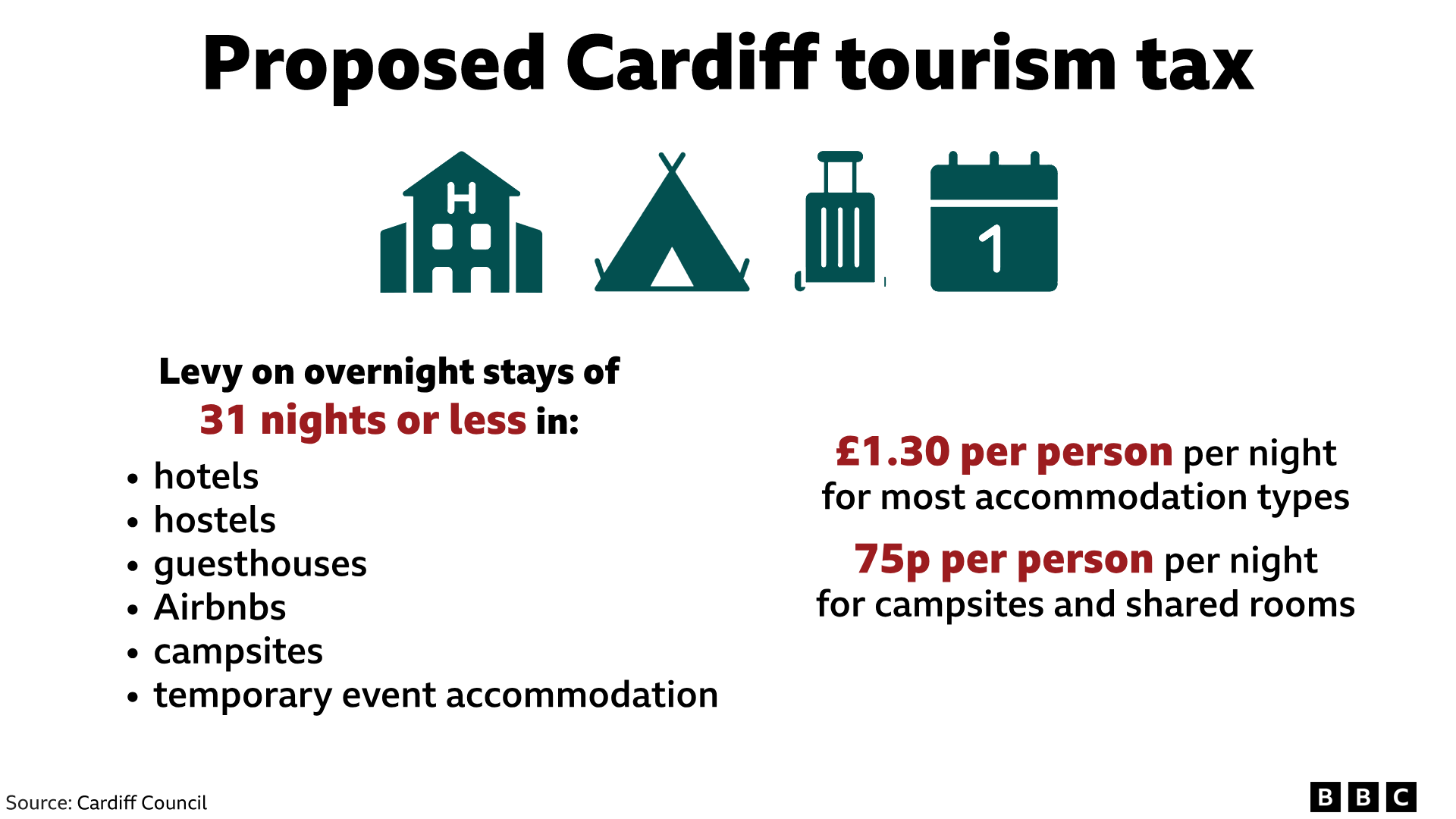
How does the tourism tax work?
The visitor levy came about as part of a co-operation deal signed between Labour and Plaid Cymru in 2021, with the legislation published in 2024.
Officials said they wanted the tax to be simple to understand, so the same rate will be paid for adults and children - although under 18s will be exempt from the 75p rate.
Local authorities decide not only whether to implement the levy, but also how the money generated is spent, according to local needs.
This is ring-fenced in their budgets for specific things, like promoting tourism, promoting the Welsh language, and improving infrastructure or services used by visitors.
While the current fee per night is fixed, councils could also charge more in future if they go through a consultation process and give 12 months' notice.
Stays of more than 31 nights will not be taxed, and neither will people forced into temporary accommodation or people in homeless hostels.
A Welsh government spokesperson said: "It is for local authorities to decide if they want to introduce a levy in their area following consultation with their communities.
"Cardiff, for example, will implement a levy from April 2027, generating revenues to be re-invested in and around the city that will further enhance the experience for visitors."