4 months ago
22
4 months ago
22

Kathryn Torneyand Ciarán McCauley,BBC News NI

 Getty Images
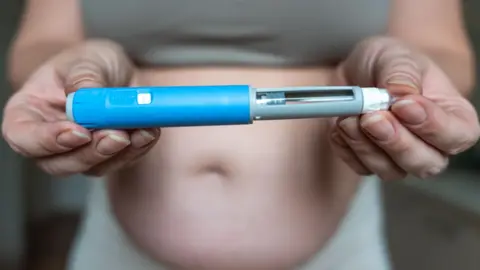
The drugs, prescribed under names such as Wegovy and Mounjaro, are widely used across the UK for weight management and to treat diabetes
The deaths of two people in Northern Ireland potentially linked to weight-loss injections have been reported to the government agency responsible for ensuring medicines are safe.
The two cases are among more than 500 suspected adverse drug reaction reports submitted from Northern Ireland over the last two years related to GLP-1 medications.
The drugs, prescribed under names such as Wegovy and Mounjaro, are widely used across the UK for weight management and to treat diabetes.
The reports were made to the Medicines and Healthcare products Regulatory Agency (MHRA).
The MHRA said a report of a suspected reaction "does not necessarily mean it has been caused by the medicine, only that the reporter had a suspicion it may have".
"Underlying or concurrent illnesses may be responsible, or the events could be coincidental," it added.
The data shows that the two deaths were of a man and a woman, one who was in their 40s and the other in their 60s, although it does not specify which age category applied to which person.
The data on suspected reactions reported from Northern Ireland in 2024 and 2025 was released in response to a Freedom of Information request.
Healthcare professionals submitted 82% of the 511 suspected adverse drug reaction reports.
In the two fatal cases, the data showed that one had taken Mounjaro, a brand name for the drug tirzepatide, and the other reaction was linked to an unspecified semagultide medication - semagulatide is sold under the brand names Wegovy, Ozempic and Rybelsus.
The data also showed there were six reported cases of acute pancreatitis over the two-year period - three suspected to have been a reaction to Mounjaro, one to Ozempic and two to unspecified brands.
The MHRA issued a warning about the risk of acute pancreatitis in January, which is often linked to gallstones, a common side effect of GLP-1s.
What does the data show about weight loss jabs?
The MHRA collects and monitors information on suspected safety concerns through its Yellow Card scheme.
Anyone - medical professionals and members of the public alike - can make a report.
Most of the reports on GLP-1s from Northern Ireland over the last two years – 458 – were registered in 2025, compared to 53 in 2024.
As well as the two fatal outcomes reported, there were 242 serious reports and 267 categorised as non-serious. One of the serious reports relates to a child aged nine or under.
The Yellow Card reports of suspected reactions include:
- 317 to Mounjaro
- 135 to Wegovy
- 12 to Ozempic
A single adverse drug reaction report can contain multiple suspected reactions in an individual.
The MHRA said patient safety was its top priority and that when a safety issue is confirmed it will "always act promptly to mitigate any identified risk".
It added that new drugs, such as GLP-1s, are more "intensively monitored" to ensure that any new safety issues are quickly identified and as the use of those drugs increase "so have the number of Yellow Card reports associated with these medicines".
The MHRA said it did not hold information on whether the medication associated with the reports from Northern Ireland was prescribed, bought from a pharmacy, or from an illegitimate supplier.
How do you get weight-loss jabs?
 Joanne McMullan
At Joanne McMullan's weight-loss clinic, about 50 patients are privately paying for injections
In Great Britain, some people are able to get the injections on the NHS for weight management or to treat diabetes.
However, in Northern Ireland, only those with type 2 diabetes who meet certain criteria can access the drugs on the NHS. Others can access them privately via pharmacies if they medically qualify based on their body mass index (BMI) being over 30, which is considered obese.
Government guidance warns that the MHRA has not assessed the safety and effectiveness of GLP-1s being used outside of their licensed use, for example for weight loss in people who are not obese or overweight.
At Joanne McMullan's weight-loss clinic at Portaferry Pharmacy, about 50 patients, aged between 18 to 75, are paying privately for weight loss injections. Mounjaro is the most popular drug issued at a cost of £200 to £300 per month.
McMullan, the National Pharmacy Association Board representative for Northern Ireland, said she had seen some positive effects.
"One lady lost over five stone to be able to have a knee replacement operation. People who were sedentary can now do exercise," she said.
There are common side effects, she added - some people can feel bloated or uncomfortable while taking GLP-1s, but often say they can put up with it while Mounjaro commonly causes digestive issues when starting out or increasing a dose, which often subsides.
She does, however, warn patients to watch out for signs of something more serious, like gall bladder problems or pancreatitis.
"I am concerned about the longer-term side effects because we don't yet have any data on people using them for many years," she added.
"But for the people we are seeing who can now do a bit of exercise, they can walk, they feel they are getting their life back - at the moment, it does seem to be worth it for them."
What have health officials said?
BBC News NI asked the Department of Health if Health Minister Mike Nesbitt was aware of the deaths reported to the MHRA and, if so, what actions had been taken but the department did not respond to those queries.
It did stress the importance of reporting suspected side effects and adverse incidents to the Yellow Card scheme, adding that it "engages regularly with the MHRA and disseminates information on drug safety to healthcare professionals, including recent MHRA guidance on the safe use of GLP-1 medicines".
The service would see GLP-1s become available on the NHS in Northern Ireland for weight loss.
The Coroners Service for Northern Ireland said, "from the limited information provided" it had been unable to identify any cases which have been reported to the coroner where GLP-1s have been referred to contributing towards a death.
Eli Lilly, the firm that makes Mounjaro, said patient safety was its "top priority", adding that it actively reports safety information to the MHRA and encourages "healthcare professionals and others" to do the same via the Yellow Card scheme.
It said the MHRA has stated that Yellow Card reports "have not been proved to be related to the drug, and should not be interpreted as a list of known side effects".
Novo Nordisk, the firm that makes Wegovy and Ozempic, said patient safety was "of the utmost importance" to the company.
It said the drugs should be taken "for their approved indications and under the supervision of a healthcare professional", and that anyone experiencing side effects should report them to their doctor and the MHRA Yellow Card scheme.