3 weeks ago
25
3 weeks ago
25

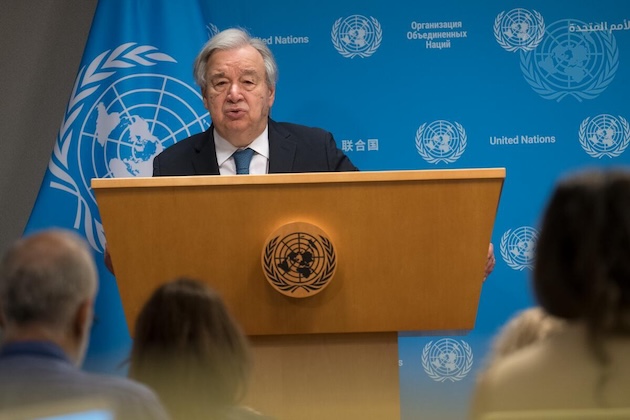 UN Secretary-General António Guterres at the launch of the preliminary report from the UN Independent Panel on AI. Credit: UN Photo/Mark Garten
UNITED NATIONS, July 2 (IPS) - The acceleration of artificial intelligence (AI) and its capabilities is far outpacing governments’ capacities to effectively regulate it. Without scientific evidence to inform their policies, countries will be left at a greater disadvantage, according to the UN’s independent panel on AI.
The UN Independent International Scientific Panel on Artificial Intelligence officially released its Preliminary Report on July 1. This is the Panel’s first global, independent scientific assessment on the opportunities, risks and impacts presented by AI. This early report work from the Panel is expected to provide a foundational evidence base to inform global policy ahead of its first comprehensive report in 2027.
The collaborative effort to build a shared understanding of AI has reached a crucial stage. Governments are making consequential decisions about AI under great uncertainty with rapidly changing, often conflicting sources of evidence and perspectives that do not necessarily reflect local realities. As AI capabilities continue to grow, the stakes for decisions made around the world are also increasing.
The preliminary report was produced by a panel composed of 40 leading experts from across multiple disciplines and every region of the world. Its members, which include the likes of computer scientists, economists, academics and human rights experts, serve in their personal capacity, independent of any government, company or institution. The report’s findings will be presented to governments at the inaugural UN Global Dialogue on AI Governance, convening in Geneva, Switzerland on 6 and 7 July.
The timing of the Panel’s report and the upcoming AI conference represents a turning point for where AI is at, according to Yoshua Bengio, one of the co-chairs of the Panel.
“It’s about the growing intelligence of machines,“ said Bengio, the renowned computer scientist who is the co-president of LawZero and founder of Mila. “You have to realise that intelligence gives power. As that power grows, it can unlock great benefits if we act wisely. But it can also lead to many perils.”
On July 1, Bengio and fellow co-chair of the panel Maria Ressa, journalist and Nobel Peace Prize winner, briefed reporters virtually on the report and the Panel’s work since it convened earlier this year. The co-chairs emphasised that the report does not give policy recommendations on the best practices for AI governance. Instead, Bengio said the policies should meet the “highest standards of scientific integrity.”
When asked about why the Panel could not make policy recommendations, Bengio remarked that their work would become very politicised and would “pollute” the Panel’s ability to “provide scientific evidence”.
Ressa added that while the differences were evident between the panel members, they found a shared language in pursuing the science behind AI. It was also where they could align in their work. “The tech has torn us apart in different realities. What the report will hopefully do for member countries of the UN is to come and bring us together to the same reality,” said Ressa.
Among the key takeaways from the report, what is clear is that in recent years, AI capabilities have accelerated, as has its adoption across multiple sectors and in societies. Currently, its advancements far outpace governments’ capacities to understand it, let alone regulate it. The decision-makers need scientific evidence to effectively govern AI, which should rise. Without this evidence, policy is weakened
The report states that AI holds “significant potential” to advance development across multiple sectors such as health, education and food production. To take advantage of that potential requires tailoring it to local contexts, institutions and user needs. The integration of AI in the health and agriculture sectors makes a case for its positive contributions, especially in the context of the Global South, where evidence has emerged of its use in these spaces. They are more effective when adapted to local contexts and when human workers are trained to use them.
With that said, countries vary in their adoption and usage of AI. The use and access of AI across the Global South lags behind the Global North, according to the report. 118 countries, predominantly in the Global South, are not engaged in major AI governance discussions, and less than one-third of developing countries have developed national AI strategies. The report warns that the Global South is disproportionately exposed to the misuse of AI due to limited capacity for mitigation and limited frameworks for influencing AI development and capacity building. The inputs and outcomes of AI also show linguistic unevenness. Existing AI model infrastructures train on only a fraction of the over 7,000 languages spoken around the world.
A select few countries concentrate AI development and computing capacity. The report shows that of the 500 largest-known public and private AI compute clusters, 75 percent were located in the United States, 15 percent in China, and 10 percent for the rest of the world. Much of the development of AI models is further concentrated in a handful of companies; 91 percent of notable AI models originated from the private sector. U.S. institutions produced 59 known AI models, compared to China’s 35 and an additional 13 from the rest of the world.
This is indicative of existing disparities when it comes to technological developments and may reinforce inequalities between developed and developing countries. This raises the risk for power to be concentrated to a select few individuals and states to shape the standards around AI. This concentration of power may then further affect economic power, military power and the power to influence public opinion.
“A handful of companies and a handful of countries are making the most consequential decisions about humanity’s future,” said Ressa.
On top of that, AI usage can challenge our shared reality. With the ease of generating and disseminating AI-generated textual and visual content, this blurs the line between what was manually created and what has been created with AI tools. This also presents complications when AI is used to create and spread deceptive, manipulated information intended to undermine institutions of information, which can have adverse effects on civic participation and democratic institutions. There is also demonstrable evidence that suggests that AI harms disproportionately affect minority communities due to limited frameworks around the training and application of AI systems.
Bengio noted that the report recognises multiple possibilities for where AI development could be headed due to the rapid acceleration and integration, although it is hard to predict where it will go. It may continue to grow exponentially, at which point it will exacerbate the gaps in AI’s capabilities and the societal risks without sufficient oversight or governance. Alternatively, AI capabilities could reach a plateau, according to Bengio, which would make AI less powerful and would give other countries more time to catch up with their expansions.
It is with these factors in mind, within the current AI landscape that begs urgent action, that governments will convene in Geneva next week for the Global Dialogue on AI Governance. There are steps that member states can take to close the gaps identified by the independent panel and other experts, not to mention a sense of urgency and duty to enact policies that will protect the human rights of their citizens. But it will require sustained commitments from member states.
“The more AI advances without shared rules, the less say governments and people will have in the outcome. So my message to governments is simple: Do not wait,” said UN Secretary-General António Guterres. “The Summit of the Future asked whether international cooperation could keep pace with the speed of technology. Today offers one answer. The science is here. We can no longer say we did not know. What we do with it is now up to all of us.”
IPS UN Bureau Report
© Inter Press Service (20260702095258) — All Rights Reserved. Original source: Inter Press Service