4 months ago
22
4 months ago
22

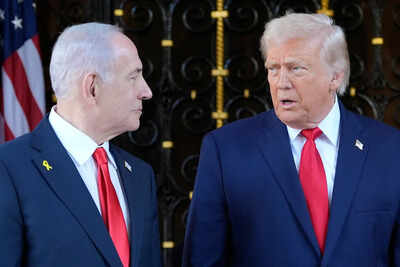
President Donald Trump greets Israel's Prime Minister Benjamin Netanyahu at his Mar-a-Lago club, Monday, Dec. 29, 2025, in Palm Beach, Fla. (AP Photo/Alex Brandon)
There’s a phenomenon, popular among OSINT enthusiasts on Twitter, called monitoring the situation. For those lucky enough to lead real lives, monitoring the situation is the Olympics of toxic masculinity, referring to the act of following conflicts on social media.
It is a multi-disciplinary pursuit that can include checking airplanes and closed airspaces, comparing different weapon systems, checking the delivery volume of pizza outlets in Washington, finding obscure facts about obit writers, digging up old ‘pookie’ tweets of Supreme Leader Ayatollah Khamenei, noticing that Reza Pahlavi has an exceptionally large nose, or wondering why Donald Trump exhibits all the attributes of an Ottoman emperor (PS: All references tweets are at the bottom).
In the last three days, social media users exhibited unprecedented levels of monitoring the situation, since the US and Israel launched operations that have decapitated the so-called Axis of Resistance. But what is the Axis of Resistance? Don’t worry, because even if you haven’t monitored the situation, here’s a small breakdown of what has happened in the Middle East so far.
A Pivotal Moment in History
There are pivotal moments in history that end up changing the course of the world.
An Italian confusing the Caribbean for India. An East India Company agent turning up in the court of a Mughal ruler. An Archduke getting murdered. An Austrian getting rejected from art school. A Swiss patent clerk getting bored at his job. Japanese pilots deciding to fly a little more than usual. A plane flying into a building. A virus escaping from a lab. A former president mocking a real-estate developer at a White House dinner.
And with the benefit of hindsight, a few Hamas terrorists paragliding into a music festival in Israel. Now, as historians are wont to point out, the fissures in the Middle East certainly did not start on October 7, 2023, but its events certainly accelerated the events that we see today.
What was the Axis of Resistance?
If you have ever been on social media, you must have seen the memes: Iran before the Islamic Revolution of 1979, often used to depict Iran as some sort of secular utopia where John Lennon’s Imagine met Rick Blaine’s Casablanca.
And then there was the Islamic Revolution, which brought to power the Islamic Republic of Iran, specifically the Islamic Revolutionary Guard Corps (IRGC) and its external operations arm, the Quds Force.
The new Iranian state had one doctrine: do anything feasible to cock a snook at the Big Satan (US) and the Little Satan (Israel). This meant building what came to be known as the Axis of Resistance, named in rhetorical defiance of the “Axis of Evil,” the term used by George W.
Bush in 2002 to describe Iran, North Korea and Iraq.Soon the axis took shape. Hezbollah was born from the wreckage of Israel’s 1982 invasion of Lebanon, trained by Iran’s Revolutionary Guard. The Houthis, an insurgency in Yemen, found in Tehran a benefactor that could strike Saudi oil fields and rattle shipping lanes in the Red Sea. Syria — under Hafez and later Bashar al-Assad — became an indispensable corridor, a land bridge that allowed Iranian weapons and other things to make their way to Lebanon.
Meanwhile, after the 2003 US invasion dismantled Saddam Hussein’s regime over non-existent weapons of mass destruction, Shia militias with Iranian backing became a pain for American forces. And finally, Hamas, a Sunni Palestinian movement, found common ground with Tehran, whose hostility towards Israel overlooked any other religious qualms.And of course, at the top of the pyramid of the Axis was the Iranian regime led by the Supreme Commander Ayatollah Khamenei.
How did Israel respond?
After the attack, in a chilling statement, Benjamin Netanyahu announced that all attackers were ‘dead men walking’. Very rarely have politicians kept their word to this effect. Much of the things that Western civilisation holds dear — from atom bombs to literature — were designed by Jews. So there’s no surprise they have also perfected revenge to an art form. To quoteFor years, whispers have told us about the depths Israel has gone to infiltrate its enemies (so much so the joke is that the only people alive in Iran’s high command are three Mossad agents who don’t know each other’s identities).
Netanyahu and Co ran slipshod in Gaza, killing Hamas commanders with precision operations that didn’t care how many civilians it accidentally killed. From exploding pagers to missiles to bombs, Israel dismantled each branch of the axis and then went after the head.For years, Israel had built its networks in Iran, carrying out audacious attacks and building a war machine Bob Dylan could have sung about. And its success showed, as the final attack took only sixty seconds, which saw multiple attacks on various sites inside a heavily guarded compound.
As Oded Ailam, a former head of Mossad’s counter-terrorism division, told The Guardian: “Sixty seconds. That’s all it took for this operation, but it is the product of years in the making.
The modern battlefield is no longer defined only by tanks and aircraft. It is defined by data, access, trust and timing. One minute can change a region.”The Axis of Resistance was built over decades. Israel, with help from Uncle Sam, destroyed it in a little more than two years.As operations go, it was so successful that it appeared to have wiped out all potential successors. As Donald Trump candidly told a reporter: “The attack was so successful it knocked out most of the candidates. It’s not going to be anybody that we were thinking of because they are all dead. Second or third place is dead.”
The Trump Salvo
Of course, none of this would have been possible without Donald Trump being back in the White House, particularly in this second term where he has no one to restrain him.For the longest time, Trump has harboured the deepest ill feelings about Iran.Read: The OG Trump DoctrineIn 1980, the first time he ever expressed any sort of view on foreign policy was when he wondered during an interview why a country like America couldn’t rescue its own citizens during the hostage crisis.For him, Iran had always been the devil that America couldn’t tame. In his first term, Trump carried out a drone attack that killed Qasem Soleimani, the head of the Quds Force and often considered the most powerful man in Iran after the Supreme Leader.
Before his death, Soleimani was often called “the senior-most powerful operative in the Middle East,” and some experts have pointed out that Soleimani’s death had really weakened the Axis.Iran has been hell-bent on assassinating Trump since then and, failing that, ensuring he wasn’t re-elected. This has included hacking the Trump campaign and even running content farms trying to turn Americans against him.When October 7 happened, Joe Biden was president, whose views and actions managed to alienate both pro- and anti-Israel Americans.
When Biden dropped out, Harris inherited his misgivings, and she tried to play both sides by running both campaigns at the same time.Trump’s arrival was manna from heaven for Netanyahu. The Donroe Doctrine doesn’t believe in the rules-based international order, thinks whatever he can come up with is best, wants to improve his monetary standing in any way feasible, wants revenge against Iran for national humiliation and finally believes: We are America, b*****.
This meant that, unlike previous presidents, Trump was the one who finally sanctioned the use of lethal force against Iran.All this heralded Trump, who has made “peace” in the Middle East one of his pet projects with a Board of Peace that consists of major regional players, many of whom are opposed to Israel without saying so publicly. Now half the Board is part of this war, with its only South Asian member fighting with Afghanistan.He’s a man who doesn’t need Congressional oversight or legal sanction. Having survived an assassination attempt and political exile, Trump (and his supporters) seem to believe he is God’s chosen warrior, where actions follow words. After Khamenei’s death, Trump announced: “I got him before he got me.”Trump and his administration have tried to give various reasons to justify their timing. Few pass the smell test.
The Beginning
Of course, this is not the end. Iran, like Israel, is a survivalist state that has spent decades preparing for isolation, sanctions and war. Regimes born in revolution do not disappear because their leadership has been targeted, and networks constructed patiently across Lebanon, Syria, Iraq and Yemen do not dissolve simply because a series of operations were executed with breathtaking efficiency. They retreat, they recalibrate, they reorganise.
Trump Iran War Address Cold Open - SNL
The Axis of Resistance may be fractured, its command hierarchy disrupted and its deterrence dented, but the forces that produced it remain stubbornly alive. Sectarian politics has not vanished. Regional rivalries have not softened. External powers have not withdrawn. What has changed is the balance of fear and confidence, and that balance in the Middle East has always been temporary.Trump may believe he has avenged decades of perceived humiliation stretching back to the hostage crisis.
Netanyahu may believe he has delivered on a vow forged in the aftermath of October 7. Yet history in this region has rarely rewarded declarations of finality. It has a tendency to respond to certainty with complication.Which means that despite the precision strikes, the covert penetrations and the bold rhetoric, none of us can say with confidence what the next chapter looks like. We are left, as always in the digital age, watching flight paths, reading oil markets, parsing official statements and pretending that pattern recognition is foresight.In other words, we continue to monitor the situation.PS: The tweets mentioned above.1) Pentagon Pizza Watch
2) Obscure Facts about Obit Writers
3) Old 'pookie' tweets
4) Reza Pahalvi's nose
5) Donald Trump being an Ottoman Emperor