2 hours ago
4
2 hours ago
4

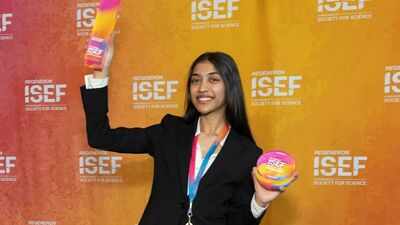
Lakshmi Agrawal (Image Credit: Society for Science)
An 18-year-old student from Bellevue, Washington, has turned an agricultural waste product into a promising solution for one of the Pacific Northwest's most pressing environmental challenges.
According to the Society for Science, Lakshmi Agrawal won the $75,000 Regeneron Young Scientist Award at the 2026 Regeneron International Science and Engineering Fair (ISEF) after developing a biodegradable sponge made from jute plant waste that removes a toxic tyre-related pollutant responsible for killing salmon in urban waterways. Her innovation stood out among more than 1,700 student researchers from around the world earning recognition for its potential to protect aquatic ecosystems while offering a low-cost and sustainable alternative to existing filtration methods.
A biodegradable solution to a growing pollution problem
The project aims to tackle pollution arising from 6PPD-quinone, a pollutant resulting from the reaction of 6PPD, a preservative usually used in vehicle tires, with ozone in the air. During rainfall, the compound comes off the road surfaces and ends up in rivers and streams via stormwater. Studies have identified 6PPD-quinone as a primary cause of coho salmon deaths in urban streams around Puget Sound.To address this issue, Lakshmi created sponge-like filters from nanocellulose made from jute plant waste, an agricultural byproduct.
This material is biodegradable and thus eco-friendly throughout its lifecycle. In experimental conditions involving water tainted with tire particles, the sponge effectively filtered out up to 80% of 6PPD-quinone. Moreover, the filtration process included other contaminants, such as heavy metals, which means that this invention can contribute to the general improvement of water quality instead of tackling only one pollutant.In addition, the invention provides many environmental and economic benefits. According to the Society for Science, creating this sponge consumes 85% less energy than traditional filtration systems and lowers production costs by 98%. Such changes can allow for the wide adoption of the technology in the stormwater treatment systems and roadside ditches.

Image Credit: Society For Science
A science fair project with real-world impact
Lakshmi received the award at the 2026 Regeneron International Science and Engineering Fair (ISEF), widely regarded as the world's largest pre-college STEM competition.
The event featured more than 1,700 finalists representing around 64 countries, regions and territories, with over $7 million awarded for outstanding student research in science, engineering and mathematics. The Regeneron Young Scientist Award recognises projects that combine scientific excellence with practical solutions to global challenges.Her project impressed judges because it transformed an inexpensive waste material into an innovative environmental technology.
Rather than relying on costly synthetic filtration media, Lakshmi's approach uses discarded jute fibres to create a sustainable hydro-sponge capable of trapping harmful pollutants before they reach rivers and streams. The concept could help communities reduce tyre-derived contamination while promoting the reuse of agricultural waste.Although the sponge has only been tested under laboratory conditions, the results suggest strong potential for future real-world applications.
Once proved successful in field experiments, the innovation will be an affordable method of securing freshwater habitats from tyre runoff and stormwater contaminants, which could protect drinking water from tyre pollutants.Lakshmi's success proves that young scientists can create practical inventions to solve environmental problems. Through sustainability and scientific inventiveness, Lakshmi's jute waste sponge not only won a top prize at ISEF but also demonstrated an innovative way to solve a frequently unrecognised water pollution problem.