5 months ago
39
5 months ago
39

Megan BonarBBC Scotland, Coatbridge
Tackling a huge fire burning underground in a Scottish town
For the past six months, Brian Kennedy has been living next to an underground fire burning at temperatures of up to 500C.
It left Brian and his neighbours dealing with smoke, ash and an overpowering "chemical" smell which some described as like living in a "war zone".
The scene was not one you'd expect on a suburban street in Coatbridge.
From the road, the houses on Burleigh Street look like normal west of Scotland homes.
But at the rear there's a wooded area where last summer fires broke out deep beneath the ground, sending smoke billowing into the air and causing residents to fear for their safety.


Brian Kennedy has lived on Burleigh Street for most of his life.
Experts eventually discovered an underground fire fuelled by oil shale which had been used in the building of a long-gone railway line 120 years ago.
It's unclear what started the fires, but to put them out, workers had to remove tonnes of "molten lava" from deep below the surface.
Brian grew up on Burleigh Street and moved back there with his wife, Allison, two years ago.
He told BBC Scotland News that he began to see the smoke plumes from the window looking out over his back garden last summer.
"It's like something out of World War One, I'm telling you," he said. "The trenches.
"I grew up here, it was lovely. Lots of trees, wildlife, lovely colours. Now there's none of that."
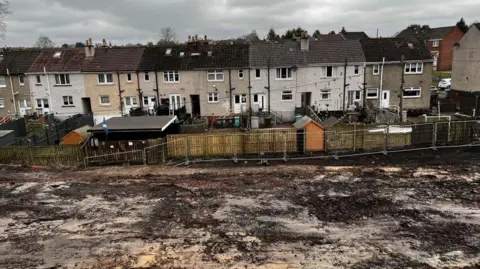
The fire has now been extinguished.
Allison said she had been living in fear of the fire spreading to their house.
On several occasions she ran down the stairs in a panic during the night after seeing a red glow through the bathroom window.
"This is the time it's spread, I'd tell myself," she said. "You could hear it crackling from in the house.
"I've not been into the garden since the summer. There's no point, it's constantly dirty and we can't keep it clean."
She said one of the worst parts was the smell.
"My sisters live 10 minutes up the road, and they could smell it," Allison said.
Residents were advised to keep windows and doors closed during the fire and the excavation process required to extinguish it.
They have battled to keep their windows, patios and cars clean - and they have been unable to hang out their washing as piles of soot would gather on anything in their gardens.
Other residents with health problems said it had worsened conditions like COPD and asthma. One said that even their dog had started to cough.
The local authority maintains that air pollution has always remained at safe levels.
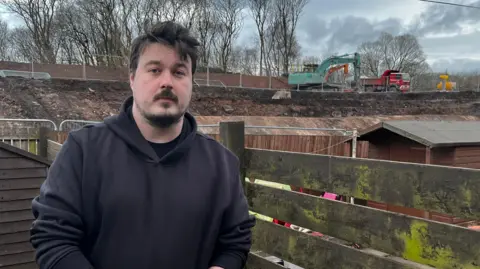
Andrew Gallagher said the view from his window is like "Chernobyl".
Another resident, Andrew Gallagher, said it was "like looking at a war zone” from his bedroom window.
"At one point, there were several fires to the right and random pockets of smoke to the left," he said.
"There was a point that fires would start at any point, two o'clock in the morning, big massive fires out of nowhere. There was nothing we could do about it.
"Before the fire broke out that whole area was covered in trees and grass, we had deer and squirrels. Now it's like Chernobyl. It's sad really."
He said the smoke has started to disappear over recent months but what's left behind is "a sight".
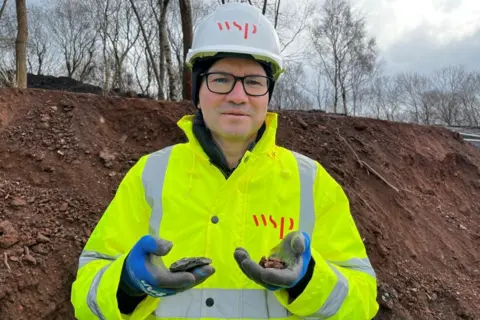
Stewart Browne said determining what was burning was difficult.
It wasn't just the residents who were left scratching their heads over the fire.
David Haggerty, the Scottish Fire and Rescue Service's (SFRS) group commander for Lanarkshire, said it was the first subterranean fire he had faced in his 25-year career.
He said they first became aware of the problem in July, after responding to a number of small surface fires over a few weeks.
When they started to dig down they escalated the issue to the council, who then called in specialist engineers and contractors.
One of them was Stewart Browne from engineering firm WSP.
Using geothermal imaging and 100-year-old maps, he discovered the area behind Burleigh Street was once a railway. When it was built, oil shale was put into the ground.
Oil shale, or blaze as it is sometimes known in Scotland, is a material that was historically mined from the bedrock.
It's not clear why 120 years later the material set alight.
Debris like 'molten lava'
Stewart said: "Fires like this are not unique in themselves but what made this fire so complex was the location, and how close it was to the houses."
He said while "unfortunate" the fire was "fascinating".
The material underground was found to be burning at temperatures of up to 500C,so contractors had to painstakingly dig it out and allow the material to cool before it could be taken away.
What they dug out was at points like "molten lava".
It was this process that caused the smoke that residents have been dealing with for months. When water was added to cool the shale it created a "sauna" effect.
North Lanarkshire Council has now confirmed the fire has been extinguished after around 30,000 tonnes of material was excavated from the site.
In the coming weeks diggers will leave, for what residents hope will be the last time.