4 months ago
37
4 months ago
37

Danielle KayeBusiness reporter

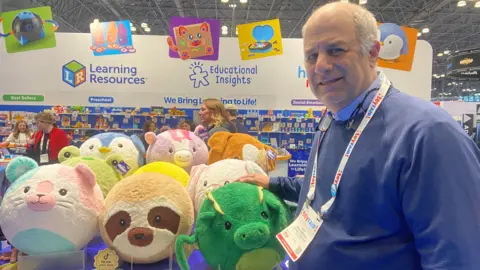 Danielle Kaye/BBC
Rick Woldenberg, the chief executive of educational toy company Learning Resources, sued the Trump administration over tariffs
As the toy industry gathered in New York City recently for its marquee annual convention, the head of one small company stood out from the crowd, greeted by fellow business owners like a minor celebrity.
Rick Woldenberg, the chief executive of Learning Resources, helped make headlines last year, when he took the White House to court, challenging Donald Trump's sweeping global tariffs on imports from countries around the world.
As Trump's rapid-fire trade announcements have slowed this year, many in the US are hoping to put the fallout from the levies - including price hikes and profit hits - behind them.
But the people popping by Woldenberg's booth were an indication of the way uncertainty over trade policy continues to unsettle many firms. The Supreme Court could decide on his case as soon as Friday.
"People have been coming to express appreciation for us standing up," Woldenberg said, speaking by a display of stuffed animals and building blocks.
Trump's chaotic tariff roll-out last year turned the business world upside down, as levies on Chinese goods at one point reached 145%.
The toy industry, which relies heavily on China for manufacturing, was particularly exposed to the new import taxes, which stuck many firms with a surge in costs.
Many businesses raised prices to help cover the duties, as their profits were hit. Woldenberg even embarked on a court battle, filing a lawsuit against the administration.
In some ways, however, the impact of the measures has been more modest than once feared, especially for consumers.
Some companies managed to shift suppliers or opted to shoulder some of the costs.
The White House also exempted some products and walked back some of the highest tariff rates. The average tariff for Chinese imports, for example, has settled at around 20%.
Alberto Cavallo, a professor at Harvard Business School who has been tracking the impact of tariffs on consumer prices, said prices have risen more quickly for cheaper items.
But while a host of lower-cost toys have gotten a bit more expensive, his research shows that tariffs have had "little impact" on toy prices overall, he said.
At the Toy Fair, interviews suggested that many businesses were hoping to avoid additional price rises this year, as tariff policy stabilises.
But few are resting easy.
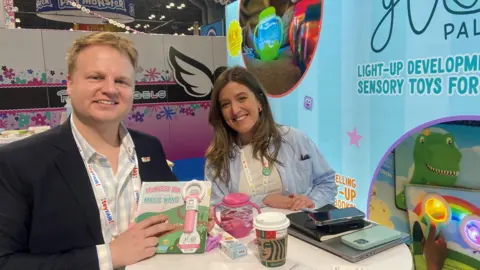 Danielle Kaye/BBC
Anna Barker and Hagan Walker, co-founders of the sensory toy company Glo Pals
"You cannot go to sleep on this president," said Jay Foreman, chief executive of Basic Fun, which saw its profits slide 65% last year.
The company ultimately raised the price of its Tonka plastic toy truck from $30 to roughly $35 at the end of last year - a price he said he expected to hold for 2026.
"We're still on edge. We'll be on edge for at least another three years."
Sensory toy company Glo Pals raised the price of its best-selling toy - a pack of water-activated light-up cubes - by roughly 20% last April to $12.99.
It was the first increase in six years. The founders of the company said they hoped to avoid further hikes in the year ahead, while cautioning that a change to tariff rates could scramble that plan.
"It's an economic landscape that is completely temperamental," said Anna Barker, co-founder of the firm. "All that uncertainty is still omnipresent for us - we're just not in the moment of volatility right now."
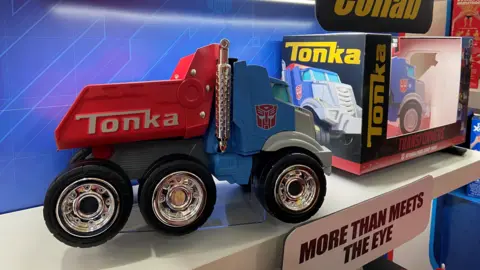 Danielle Kaye/BBC
A Tonka toy truck on display at a booth at the New York City Toy Fair
The White House has said it will find other tools to impose tariffs if the Supreme Court rules against the current measures.
If the Trump administration loses the tariff case, the government could also have to refund some of the billions of dollars it has collected from businesses.
Foreman said a decision like that could allow the company to bring prices back down to "normal levels". Woldenberg also said his firm was betting "on further relief because of the lawsuit".
"We're trying to pass that back as quickly as we can," Woldenberg said.
Others are less optimistic.
Tim Hislop, co-founder of UK-based toy brand Floss & Rock, said he was not betting on getting refunds for tariffs his firm already paid to bring his toys into the US market, which accounts for more than half of his company's revenue.
But a ruling against the measure could still lower his costs and bring relief. He chuckled: "I have a little prayer every night."